

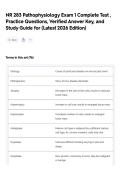
NR 283 Pathophysiology Exam 1 Complete Test ,
Practice Questions, Verified Answer Key, and
Study Guide for (Latest 2026 Edition)
Save
Terms in this set (76)
Etiology Cause of particular disease on microscopic level
Pathogenesis Story of how disease develops
Atrophy Decrease in the size of the cells, results in reduced
tissue mass
Hypertrophy Increase in cell size, results in enlarged tissue mass
Hyperplasia Increased number of cells, results in enlarged
tissue mass
Metaplasia Mature cell type is replaced by a different mature
cell type, Ex: chronic smokers, cells lose cilia
Dysplasia Cells are different looking varying in size and
shape
Neoplasia New growth, commonly a tumor. May be malignant
or benign
, Apoptosis Programmed cell death, normal occurrence in the
body
Ischemia Deficit of oxygen in the cells
Hypoxia Reduced oxygen in the tissues
Iatrogenic illness or disease process because a medical
process was done ex: CAUTI
Autosomal Recessive Disorders Has to have two recessive genes to have disease,
only one recessive gene to be carrier ex: Cystic
fibrosis, PKU (phenylketonuria), Tay-Sachs
Cystic fibrosis autosomal recessive disorder that causes thick
mucous secretions
PKU (phenylketonuria) autosomal recessive disorder that causes an
inability to metabolize phenylalanine. Can cause
mental retardation. Pt must follow strict very low
protein diet
Tay-Sachs autosomal recessive disorder that causes an
enzyme to not be produced causing fatty proteins
build up causing destruction of nerve cells in the
brain and spinal cord
Autosomal Dominant Disorders Only takes one gene for disease to show. There are
no carriers, either have disease or don't. Marfan
Syndrome, Huntington's, Familial
Hypercholesterolemia
Practice Questions, Verified Answer Key, and
Study Guide for (Latest 2026 Edition)
Save
Terms in this set (76)
Etiology Cause of particular disease on microscopic level
Pathogenesis Story of how disease develops
Atrophy Decrease in the size of the cells, results in reduced
tissue mass
Hypertrophy Increase in cell size, results in enlarged tissue mass
Hyperplasia Increased number of cells, results in enlarged
tissue mass
Metaplasia Mature cell type is replaced by a different mature
cell type, Ex: chronic smokers, cells lose cilia
Dysplasia Cells are different looking varying in size and
shape
Neoplasia New growth, commonly a tumor. May be malignant
or benign
, Apoptosis Programmed cell death, normal occurrence in the
body
Ischemia Deficit of oxygen in the cells
Hypoxia Reduced oxygen in the tissues
Iatrogenic illness or disease process because a medical
process was done ex: CAUTI
Autosomal Recessive Disorders Has to have two recessive genes to have disease,
only one recessive gene to be carrier ex: Cystic
fibrosis, PKU (phenylketonuria), Tay-Sachs
Cystic fibrosis autosomal recessive disorder that causes thick
mucous secretions
PKU (phenylketonuria) autosomal recessive disorder that causes an
inability to metabolize phenylalanine. Can cause
mental retardation. Pt must follow strict very low
protein diet
Tay-Sachs autosomal recessive disorder that causes an
enzyme to not be produced causing fatty proteins
build up causing destruction of nerve cells in the
brain and spinal cord
Autosomal Dominant Disorders Only takes one gene for disease to show. There are
no carriers, either have disease or don't. Marfan
Syndrome, Huntington's, Familial
Hypercholesterolemia


