

Exam (elaborations)
ZOL3703 Assignment 1 (COMPLETE ANSWERS) Semester 1 2026 - DUE 13 March 2026
Institution
University Of South Africa (Unisa)
Course
Applied Zoology (ZOL3703)
Draw and label the complete life cycle of Taenia solium, highlighting the definitive host,
intermediate host, infective stage, and mode of transmission.
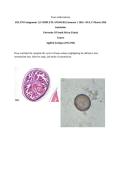
,Above is a complete, labeled life cycle of Taenia solium (pork tapeworm) showing the
definitive host, intermediate host, infective stage, and transmission.
Life Cycle of Taenia solium
1. Adult Worm in Human Intestine (Definitive Host)
, 2. Definitive host: Human
Adult tapeworm lives in the small intestine of humans.
The worm attaches to the intestinal wall using hooks and suckers.
Mature segments (proglottids) containing eggs are released in human feces.
Key label:
Definitive host → Human
Stage → Adult worm
2. Eggs Passed in Human Feces
Eggs or gravid proglottids contaminate:
o Soil
o Water
o Vegetation
Poor sanitation increases spread.
Mode of transmission:
➡ Fecal contamination of food/water.
Key label:
Infective stage for pigs → Eggs
3. Pig Ingests Eggs (Intermediate Host)
✅ Intermediate host: Pig
Pigs eat contaminated food or water.
Eggs hatch in pig intestine → release larvae (oncospheres).
Larvae penetrate intestinal wall → enter bloodstream.
They settle in muscles and develop into cysticercoids (larval cysts).
Key label:
Intermediate host → Pig
, Larval stage → Cysticercoses
4. Humans Eat Undercooked Pork
Humans consume raw or undercooked pork containing cysticerci.
Cyst wall dissolves in intestine.
Larva develops into adult tapeworm.
Mode of transmission:
➡ Eating undercooked infected pork.
Key label:
Infective stage for humans → cysticercoses
5. Development into Adult Worm
Tapeworm matures in human intestine.
Produces proglottids with eggs.
Cycle repeats.
Special Case: Human Cysticercosis (Accidental Infection)
This is important in exams.
Humans may ingest eggs directly (contaminated food/water or poor hygiene).
Larvae form cysts in:
o Brain (neurocysticercosis)
o Muscles
o Eyes
Here humans act as an accidental intermediate host.
Key label:
Infective stage → Eggs
Transmission → Fecal–oral contamination
ZOL3703 Assignment 1 (COMPLETE ANSWERS) Semester 1 2026 - DUE 13 March 2026
Institution
University Of South Africa (Unisa)
Course
Applied Zoology (ZOL3703)
Draw and label the complete life cycle of Taenia solium, highlighting the definitive host,
intermediate host, infective stage, and mode of transmission.
,Above is a complete, labeled life cycle of Taenia solium (pork tapeworm) showing the
definitive host, intermediate host, infective stage, and transmission.
Life Cycle of Taenia solium
1. Adult Worm in Human Intestine (Definitive Host)
, 2. Definitive host: Human
Adult tapeworm lives in the small intestine of humans.
The worm attaches to the intestinal wall using hooks and suckers.
Mature segments (proglottids) containing eggs are released in human feces.
Key label:
Definitive host → Human
Stage → Adult worm
2. Eggs Passed in Human Feces
Eggs or gravid proglottids contaminate:
o Soil
o Water
o Vegetation
Poor sanitation increases spread.
Mode of transmission:
➡ Fecal contamination of food/water.
Key label:
Infective stage for pigs → Eggs
3. Pig Ingests Eggs (Intermediate Host)
✅ Intermediate host: Pig
Pigs eat contaminated food or water.
Eggs hatch in pig intestine → release larvae (oncospheres).
Larvae penetrate intestinal wall → enter bloodstream.
They settle in muscles and develop into cysticercoids (larval cysts).
Key label:
Intermediate host → Pig
, Larval stage → Cysticercoses
4. Humans Eat Undercooked Pork
Humans consume raw or undercooked pork containing cysticerci.
Cyst wall dissolves in intestine.
Larva develops into adult tapeworm.
Mode of transmission:
➡ Eating undercooked infected pork.
Key label:
Infective stage for humans → cysticercoses
5. Development into Adult Worm
Tapeworm matures in human intestine.
Produces proglottids with eggs.
Cycle repeats.
Special Case: Human Cysticercosis (Accidental Infection)
This is important in exams.
Humans may ingest eggs directly (contaminated food/water or poor hygiene).
Larvae form cysts in:
o Brain (neurocysticercosis)
o Muscles
o Eyes
Here humans act as an accidental intermediate host.
Key label:
Infective stage → Eggs
Transmission → Fecal–oral contamination


