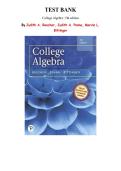
TEST BANK
College Algebra | 5th edition
By Judith A. Beecher, Judith A. Penna, Marvin L.
Bittinger
TU
TO
R
G
U
R
U
,Table of Content
Graphs, Functions, and Models
1.1 Introduction to Graphing
1.2 Functions and Graphs
1.3 Linear Functions, Slope, and Applications
1.4 Equations of Lines and Modeling
1.5 Linear Equations, Functions, Zeros, and Applications
1.6 Solving Linear Inequalities
More on Functions
2.1 Increasing, Decreasing, and Piecewise Functions; Applications
2.2 The Algebra of Functions
2.3 The Composition of Functions
2.4 Symmetry
TU
2.5 Transformations
2.6 Variation and Applications
Quadratic Functions and Equations; Inequalities
3.1 The Complex Numbers
3.2 Quadratic Equations, Functions, Zeros, and Models
3.3 Analyzing Graphs of Quadratic Functions
TO
3.4 Solving Rational Equations and Radical Equations
3.5 Solving Equations and Inequalities with Absolute Value
Polynomial Functions and Rational Functions
4.1 Polynomial Functions and Models
4.2 Graphing Polynomial Functions
4.3 Polynomial Division; The Remainder Theorem and the Factor Theorem
R
4.4 Theorems about Zeros of Polynomial Functions
4.5 Rational Functions
4.6 Polynomial Inequalities and Rational Inequalities
G
Exponential Functions and Logarithmic Functions
5.1 Inverse Functions
5.2 Exponential Functions and Graphs
U
5.3 Logarithmic Functions and Graphs
5.4 Properties of Logarithmic Functions
5.5 Solving Exponential Equations and Logarithmic Equations
R
5.6 Applications and Models: Growth and Decay; Compound Interest
Systems of Equations and Matrices
6.1 Systems of Equations in Two Variables
U
6.2 Systems of Equations in Three Variables
6.3 Matrices and Systems of Equations
6.4 Matrix Operations
6.5 Inverses of Matrices
6.6 Determinants and Cramer's Rule
6.7 Systems of Inequalities and Linear Programming
6.8 Partial Fractions
Conic Sections
7.1 The Parabola
7.2 The Circle and the Ellipse
7.3 The Hyperbola
7.4 Nonlinear Systems of Equations and Inequalities
Sequences, Series, and Combinatorics
,8.1 Sequences and Series
8.2 Arithmetic Sequences and Series
8.3 Geometric Sequences and Series
8.4 Mathematical Induction
8.5 Combinatorics: Permutations
8.6 Combinatorics: Combinations
8.7 The Binomial Theorem
8.8 Probability
TU
TO
R
G
U
R
U
, qwertyuio
3
1. Determine whether the ordered pair − 5, is a solution of the ANSWERS
4
equation 3x – 8y = 21. 1.
2. Find the intercepts of 3x − 2 y = 6
TU
and graph the line. 2.
See graph.
TO
3.
3. Find the distance between (4, 8) and (–7, 6) .
4.
4. Find the midpoint of the segment with endpoints (1, 0) and
(5, – 8) .
R
5.
Find the center and the radius of the circle ( x + 6) + y2 = 9 .
2
G
5.
6.
6. Find an equation of the circle with center (–2, 3) and radius 11 .
U
7. a) Determine whether the relation {(–5, 5),(–4, 4),(3, – 3),(1, 1)} 7. a)
R
is a function. Answer yes or no. b)
c)
b) Find the domain of the relation.
c) Find the range of the relation.
U
8. a)
8. Given that f ( x) = x2 – 6x + 2 , find each of the following. b)
a) f (–1) b) f (a + 3)
3– x
9. Given that f ( x ) = , find each of the following. 9. a)
4+ x b)
a) f (− 4) b) f (− 3)
iuytrew
College Algebra | 5th edition
By Judith A. Beecher, Judith A. Penna, Marvin L.
Bittinger
TU
TO
R
G
U
R
U
,Table of Content
Graphs, Functions, and Models
1.1 Introduction to Graphing
1.2 Functions and Graphs
1.3 Linear Functions, Slope, and Applications
1.4 Equations of Lines and Modeling
1.5 Linear Equations, Functions, Zeros, and Applications
1.6 Solving Linear Inequalities
More on Functions
2.1 Increasing, Decreasing, and Piecewise Functions; Applications
2.2 The Algebra of Functions
2.3 The Composition of Functions
2.4 Symmetry
TU
2.5 Transformations
2.6 Variation and Applications
Quadratic Functions and Equations; Inequalities
3.1 The Complex Numbers
3.2 Quadratic Equations, Functions, Zeros, and Models
3.3 Analyzing Graphs of Quadratic Functions
TO
3.4 Solving Rational Equations and Radical Equations
3.5 Solving Equations and Inequalities with Absolute Value
Polynomial Functions and Rational Functions
4.1 Polynomial Functions and Models
4.2 Graphing Polynomial Functions
4.3 Polynomial Division; The Remainder Theorem and the Factor Theorem
R
4.4 Theorems about Zeros of Polynomial Functions
4.5 Rational Functions
4.6 Polynomial Inequalities and Rational Inequalities
G
Exponential Functions and Logarithmic Functions
5.1 Inverse Functions
5.2 Exponential Functions and Graphs
U
5.3 Logarithmic Functions and Graphs
5.4 Properties of Logarithmic Functions
5.5 Solving Exponential Equations and Logarithmic Equations
R
5.6 Applications and Models: Growth and Decay; Compound Interest
Systems of Equations and Matrices
6.1 Systems of Equations in Two Variables
U
6.2 Systems of Equations in Three Variables
6.3 Matrices and Systems of Equations
6.4 Matrix Operations
6.5 Inverses of Matrices
6.6 Determinants and Cramer's Rule
6.7 Systems of Inequalities and Linear Programming
6.8 Partial Fractions
Conic Sections
7.1 The Parabola
7.2 The Circle and the Ellipse
7.3 The Hyperbola
7.4 Nonlinear Systems of Equations and Inequalities
Sequences, Series, and Combinatorics
,8.1 Sequences and Series
8.2 Arithmetic Sequences and Series
8.3 Geometric Sequences and Series
8.4 Mathematical Induction
8.5 Combinatorics: Permutations
8.6 Combinatorics: Combinations
8.7 The Binomial Theorem
8.8 Probability
TU
TO
R
G
U
R
U
, qwertyuio
3
1. Determine whether the ordered pair − 5, is a solution of the ANSWERS
4
equation 3x – 8y = 21. 1.
2. Find the intercepts of 3x − 2 y = 6
TU
and graph the line. 2.
See graph.
TO
3.
3. Find the distance between (4, 8) and (–7, 6) .
4.
4. Find the midpoint of the segment with endpoints (1, 0) and
(5, – 8) .
R
5.
Find the center and the radius of the circle ( x + 6) + y2 = 9 .
2
G
5.
6.
6. Find an equation of the circle with center (–2, 3) and radius 11 .
U
7. a) Determine whether the relation {(–5, 5),(–4, 4),(3, – 3),(1, 1)} 7. a)
R
is a function. Answer yes or no. b)
c)
b) Find the domain of the relation.
c) Find the range of the relation.
U
8. a)
8. Given that f ( x) = x2 – 6x + 2 , find each of the following. b)
a) f (–1) b) f (a + 3)
3– x
9. Given that f ( x ) = , find each of the following. 9. a)
4+ x b)
a) f (− 4) b) f (− 3)
iuytrew