

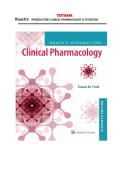
TESTBANK
Roach's
ROACHES INTRODUCTORY CLINICAL PHARMACOLOGY 11TH EDITION
This comprehensive test bank for Roach’s Introductory Clinical Pharmacology provides fully verified exam
questions and answers to help students master drug classifications, dosage calculations, safety guidelines,
and clinical decision-making.
Each chapter includes application-based questions, NCLEX-style items, and clear rationales that mirror
real course assessments. Ideal for nursing, pharmacology, and healthcare learners seeking accurate, high-
quality study support.
Download instantly to strengthen your understanding of clinical pharmacology and boost your exam
performance.
, MULTIPLE CHOICE
1. A nursing instructor is preparing a teaching plan for a group of nursing students about
pharmacology. When describing this topic, the instructor would focus the discussion on
which of the following as an essential aspect?
A) Drug name
B) Drug class
C) Drug action
ni andaD)akanDrug
menemui
sourcebahan
Ans: Cpembelajaran
Feedback: yang disusun dengan teliti untuk membantu anda
belajar Pharmacology
dengan lebih is mudah
the study ofberkesan.
dan drugs and Setiap dokumen
their action direka
on living secaraThus,
organisms. teratur
an supaya
maklumat penting
essential senang
aspect difahami dan
of pharmacology diingati.
is drug Bahan
action. ini sesuai untuk
An understanding persediaan
of the drug name,
peperiksaan,
drug class, and drug source is important, but the most critical aspect related to sentiasa
ulang kaji, dan pengukuhan pengetahuan. Kualiti dan ketepatan
menjadipharmacology
keutamaan, is memastikan
how the druganda
acts boleh belajar dengan yakin. Pelajar menghargai
in the body.
ringkasan yang jelas dan penerangan praktikal yang menjimatkan masa serta mengurangkan
tekanan. Matlamat saya adalah untuk menjadikan pengalaman belajar anda lebih teratur dan
produktif. Muat turun dengan keyakinan dan gunakan sumber ini untuk meningkatkan prestasi
2. A nursing student is preparing to administer a prescribed drug to a patient. The student
akademik anda secara konsisten.
reviews information about the drug and its actions. Which of the following would be the
best choice for obtaining this information? Select all that apply.
Czech (±130 words)
A) Nursing instructor
B) Nurse assigned to the patient
Vítejte v mém obchodě na Stuvia! Najdete zde pečlivě připravené studijní materiály navržené
C) Clinical drug reference
tak, aby bylo učení jednodušší a efektivnější. Každý dokument má přehlednou strukturu, která
D) Prescribing health care provider
usnadňuje pochopení důležitých informací. Materiály jsou ideální pro přípravu na zkoušky,
E) Clinical pharmacist Ans: C, E
opakování i prohlubování znalostí. Důraz je kladen na kvalitu a spolehlivost, takže můžete
Feedback:
studovat s jistotou. Studenti oceňují j
Although the nursing student can ask the nursing instructor, the nurse assigned to the
patient, and the prescribing health care provider for information about the drug, the best
choices for drug information would include an appropriate drug reference and the clinical
pharmacist.
3. When describing the various types of medications to a group of nursing students, a
nursing instructor would identify which of the following as a source for deriving
medications? Select all that apply.
A) Plants
B) Synthetic sources
C) Mold
D) Minerals
E) Animals
Ans: A, B, C, D, E Feedback:
Medications are derived from natural sources, for example, plants, molds, minerals, and
animals, as well as created synthetically in a laboratory.
Page 2
,4. Which of the following names may be assigned to a drug during the process of
development? Select all that apply.
A) Chemical name
B) Official name
C) Pharmacologic name
D) Trade name
E) Nonproprietary name Ans: A, B, D, E Feedback:
Throughout the process of development, drugs may have several names assigned to them
including a chemical name, a generic (nonproprietary) name, an official name, and a
trade or brand name.
5. A drug may be classified by which of the following? Select all that apply.
A) The chemical type of the drug's active ingredient
B) The way the drug is used to treat a specific condition
C) The generic name of the drug
D) The trade name of the drug
E) The nonproprietary name of the drug Ans: A, B
Feedback:
A drug may be classified by the chemical type of the active ingredient or by the way it is
used to treat a particular condition. Generic, trade, and nonproprietary refer to how a
drug is named.
6. A group of nursing students are reviewing information about the process of drug
development in the United States. The students demonstrate understanding of this
process when they identify that which of the following categories are assigned by
the Food and Drug Administration to newly approved drugs? Select all that apply.
A) Metabolite
B) Noncontrolled substance
C) Prescription
D) Nonprescription
E) Controlled substance Ans: C, D, E
Feedback:
Once drugs are approved for use, the FDA assigns the drug to one of the following
categories: prescription, nonprescription, or controlled substance. Metabolite refers to
the inactive form of the drug. Noncontrolled substance is a term that is not used.
7. Which of the following would be most important for the nurse to do to ensure the safe use
of prescription drugs in the institutional setting? Select all that apply.
A) Administering drugs
B) Monitoring clients for drug effects
C) Prescribing drugs
D) Evaluating clients for toxic effects
E) Educating clients/caregivers about drugs Ans: A, B, D, E Feedback:
Page 3
, In the institutional setting, the nurse's role to ensure safe use of prescription drugs
includes administering drugs, monitoring drug effects, evaluating for toxic effects, and
educating clients and caregivers about drugs.
8. The nurse is helping a client review a prescription from the health care provider. When
examining the prescription, which of the following would the nurse expect to find
documented? Select all that apply.
A) Name of the drug
B) Dosage of the drug
C) Route of drug administration
D) Times of drug administration
E) Licensed prescriber's signature Ans: A, B, C, D, E
Feedback:
The prescription must contain the client's name, the name of the drug, the dosage, the
method and times of administration, and the signature of the licensed health care
provider prescribing the drug.
9. After teaching a group of nursing students about nonprescription drugs, the nursing
instructor determines that the teaching was successful when the students identify which
of the following? Select all that apply.
A) They require a licensed health care provider's signature.
B) They are referred to as over-the-counter drugs.
C) They can be taken without risk to the client.
D) They have certain labeling requirements.
E) They should be taken only as directed on the label. Ans: B, D, E Feedback:
Nonprescription drugs are often referred to as over-the-counter (OTC) drugs. They do
not require a prescription (a licensed health care provider's signature) but do not come
without risk to the client. The federal government has imposed labeling requirements of
OTC drugs and they should only be taken as directed on the label unless under the
supervision of a health care provider.
10. A nursing student is reviewing information about the Controlled Substances Act of 1970.
The student would expect to find which of the following as being regulated for drugs
classified as controlled substances? Select all that apply.
A) Manufacturing
B) Elimination
C) Distribution
D) Formulation
E) Dispensing Ans: A, C, E Feedback:
The Controlled Substances Act of 1970 regulates the manufacture, distribution, and
dispensing of drugs classified as controlled substances. Elimination refers to the
excretion of drugs from the body, a pharmacokinetic activity. The act does not address
formulation of the drug.
Page 4
Roach's
ROACHES INTRODUCTORY CLINICAL PHARMACOLOGY 11TH EDITION
This comprehensive test bank for Roach’s Introductory Clinical Pharmacology provides fully verified exam
questions and answers to help students master drug classifications, dosage calculations, safety guidelines,
and clinical decision-making.
Each chapter includes application-based questions, NCLEX-style items, and clear rationales that mirror
real course assessments. Ideal for nursing, pharmacology, and healthcare learners seeking accurate, high-
quality study support.
Download instantly to strengthen your understanding of clinical pharmacology and boost your exam
performance.
, MULTIPLE CHOICE
1. A nursing instructor is preparing a teaching plan for a group of nursing students about
pharmacology. When describing this topic, the instructor would focus the discussion on
which of the following as an essential aspect?
A) Drug name
B) Drug class
C) Drug action
ni andaD)akanDrug
menemui
sourcebahan
Ans: Cpembelajaran
Feedback: yang disusun dengan teliti untuk membantu anda
belajar Pharmacology
dengan lebih is mudah
the study ofberkesan.
dan drugs and Setiap dokumen
their action direka
on living secaraThus,
organisms. teratur
an supaya
maklumat penting
essential senang
aspect difahami dan
of pharmacology diingati.
is drug Bahan
action. ini sesuai untuk
An understanding persediaan
of the drug name,
peperiksaan,
drug class, and drug source is important, but the most critical aspect related to sentiasa
ulang kaji, dan pengukuhan pengetahuan. Kualiti dan ketepatan
menjadipharmacology
keutamaan, is memastikan
how the druganda
acts boleh belajar dengan yakin. Pelajar menghargai
in the body.
ringkasan yang jelas dan penerangan praktikal yang menjimatkan masa serta mengurangkan
tekanan. Matlamat saya adalah untuk menjadikan pengalaman belajar anda lebih teratur dan
produktif. Muat turun dengan keyakinan dan gunakan sumber ini untuk meningkatkan prestasi
2. A nursing student is preparing to administer a prescribed drug to a patient. The student
akademik anda secara konsisten.
reviews information about the drug and its actions. Which of the following would be the
best choice for obtaining this information? Select all that apply.
Czech (±130 words)
A) Nursing instructor
B) Nurse assigned to the patient
Vítejte v mém obchodě na Stuvia! Najdete zde pečlivě připravené studijní materiály navržené
C) Clinical drug reference
tak, aby bylo učení jednodušší a efektivnější. Každý dokument má přehlednou strukturu, která
D) Prescribing health care provider
usnadňuje pochopení důležitých informací. Materiály jsou ideální pro přípravu na zkoušky,
E) Clinical pharmacist Ans: C, E
opakování i prohlubování znalostí. Důraz je kladen na kvalitu a spolehlivost, takže můžete
Feedback:
studovat s jistotou. Studenti oceňují j
Although the nursing student can ask the nursing instructor, the nurse assigned to the
patient, and the prescribing health care provider for information about the drug, the best
choices for drug information would include an appropriate drug reference and the clinical
pharmacist.
3. When describing the various types of medications to a group of nursing students, a
nursing instructor would identify which of the following as a source for deriving
medications? Select all that apply.
A) Plants
B) Synthetic sources
C) Mold
D) Minerals
E) Animals
Ans: A, B, C, D, E Feedback:
Medications are derived from natural sources, for example, plants, molds, minerals, and
animals, as well as created synthetically in a laboratory.
Page 2
,4. Which of the following names may be assigned to a drug during the process of
development? Select all that apply.
A) Chemical name
B) Official name
C) Pharmacologic name
D) Trade name
E) Nonproprietary name Ans: A, B, D, E Feedback:
Throughout the process of development, drugs may have several names assigned to them
including a chemical name, a generic (nonproprietary) name, an official name, and a
trade or brand name.
5. A drug may be classified by which of the following? Select all that apply.
A) The chemical type of the drug's active ingredient
B) The way the drug is used to treat a specific condition
C) The generic name of the drug
D) The trade name of the drug
E) The nonproprietary name of the drug Ans: A, B
Feedback:
A drug may be classified by the chemical type of the active ingredient or by the way it is
used to treat a particular condition. Generic, trade, and nonproprietary refer to how a
drug is named.
6. A group of nursing students are reviewing information about the process of drug
development in the United States. The students demonstrate understanding of this
process when they identify that which of the following categories are assigned by
the Food and Drug Administration to newly approved drugs? Select all that apply.
A) Metabolite
B) Noncontrolled substance
C) Prescription
D) Nonprescription
E) Controlled substance Ans: C, D, E
Feedback:
Once drugs are approved for use, the FDA assigns the drug to one of the following
categories: prescription, nonprescription, or controlled substance. Metabolite refers to
the inactive form of the drug. Noncontrolled substance is a term that is not used.
7. Which of the following would be most important for the nurse to do to ensure the safe use
of prescription drugs in the institutional setting? Select all that apply.
A) Administering drugs
B) Monitoring clients for drug effects
C) Prescribing drugs
D) Evaluating clients for toxic effects
E) Educating clients/caregivers about drugs Ans: A, B, D, E Feedback:
Page 3
, In the institutional setting, the nurse's role to ensure safe use of prescription drugs
includes administering drugs, monitoring drug effects, evaluating for toxic effects, and
educating clients and caregivers about drugs.
8. The nurse is helping a client review a prescription from the health care provider. When
examining the prescription, which of the following would the nurse expect to find
documented? Select all that apply.
A) Name of the drug
B) Dosage of the drug
C) Route of drug administration
D) Times of drug administration
E) Licensed prescriber's signature Ans: A, B, C, D, E
Feedback:
The prescription must contain the client's name, the name of the drug, the dosage, the
method and times of administration, and the signature of the licensed health care
provider prescribing the drug.
9. After teaching a group of nursing students about nonprescription drugs, the nursing
instructor determines that the teaching was successful when the students identify which
of the following? Select all that apply.
A) They require a licensed health care provider's signature.
B) They are referred to as over-the-counter drugs.
C) They can be taken without risk to the client.
D) They have certain labeling requirements.
E) They should be taken only as directed on the label. Ans: B, D, E Feedback:
Nonprescription drugs are often referred to as over-the-counter (OTC) drugs. They do
not require a prescription (a licensed health care provider's signature) but do not come
without risk to the client. The federal government has imposed labeling requirements of
OTC drugs and they should only be taken as directed on the label unless under the
supervision of a health care provider.
10. A nursing student is reviewing information about the Controlled Substances Act of 1970.
The student would expect to find which of the following as being regulated for drugs
classified as controlled substances? Select all that apply.
A) Manufacturing
B) Elimination
C) Distribution
D) Formulation
E) Dispensing Ans: A, C, E Feedback:
The Controlled Substances Act of 1970 regulates the manufacture, distribution, and
dispensing of drugs classified as controlled substances. Elimination refers to the
excretion of drugs from the body, a pharmacokinetic activity. The act does not address
formulation of the drug.
Page 4



