TEST BANK
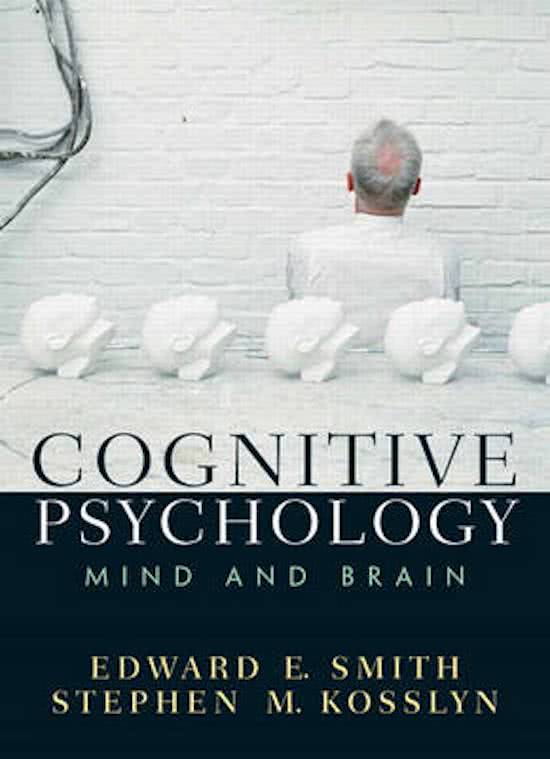
COGNITIVE PSYCHOLOGY
Mind and Brain 1st Edition by
Edward E. Smith & Stephen M. Kosslyn
,Test Bank for Cognitive Psychology: Mind and Brain 1st Edition Edward E. Smith
Chapter 1: How the Brain Gives Rise to the Mind
Multiple Choice
1. deals with the processing of information from the senses.
a. Encoding c. Perception
b. Executive processing d. Mental simulation
Answer: c
Page(s) in Text: 2
Topic: Introductory Terms
Question Type: factual, moderate
*2. The cognitive process responsible for entering new information into memory is
.
a. executive processing c. attention
b. encoding d. representation in long-term memory
Answer: b
Page(s) in Text: 2
Topic: Introductory Terms
Question Type: factual, easy
*3. allows you to hold information in awareness and to think about it.
a. Working memory c. Mental simulation
b. Attention d. Executive processing
Answer: a
Page(s) in Text: 2
Topic: Introductory Terms
Question Type: factual, easy
4. Preparing and executing a response to a stimulus requires .
a. attention c. working memory
b. executive processing d. motor cognition
Answer: d
Page(s) in Text: 2-3
Topic: Introductory Terms
Question Type: conceptual, difficult
,5. Plato made a distinction between .
a. wax and stone tablets c. memories for facts and events
b. the brain and its functions d. etching and carving
Answer: b
Page(s) in Text: 3
Topic: A Brief History
Question Type: factual, easy
6. The mind-body problem was originally articulated by .
a. Plato c. Aristotle
b. Locke d. Descartes
Answer: d
Page(s) in Text: 4
Topic: A Brief History
Question Type: factual, easy
7. The idea that thought was composed of a series of images was espoused by .
a. Plato c. Locke
b. Descartes d. Berkeley
Answer: c
Page(s) in Text: 4
Topic: A Brief History
Question Type: factual, moderate
8. Looking within oneself to assess one’s mental activity is referred to as .
a. reflectance c. transference
b. introspection d. metacognition
Answer: b
Page(s) in Text: 4-5
Topic: A Brief History
Question Type: factual, easy
9. was interested in understanding the nature of consciousness.
a. Locke c. Chomsky
b. Berkeley d. Wundt
Answer: d
Page(s) in Text: 4
Topic: A Brief History
Question Type: factual, easy
, 10. When you describe to your friend how a stunning sunset looked, you are engaging in
.
a. verbal report c. introspection
b. self-report d. perception
Answer: c
Page(s) in Text: 5
Topic: A Brief History
Question Type: conceptual, difficult
11. According to Wundt and Tichner, consciousness can be understood by characterizing
and the .
a. basic elements, rules that combine them c. physical stimulus, behavioral response
b. thoughts, associated processing resources d. perceptions, decisions about them
Answer: a
Page(s) in Text: 4
Topic: A Brief History
Question Type: factual, moderate
12. One of the problems with introspection is that people .
a. are unaware of sensations c. could not do it
b. could not be trained in it d. can make decisions without knowing how
Answer: d
Page(s) in Text: 6
Topic: A Brief History
Question Type: factual, moderate
13. Functionalist psychology was developed by and motivated by .
a. Tichner, Wundt c. James, Darwin
b. Wundt, James d. Skinner, Hull
Answer: c
Page(s) in Text: 6
Topic: A Brief History
Question Type: factual, easy
COGNITIVE PSYCHOLOGY
Mind and Brain 1st Edition by
Edward E. Smith & Stephen M. Kosslyn
,Test Bank for Cognitive Psychology: Mind and Brain 1st Edition Edward E. Smith
Chapter 1: How the Brain Gives Rise to the Mind
Multiple Choice
1. deals with the processing of information from the senses.
a. Encoding c. Perception
b. Executive processing d. Mental simulation
Answer: c
Page(s) in Text: 2
Topic: Introductory Terms
Question Type: factual, moderate
*2. The cognitive process responsible for entering new information into memory is
.
a. executive processing c. attention
b. encoding d. representation in long-term memory
Answer: b
Page(s) in Text: 2
Topic: Introductory Terms
Question Type: factual, easy
*3. allows you to hold information in awareness and to think about it.
a. Working memory c. Mental simulation
b. Attention d. Executive processing
Answer: a
Page(s) in Text: 2
Topic: Introductory Terms
Question Type: factual, easy
4. Preparing and executing a response to a stimulus requires .
a. attention c. working memory
b. executive processing d. motor cognition
Answer: d
Page(s) in Text: 2-3
Topic: Introductory Terms
Question Type: conceptual, difficult
,5. Plato made a distinction between .
a. wax and stone tablets c. memories for facts and events
b. the brain and its functions d. etching and carving
Answer: b
Page(s) in Text: 3
Topic: A Brief History
Question Type: factual, easy
6. The mind-body problem was originally articulated by .
a. Plato c. Aristotle
b. Locke d. Descartes
Answer: d
Page(s) in Text: 4
Topic: A Brief History
Question Type: factual, easy
7. The idea that thought was composed of a series of images was espoused by .
a. Plato c. Locke
b. Descartes d. Berkeley
Answer: c
Page(s) in Text: 4
Topic: A Brief History
Question Type: factual, moderate
8. Looking within oneself to assess one’s mental activity is referred to as .
a. reflectance c. transference
b. introspection d. metacognition
Answer: b
Page(s) in Text: 4-5
Topic: A Brief History
Question Type: factual, easy
9. was interested in understanding the nature of consciousness.
a. Locke c. Chomsky
b. Berkeley d. Wundt
Answer: d
Page(s) in Text: 4
Topic: A Brief History
Question Type: factual, easy
, 10. When you describe to your friend how a stunning sunset looked, you are engaging in
.
a. verbal report c. introspection
b. self-report d. perception
Answer: c
Page(s) in Text: 5
Topic: A Brief History
Question Type: conceptual, difficult
11. According to Wundt and Tichner, consciousness can be understood by characterizing
and the .
a. basic elements, rules that combine them c. physical stimulus, behavioral response
b. thoughts, associated processing resources d. perceptions, decisions about them
Answer: a
Page(s) in Text: 4
Topic: A Brief History
Question Type: factual, moderate
12. One of the problems with introspection is that people .
a. are unaware of sensations c. could not do it
b. could not be trained in it d. can make decisions without knowing how
Answer: d
Page(s) in Text: 6
Topic: A Brief History
Question Type: factual, moderate
13. Functionalist psychology was developed by and motivated by .
a. Tichner, Wundt c. James, Darwin
b. Wundt, James d. Skinner, Hull
Answer: c
Page(s) in Text: 6
Topic: A Brief History
Question Type: factual, easy