Lecture 1 (LECTURE) – Chemical
Components of the Cell
(Thunnissen)
Biochemistry:
- Explores life at the level of atoms and molecules
- Studies the structure and function of bio molecules
- Analyses how bio molecules behave and interact when they are combined with other
molecules both in- and outside a cel
There are essential concepts that unify chemistry and biology:
- Small repetitive units join to form larger, more complicated structures
- Slight variety can lead to great diversity
- Composition dictates form dictates function (composition > form > function)
- Stability is preferable to instability
- Change involves energy
- Changes can often be reversed
- Changes can happen at different rates
- Some processes need a helping hand to get them started and keep the under control
Chemical elements essential to cells
There are some chemical elements (atoms) that are vital to all biological cells: H, O, C, N, Na, K, Ca,
Mg, P, S and Cl.
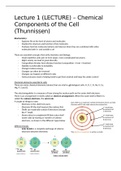
The electronegativity is a measure of how strong the nucleus pulls on the outer shell electrons.
There is an arrangement in shells called an electron arrangement. When the outer shell is filled it is
called the valence electrons, the octet rule.
A couple of things to note:
- Electrons in the shell form pairs
- Electrons fill the shell nearest the nucleus first
- Shells can maximally contain 8 electrons (except
the 1st shell)
- Atoms strive to completely fill their outer shell
(octet rule) by sharing or transfer of valence
electrons, as shown in the different types below
Different bonds
- Ionic bonds is a complete exchange of valence
electrons between elements:
Components of the Cell
(Thunnissen)
Biochemistry:
- Explores life at the level of atoms and molecules
- Studies the structure and function of bio molecules
- Analyses how bio molecules behave and interact when they are combined with other
molecules both in- and outside a cel
There are essential concepts that unify chemistry and biology:
- Small repetitive units join to form larger, more complicated structures
- Slight variety can lead to great diversity
- Composition dictates form dictates function (composition > form > function)
- Stability is preferable to instability
- Change involves energy
- Changes can often be reversed
- Changes can happen at different rates
- Some processes need a helping hand to get them started and keep the under control
Chemical elements essential to cells
There are some chemical elements (atoms) that are vital to all biological cells: H, O, C, N, Na, K, Ca,
Mg, P, S and Cl.
The electronegativity is a measure of how strong the nucleus pulls on the outer shell electrons.
There is an arrangement in shells called an electron arrangement. When the outer shell is filled it is
called the valence electrons, the octet rule.
A couple of things to note:
- Electrons in the shell form pairs
- Electrons fill the shell nearest the nucleus first
- Shells can maximally contain 8 electrons (except
the 1st shell)
- Atoms strive to completely fill their outer shell
(octet rule) by sharing or transfer of valence
electrons, as shown in the different types below
Different bonds
- Ionic bonds is a complete exchange of valence
electrons between elements: