
Tijmen Lourens Summary Cardiovascular Disease
Cardiovascular disease
Endothelial cell function:
Oxygen shortage is what initiates blood vessel formation.
Every organ has a different capillary network because all organs have a different way in
which the oxygen needs to be transported. For example, the capillary in the lungs are
surrounding alveoli very densely.
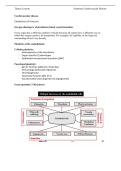
Plasticity of the endothelium:
Cellular plasticity:
- Heterogeneity of the vasculature
- Organ-specific EC phenotypes
- Endothelial-mesenchymal transition (EMT)
Functional plasticity:
- Barrier function (adhesion molecules)
- Immunology (leukocyte migration)
- Thrombogenicity
- Vasomotor function (NO, ET1)
- Vascularisation (vasculogenesis & angiogenesis)
Exam question!! This picture
,Tijmen Lourens Summary Cardiovascular Disease
1) Endothelial barrier function:
- Tight junctions (occludins)
o Sealing of the EC layer (membrane fusion)
- Adherence junctions (VE-cadherin)
o Cell-cell connections (distribution of force)
o Gap junctions
▪ EC-EC communication (connection of
cytoplasm)
- Importance of the EC barrier
o Formation of gradients
▪ Pressure (high in vasculature, low in tissue)
▪ Metabolites (active transport from blood into tissues)
o Inhibition of leukocyte migration
2) Regulation of thrombogenicity:
- Heparan-sulfaphates (inhibition of thrombosis)
- Secretion of coagulation factors
- Inhibition of platelet aggregation
o Endothelial cells in healthy environment secrete these molecules to inhibit
platelet aggregation
3) Endothelial regulation of the vasomotor response
- Production of vasoactive substances by the endothelium
o Vasodilation: nitric oxide (NO)
▪ More nitric oxide → lower blood pressure
▪ If you ate something → you produce arginine → NO is produced by
conversion of arginine to citruline → more blood dilation → more
blood to stomach → more nutrients to your stomach
o Vasoconstriction: endothelin-1 (ET1)
- Relaxation and dilatation is dependent on the endothelial cells
o It is dependent on the equilibrium between NO and ET1. More NO leads to
dilation, more ET1 leads to constriction.
NO is anti-inflammatory, anti-thrombogenic and vasodilatory.
All visual signs of inflammation are (in part) caused by endothelial cell damage!
- Heat = Leakage of plasma from blood vessels into subdermal space (EC Barrier)
- Redness = Leakage of red blood cells into subdermal space (EC Barrier)
- Swelling = Accumulation of liquid in interstitial space
(EC Barrier)
- Pain = strange components coming in skin → nerves in skin get activated
- Loss of function = accumulation of tissue damage & loss of nutrition transport
,Tijmen Lourens Summary Cardiovascular Disease
In presentation: why did you decide what experimental model you used.
Lecture 2: development and function of the vascular system:
There are 3 layers with distinct functions:
» Tunica Externa (Adventitia)
» Tunica Media
» Tunica Intima
And these are separated by 2 elastic membranes: lamina elastica interna/externa.
, Tijmen Lourens Summary Cardiovascular Disease
3 types of endothelial cells in angiogenesis:
- Stalk cell
o cell
- Phalanx cell
Tip cell differentiation:
VEGF binds to a heteromeric receptor complex of VEGFR2/3. VEGF signalling induces tip
cell differentiation.
VEGF induces the expression of DII4. DII4/Notch1 interaction inhibits tip cell differentiation
of adjacent cells by the inhibition of VEGFR2 expression.
Tip cell migration:
- Filopodia/lamellopodia (high expression of VEGFR2 and integrins (sense gradients)
- VEGF/VEGFR2 signaling activates FAK
- FAK causes actin polymerization that causes movement
o Degradation of the extracellular matrix by Matrix Metalloproteases (MMP)
o MT1-MMP (MMP14) degrades the basal lamina, which allows migration of Tip
cells
Stalk cell differentiation and proliferation:
- Dll4/Notch1 interaction inhibits VEGFR2/3 expression in ‘stalk cells’
(decreased sensitivity to VEGF)
- Notch1 activates VEGFR1 (Flt1) expression
(increased proliferation)
- Notch1 activates integrin expression
(cell-matrix interaction = stabilization)
- Notch1 activates Wnt signaling
- Wnt signaling increases cell-cell contacts (stabilization)
Stalk cell lumen formation:
- Pinocytosis (formation and endocytosis) of membrane intrusions form vacuoles
o Mechanisms unknown, but controlled by RhoA (ROCK) activity
- Coalescence of vacuoles forms intracellular lumen
- Fusion of intercellular lumens
- EC share 1 lumen, but their cytoplasm remains separated!
Mural cells:
- Mural cells form the Tunica Media and surround the endothelium.
Cardiovascular disease
Endothelial cell function:
Oxygen shortage is what initiates blood vessel formation.
Every organ has a different capillary network because all organs have a different way in
which the oxygen needs to be transported. For example, the capillary in the lungs are
surrounding alveoli very densely.
Plasticity of the endothelium:
Cellular plasticity:
- Heterogeneity of the vasculature
- Organ-specific EC phenotypes
- Endothelial-mesenchymal transition (EMT)
Functional plasticity:
- Barrier function (adhesion molecules)
- Immunology (leukocyte migration)
- Thrombogenicity
- Vasomotor function (NO, ET1)
- Vascularisation (vasculogenesis & angiogenesis)
Exam question!! This picture
,Tijmen Lourens Summary Cardiovascular Disease
1) Endothelial barrier function:
- Tight junctions (occludins)
o Sealing of the EC layer (membrane fusion)
- Adherence junctions (VE-cadherin)
o Cell-cell connections (distribution of force)
o Gap junctions
▪ EC-EC communication (connection of
cytoplasm)
- Importance of the EC barrier
o Formation of gradients
▪ Pressure (high in vasculature, low in tissue)
▪ Metabolites (active transport from blood into tissues)
o Inhibition of leukocyte migration
2) Regulation of thrombogenicity:
- Heparan-sulfaphates (inhibition of thrombosis)
- Secretion of coagulation factors
- Inhibition of platelet aggregation
o Endothelial cells in healthy environment secrete these molecules to inhibit
platelet aggregation
3) Endothelial regulation of the vasomotor response
- Production of vasoactive substances by the endothelium
o Vasodilation: nitric oxide (NO)
▪ More nitric oxide → lower blood pressure
▪ If you ate something → you produce arginine → NO is produced by
conversion of arginine to citruline → more blood dilation → more
blood to stomach → more nutrients to your stomach
o Vasoconstriction: endothelin-1 (ET1)
- Relaxation and dilatation is dependent on the endothelial cells
o It is dependent on the equilibrium between NO and ET1. More NO leads to
dilation, more ET1 leads to constriction.
NO is anti-inflammatory, anti-thrombogenic and vasodilatory.
All visual signs of inflammation are (in part) caused by endothelial cell damage!
- Heat = Leakage of plasma from blood vessels into subdermal space (EC Barrier)
- Redness = Leakage of red blood cells into subdermal space (EC Barrier)
- Swelling = Accumulation of liquid in interstitial space
(EC Barrier)
- Pain = strange components coming in skin → nerves in skin get activated
- Loss of function = accumulation of tissue damage & loss of nutrition transport
,Tijmen Lourens Summary Cardiovascular Disease
In presentation: why did you decide what experimental model you used.
Lecture 2: development and function of the vascular system:
There are 3 layers with distinct functions:
» Tunica Externa (Adventitia)
» Tunica Media
» Tunica Intima
And these are separated by 2 elastic membranes: lamina elastica interna/externa.
, Tijmen Lourens Summary Cardiovascular Disease
3 types of endothelial cells in angiogenesis:
- Stalk cell
o cell
- Phalanx cell
Tip cell differentiation:
VEGF binds to a heteromeric receptor complex of VEGFR2/3. VEGF signalling induces tip
cell differentiation.
VEGF induces the expression of DII4. DII4/Notch1 interaction inhibits tip cell differentiation
of adjacent cells by the inhibition of VEGFR2 expression.
Tip cell migration:
- Filopodia/lamellopodia (high expression of VEGFR2 and integrins (sense gradients)
- VEGF/VEGFR2 signaling activates FAK
- FAK causes actin polymerization that causes movement
o Degradation of the extracellular matrix by Matrix Metalloproteases (MMP)
o MT1-MMP (MMP14) degrades the basal lamina, which allows migration of Tip
cells
Stalk cell differentiation and proliferation:
- Dll4/Notch1 interaction inhibits VEGFR2/3 expression in ‘stalk cells’
(decreased sensitivity to VEGF)
- Notch1 activates VEGFR1 (Flt1) expression
(increased proliferation)
- Notch1 activates integrin expression
(cell-matrix interaction = stabilization)
- Notch1 activates Wnt signaling
- Wnt signaling increases cell-cell contacts (stabilization)
Stalk cell lumen formation:
- Pinocytosis (formation and endocytosis) of membrane intrusions form vacuoles
o Mechanisms unknown, but controlled by RhoA (ROCK) activity
- Coalescence of vacuoles forms intracellular lumen
- Fusion of intercellular lumens
- EC share 1 lumen, but their cytoplasm remains separated!
Mural cells:
- Mural cells form the Tunica Media and surround the endothelium.


