Growth factor signalling and oncogenes
The process of cell division (cell proliferation or cell growth) must be regulated and
DNA replication must be precisely coordinated in order to maintain the integrity of the
genome for each cell generation.
An extracellular growth factor stimulates cell growth by transmitting a signal into the
cell.
4 types of proteins involved in the transduction of growth factor signal:
1. Growth factors
2. Growth factor receptors; mostly tyrosine kinases.
Kinases phosphorylate (transfer a phosphate group from ATP/GTP to hydroxyl
groups on amino acids of the target protein) specific amino acid residues in
target proteins
Extracellular ligand-binding domain
Single transmembrane domain
Cytoplasmic protein tyrosine kinase domain
3. Intracellular signal transducers
4. Nuclear transcription factors (transcription factors); they elicit (opwekken) the
mitogenic effect
Epidermal growth factor signalling: an important paradigm
Epidermal growth factor (EGF)
Epidermal growth factor receptor (EGFR) (ErbB1 /
HER1); tyrosine kinases.
This was the first to be discovered. 3 additional
members have been identified later: ErbB2
(HER2), ErbB3 (HER3) and ErbB4 (HER4)
HER2 bind not to a known ligand but acts as a co-
receptor for the other receptors
HER3 has only a weak kinase activity
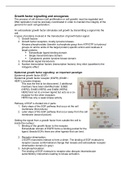
Pathway of EGF is divided into 2 parts:
1. Early steps of the EGF pathway that occur at the cell
membrane (first picture)
2. Later steps of the EGF pathway that occur away from the cell
membrane (second picture)
Getting the signal from a growth factor from outside the cell to
inside the nucleus:
1. Binding of the growth factor to the receptor;
Extracellular domain of EGFR forms a binding pocket for the
ligand. Beside EGFs there are other ligands that can bind.
2. Receptor dimerization;
2 EGFR monomers interact to form a dimer. The binding of EGF molecule to
receptor causes conformational change that reveals and extracellular receptor
dimerization domain (In gray)
3. Autophosphorylation;
The binding of EGF molecule to receptor also disrupts intramolecular
autoinhibitory interactions leading to kinase activation.
, The change in shape permits access of ATP and substrate to cytoplasmic
protein tyrosine kinase domain
The dimerization enables the kinase domain of 1 receptor of the dimer to
phosphorylate the other receptor of the dimer and vice versa)
Now a signal from outside the cell has been transduced to inside the cell.
4. Activation of intracellular transducers (RAS);
Due to autophosphorylation proteins with SH2 and SH3 domains can bind
(e.g. Grb2, SRC, ABL and PI3-K)
Grb2 contains SH2 and SH3;
- SH2: recognized the phosphorylated EGFR;
bind to EGFR
- SH3: facilitates the recruitment of specific
proteins to the membrane; 2 SH3 interact with
SH3 domain of SOS (son of sevenless)
SOS facilitates the activation of the intracellular
transducer RAS
RAS activation; pivotal role – links activation of tyrosine kinase receptors with
downstream signalling pathway
N-, H- and K-RAS carry the signal through the cytoplasm and into the nucleus.
They are GTP-binding proteins (GTP = active, GDP = inactive):
- SOS mediates the exchange of GDP to GTP by
catalysing the GDP on RAS.
- GTPase activation proteins (GAPs) catalyse the
hydrolysis of GTP to GDP to terminate the signal
5. Activation of a cascade of serine/threonine kinases
(RAF, MEK, MAPK)
Raf activation
RAS-GTP binds to and contributes to the activation of
RAF.
Activated RAF is a signal transducer that carries the
signal away from the membrane
RAF has a kinase function an phosphorylates MEK (or MAPKK)
The MAP kinase cascade
The activated MEK go on to phosphorylation MAPKs (or ERKs).
The activated MAPKs can enter the nucleus and can there phosphorylate
many transcription factors (TFs)
6. Regulation of transcription factors for gene expression (to produce proteins
needed for cell growth)
The AP-1 transcription factor is an important target of the MAPK-cascade.
It regulates the expression of genes involved in differentiation, growth and cell
death.
The process of cell division (cell proliferation or cell growth) must be regulated and
DNA replication must be precisely coordinated in order to maintain the integrity of the
genome for each cell generation.
An extracellular growth factor stimulates cell growth by transmitting a signal into the
cell.
4 types of proteins involved in the transduction of growth factor signal:
1. Growth factors
2. Growth factor receptors; mostly tyrosine kinases.
Kinases phosphorylate (transfer a phosphate group from ATP/GTP to hydroxyl
groups on amino acids of the target protein) specific amino acid residues in
target proteins
Extracellular ligand-binding domain
Single transmembrane domain
Cytoplasmic protein tyrosine kinase domain
3. Intracellular signal transducers
4. Nuclear transcription factors (transcription factors); they elicit (opwekken) the
mitogenic effect
Epidermal growth factor signalling: an important paradigm
Epidermal growth factor (EGF)
Epidermal growth factor receptor (EGFR) (ErbB1 /
HER1); tyrosine kinases.
This was the first to be discovered. 3 additional
members have been identified later: ErbB2
(HER2), ErbB3 (HER3) and ErbB4 (HER4)
HER2 bind not to a known ligand but acts as a co-
receptor for the other receptors
HER3 has only a weak kinase activity
Pathway of EGF is divided into 2 parts:
1. Early steps of the EGF pathway that occur at the cell
membrane (first picture)
2. Later steps of the EGF pathway that occur away from the cell
membrane (second picture)
Getting the signal from a growth factor from outside the cell to
inside the nucleus:
1. Binding of the growth factor to the receptor;
Extracellular domain of EGFR forms a binding pocket for the
ligand. Beside EGFs there are other ligands that can bind.
2. Receptor dimerization;
2 EGFR monomers interact to form a dimer. The binding of EGF molecule to
receptor causes conformational change that reveals and extracellular receptor
dimerization domain (In gray)
3. Autophosphorylation;
The binding of EGF molecule to receptor also disrupts intramolecular
autoinhibitory interactions leading to kinase activation.
, The change in shape permits access of ATP and substrate to cytoplasmic
protein tyrosine kinase domain
The dimerization enables the kinase domain of 1 receptor of the dimer to
phosphorylate the other receptor of the dimer and vice versa)
Now a signal from outside the cell has been transduced to inside the cell.
4. Activation of intracellular transducers (RAS);
Due to autophosphorylation proteins with SH2 and SH3 domains can bind
(e.g. Grb2, SRC, ABL and PI3-K)
Grb2 contains SH2 and SH3;
- SH2: recognized the phosphorylated EGFR;
bind to EGFR
- SH3: facilitates the recruitment of specific
proteins to the membrane; 2 SH3 interact with
SH3 domain of SOS (son of sevenless)
SOS facilitates the activation of the intracellular
transducer RAS
RAS activation; pivotal role – links activation of tyrosine kinase receptors with
downstream signalling pathway
N-, H- and K-RAS carry the signal through the cytoplasm and into the nucleus.
They are GTP-binding proteins (GTP = active, GDP = inactive):
- SOS mediates the exchange of GDP to GTP by
catalysing the GDP on RAS.
- GTPase activation proteins (GAPs) catalyse the
hydrolysis of GTP to GDP to terminate the signal
5. Activation of a cascade of serine/threonine kinases
(RAF, MEK, MAPK)
Raf activation
RAS-GTP binds to and contributes to the activation of
RAF.
Activated RAF is a signal transducer that carries the
signal away from the membrane
RAF has a kinase function an phosphorylates MEK (or MAPKK)
The MAP kinase cascade
The activated MEK go on to phosphorylation MAPKs (or ERKs).
The activated MAPKs can enter the nucleus and can there phosphorylate
many transcription factors (TFs)
6. Regulation of transcription factors for gene expression (to produce proteins
needed for cell growth)
The AP-1 transcription factor is an important target of the MAPK-cascade.
It regulates the expression of genes involved in differentiation, growth and cell
death.