
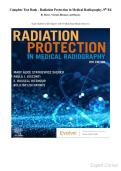
Complete Test Bank - Radiation Protection in Medical Radiography, 9th Ed
By Sherer, Visconti, Ritenour, and Haynes
(Latest Edition | All Chapters with Verified Exam-Ready Answers)
,TABLE OF CONTENTS
1. Introduction to Radiation Protection
2. Radiation: Types, Sources, and Doses Received
3. Interaction of X-Radiation with Matter
4. Radiation Quantities and Units
5. Radiation Monitoring
6. Overview of Cell Biology
7. Molecular and Cellular Radiation Biology
8. Early Tissue Reactions and Their Effects on Organ Systems
9. Stochastic Effects and Late Tissue Reactions of Radiation in Organ Systems
10. Equipment Design for Radiation Protection
11. Management of Patient Radiation Dose During Diagnostic X-Ray Procedures
12. Radiation Safety in Computed Tomography and Mammography
13. Management of Imaging Personnel Radiation Dose During Diagnostic X-Ray Procedures
14. Radioisotopes and Radiation Protection
,Chapter 01: Introduction to Radiation Protection
MULTIPLE CHOICE
1. Consequences of ionization in human cells include
1. creation of unstable atoms.
2. production of free electrons.
3. creation of highly reactive free radicals capable of producing substances poisonous to the cell.
4. creation of new biologic molecules detrimental to the living cell.
5. injury to the cell that may manifest itself as abnormal function or loss of function.
a. 1, 2, and 3 only
b. 2, 3, and 4 only
c. 3, 4, and 5 only
d. 1, 2, 3, 4, and 5
Answer: D
2. Which of the following is a form of radiation that is capable of creating electrically charged particles by
removing orbital electrons from the atom of normal matter through which it passes?
a. Ionizing radiation
b. Nonionizing radiation
c. Subatomic radiation
d. Ultrasonic radiation
Answer: A
, 3. Regarding exposure to ionizing radiation, patients who are educated to understand the medical benefit of
an imaging procedure are more likely to
a. assume a small chance of biologic damage but not suppress any radiation phobia they may have.
b. cancel their scheduled procedure because they are not willing to assume a small chance of biologic
damage.
c. suppress any radiation phobia but not risk a small chance of possible biologic damage.
d. suppress any radiation phobia and be willing to assume a small chance of possible biologic damage.
Answer: D
4. The millisievert (mSv) is equal to
a. 1/10 of a sievert.
b. 1/100 of a sievert.
c. 1/1000 of a sievert.
d. 1/10,000 of a sievert.
Answer: C
5. The advantages of the BERT method are
1. it does not imply radiation risk; it is simply a means for comparison.
2. it emphasizes that radiation is an innate part of our environment.
3. it provides an answer that is easy for the patient to comprehend.
a. 1 and 2 only
b. 1 and 3 only
c. 2 and 3 only
By Sherer, Visconti, Ritenour, and Haynes
(Latest Edition | All Chapters with Verified Exam-Ready Answers)
,TABLE OF CONTENTS
1. Introduction to Radiation Protection
2. Radiation: Types, Sources, and Doses Received
3. Interaction of X-Radiation with Matter
4. Radiation Quantities and Units
5. Radiation Monitoring
6. Overview of Cell Biology
7. Molecular and Cellular Radiation Biology
8. Early Tissue Reactions and Their Effects on Organ Systems
9. Stochastic Effects and Late Tissue Reactions of Radiation in Organ Systems
10. Equipment Design for Radiation Protection
11. Management of Patient Radiation Dose During Diagnostic X-Ray Procedures
12. Radiation Safety in Computed Tomography and Mammography
13. Management of Imaging Personnel Radiation Dose During Diagnostic X-Ray Procedures
14. Radioisotopes and Radiation Protection
,Chapter 01: Introduction to Radiation Protection
MULTIPLE CHOICE
1. Consequences of ionization in human cells include
1. creation of unstable atoms.
2. production of free electrons.
3. creation of highly reactive free radicals capable of producing substances poisonous to the cell.
4. creation of new biologic molecules detrimental to the living cell.
5. injury to the cell that may manifest itself as abnormal function or loss of function.
a. 1, 2, and 3 only
b. 2, 3, and 4 only
c. 3, 4, and 5 only
d. 1, 2, 3, 4, and 5
Answer: D
2. Which of the following is a form of radiation that is capable of creating electrically charged particles by
removing orbital electrons from the atom of normal matter through which it passes?
a. Ionizing radiation
b. Nonionizing radiation
c. Subatomic radiation
d. Ultrasonic radiation
Answer: A
, 3. Regarding exposure to ionizing radiation, patients who are educated to understand the medical benefit of
an imaging procedure are more likely to
a. assume a small chance of biologic damage but not suppress any radiation phobia they may have.
b. cancel their scheduled procedure because they are not willing to assume a small chance of biologic
damage.
c. suppress any radiation phobia but not risk a small chance of possible biologic damage.
d. suppress any radiation phobia and be willing to assume a small chance of possible biologic damage.
Answer: D
4. The millisievert (mSv) is equal to
a. 1/10 of a sievert.
b. 1/100 of a sievert.
c. 1/1000 of a sievert.
d. 1/10,000 of a sievert.
Answer: C
5. The advantages of the BERT method are
1. it does not imply radiation risk; it is simply a means for comparison.
2. it emphasizes that radiation is an innate part of our environment.
3. it provides an answer that is easy for the patient to comprehend.
a. 1 and 2 only
b. 1 and 3 only
c. 2 and 3 only


