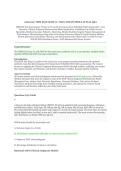
2026/2027 HESI EXIT EXAM V2 | NGN CASE STUDIES & ACTUAL Q&A
HESI RN Exit Examination Version 2 (V2) with Next Generation NCLEX® (NGN) Integration | Core
Domains: Clinical Judgment Measurement Model Application, Unfolding Case Studies Across
Specialties (Medical-Surgical, Pediatric, Maternity, Mental Health), Complex Patient Management &
Prioritization, Pharmacology Integration in Evolving Scenarios, Ethical & Legal Decision-Making,
Patient Education & Discharge Planning, and Interprofessional Collaboration in NGN Formats |
NCLEX-RN® Readiness Focus | NGN-Enhanced Exit Exam Format
Exam Structure
The HESI Exit Exam V2 with NGN for the 2026/2027 academic cycle is a 150-question, multiple-choice
question (MCQ) and NGN item-type examination.
Introduction
This HESI Exit Exam V2 guide for the 2026/2027 cycle prepares nursing students for the updated
predictor exam that fully integrates Next Generation NCLEX® (NGN) style assessments. The content
focuses on applying the Clinical Judgment Measurement Model through realistic, unfolding case studies
that require analysis, prioritization, and decision-making in complex, dynamic patient situations.
Answer Format
All correct answers and clinical judgment actions must be presented in bold and green, followed by
detailed rationales that trace the cognitive steps of the NGN Clinical Judgment Measurement Model
(Recognize Cues, Analyze Cues, Prioritize Hypotheses, Generate Solutions, Take Action, Evaluate
Outcomes), integrate knowledge from multiple nursing specialties, and explain the evidence-based
rationale for each decision within the case study framework.
Questions (150 Total)
1.
A 68-year-old male with heart failure (HFrEF, EF 25%) is admitted with worsening dyspnea, orthopnea,
and bilateral crackles. Vital signs: BP 168/94 mm Hg, HR 112 bpm, RR 28/min, SpO₂ 88% on room air.
He is prescribed furosemide 40 mg IV and oxygen at 2 L/min via nasal cannula. One hour later, he reports
feeling slightly better, but SpO₂ is now 90%, and he remains tachycardic. The nurse reviews his morning
labs: potassium 3.1 mEq/L, BNP 520 pg/mL.
Which action should the nurse take next?
A. Increase oxygen to 4 L/min
B. Administer potassium chloride as ordered and monitor ECG
C. Request a STAT echocardiogram
D. Encourage ambulation to improve circulation
Rationale (NGN Clinical Judgment Model):
,Recognize Cues: Hypokalemia (K⁺ 3.1), tachycardia, HF exacerbation.
Analyze Cues: Hypokalemia increases risk of digoxin toxicity and lethal arrhythmias—especially
dangerous in a patient with HFrEF who may be on digoxin or other QT-prolonging drugs.
Prioritize Hypotheses: Risk for cardiac dysrhythmia > mild hypoxia (SpO₂ improved to 90%).
Generate Solutions: Correct potassium, monitor ECG, reassess respiratory status.
Take Action: Administer KCl per order—this addresses the most urgent safety risk.
Evaluate Outcomes: Monitor for resolution of arrhythmia risk and continued improvement in
oxygenation.
2.
A 2-day-old newborn has jaundice noted on the face and chest. Total serum bilirubin is 14 mg/dL. The
infant is breastfeeding well, voiding, and stooling. Blood type: mother O+, baby A+.
What is the priority nursing action?
A. Prepare for exchange transfusion
B. Initiate phototherapy and continue breastfeeding
C. Stop breastfeeding and switch to formula
D. Administer IV immunoglobulin immediately
Rationale (NGN Clinical Judgment Model):
Recognize Cues: Jaundice at 48 hours, bilirubin 14 mg/dL, ABO incompatibility.
Analyze Cues: This is likely hemolytic disease of the newborn (HDN) due to ABO mismatch. Level is
above phototherapy threshold per AAP nomogram for age.
Prioritize Hypotheses: Risk for kernicterus if bilirubin rises >20–25 mg/dL.
Generate Solutions: Phototherapy lowers bilirubin; breastfeeding supports hydration and caloric
intake.
Take Action: Start phototherapy—do not stop breastfeeding unless clinically indicated.
Evaluate Outcomes: Monitor bilirubin levels every 4–6 hours until declining.
3.
,A 45-year-old female with bipolar I disorder is admitted after a manic episode. She is hyperverbal, pacing,
and has not slept in 3 days. She refuses her lithium and says, “I don’t need meds—I’m finally free!” Her
lithium level was 0.4 mEq/L (subtherapeutic) on admission.
What is the nurse’s best initial response?
A. “You must take your medication or you’ll get worse.”
B. “I hear you feel free. Can you tell me more about what that means for you?”
C. Administer IM haloperidol without consent
D. Restrain her for safety
Rationale (NGN Clinical Judgment Model):
Recognize Cues: Mania, refusal of treatment, poor insight.
Analyze Cues: Patient lacks capacity to make informed decisions during acute mania but is not
imminently violent.
Prioritize Hypotheses: Build rapport before enforcing treatment to reduce trauma and resistance.
Generate Solutions: Use therapeutic communication to engage, then involve psychiatrist for capacity
assessment.
Take Action: Validate feelings and explore meaning—this aligns with recovery-oriented care.
Evaluate Outcomes: Assess for reduced agitation and willingness to discuss treatment options.
4.
A 72-year-old male 1 day post-op from hip replacement is confused, pulling at his IV, and calling the nurse
by his daughter’s name. His wife says, “He’s never been like this before.” Vital signs stable. Urinalysis
shows cloudy urine with WBCs.
What condition should the nurse suspect?
A. Dementia
B. Delirium secondary to UTI
C. Stroke
D. Depression
Rationale (NGN Clinical Judgment Model):
, Recognize Cues: Acute confusion, inattention, altered consciousness, urinary symptoms.
Analyze Cues: Sudden onset + infection = delirium. Dementia is chronic and progressive.
Prioritize Hypotheses: Delirium is a medical emergency requiring prompt treatment of underlying
cause.
Generate Solutions: Treat UTI, reorient, ensure safety, avoid restraints.
Take Action: Notify provider for antibiotics and non-pharmacologic interventions.
Evaluate Outcomes: Monitor for return to baseline mental status within 24–72 hours of treatment.
5.
A 6-year-old with asthma presents to the ED with severe respiratory distress. RR 48/min, HR 140 bpm,
SpO₂ 86% on room air, audible wheezing, and intercostal retractions. Albuterol nebulizer was given en
route with minimal improvement.
What is the priority intervention?
A. Oral prednisone
B. Continuous albuterol nebulizer and supplemental oxygen
C. Chest X-ray
D. Discharge with inhaler education
Rationale (NGN Clinical Judgment Model):
Recognize Cues: Severe asthma exacerbation, hypoxia, tachypnea, poor response to initial
bronchodilator.
Analyze Cues: Impending respiratory failure—wheezing may disappear if fatigue sets in (“silent
chest”).
Prioritize Hypotheses: Airway and oxygenation are immediate threats to life.
Generate Solutions: Continuous beta-agonist therapy + oxygen improves bronchodilation and gas
exchange.
Take Action: Initiate continuous albuterol and high-flow O₂ per protocol.
Evaluate Outcomes: Reassess SpO₂, work of breathing, and peak flow every 20 minutes.
6.
HESI RN Exit Examination Version 2 (V2) with Next Generation NCLEX® (NGN) Integration | Core
Domains: Clinical Judgment Measurement Model Application, Unfolding Case Studies Across
Specialties (Medical-Surgical, Pediatric, Maternity, Mental Health), Complex Patient Management &
Prioritization, Pharmacology Integration in Evolving Scenarios, Ethical & Legal Decision-Making,
Patient Education & Discharge Planning, and Interprofessional Collaboration in NGN Formats |
NCLEX-RN® Readiness Focus | NGN-Enhanced Exit Exam Format
Exam Structure
The HESI Exit Exam V2 with NGN for the 2026/2027 academic cycle is a 150-question, multiple-choice
question (MCQ) and NGN item-type examination.
Introduction
This HESI Exit Exam V2 guide for the 2026/2027 cycle prepares nursing students for the updated
predictor exam that fully integrates Next Generation NCLEX® (NGN) style assessments. The content
focuses on applying the Clinical Judgment Measurement Model through realistic, unfolding case studies
that require analysis, prioritization, and decision-making in complex, dynamic patient situations.
Answer Format
All correct answers and clinical judgment actions must be presented in bold and green, followed by
detailed rationales that trace the cognitive steps of the NGN Clinical Judgment Measurement Model
(Recognize Cues, Analyze Cues, Prioritize Hypotheses, Generate Solutions, Take Action, Evaluate
Outcomes), integrate knowledge from multiple nursing specialties, and explain the evidence-based
rationale for each decision within the case study framework.
Questions (150 Total)
1.
A 68-year-old male with heart failure (HFrEF, EF 25%) is admitted with worsening dyspnea, orthopnea,
and bilateral crackles. Vital signs: BP 168/94 mm Hg, HR 112 bpm, RR 28/min, SpO₂ 88% on room air.
He is prescribed furosemide 40 mg IV and oxygen at 2 L/min via nasal cannula. One hour later, he reports
feeling slightly better, but SpO₂ is now 90%, and he remains tachycardic. The nurse reviews his morning
labs: potassium 3.1 mEq/L, BNP 520 pg/mL.
Which action should the nurse take next?
A. Increase oxygen to 4 L/min
B. Administer potassium chloride as ordered and monitor ECG
C. Request a STAT echocardiogram
D. Encourage ambulation to improve circulation
Rationale (NGN Clinical Judgment Model):
,Recognize Cues: Hypokalemia (K⁺ 3.1), tachycardia, HF exacerbation.
Analyze Cues: Hypokalemia increases risk of digoxin toxicity and lethal arrhythmias—especially
dangerous in a patient with HFrEF who may be on digoxin or other QT-prolonging drugs.
Prioritize Hypotheses: Risk for cardiac dysrhythmia > mild hypoxia (SpO₂ improved to 90%).
Generate Solutions: Correct potassium, monitor ECG, reassess respiratory status.
Take Action: Administer KCl per order—this addresses the most urgent safety risk.
Evaluate Outcomes: Monitor for resolution of arrhythmia risk and continued improvement in
oxygenation.
2.
A 2-day-old newborn has jaundice noted on the face and chest. Total serum bilirubin is 14 mg/dL. The
infant is breastfeeding well, voiding, and stooling. Blood type: mother O+, baby A+.
What is the priority nursing action?
A. Prepare for exchange transfusion
B. Initiate phototherapy and continue breastfeeding
C. Stop breastfeeding and switch to formula
D. Administer IV immunoglobulin immediately
Rationale (NGN Clinical Judgment Model):
Recognize Cues: Jaundice at 48 hours, bilirubin 14 mg/dL, ABO incompatibility.
Analyze Cues: This is likely hemolytic disease of the newborn (HDN) due to ABO mismatch. Level is
above phototherapy threshold per AAP nomogram for age.
Prioritize Hypotheses: Risk for kernicterus if bilirubin rises >20–25 mg/dL.
Generate Solutions: Phototherapy lowers bilirubin; breastfeeding supports hydration and caloric
intake.
Take Action: Start phototherapy—do not stop breastfeeding unless clinically indicated.
Evaluate Outcomes: Monitor bilirubin levels every 4–6 hours until declining.
3.
,A 45-year-old female with bipolar I disorder is admitted after a manic episode. She is hyperverbal, pacing,
and has not slept in 3 days. She refuses her lithium and says, “I don’t need meds—I’m finally free!” Her
lithium level was 0.4 mEq/L (subtherapeutic) on admission.
What is the nurse’s best initial response?
A. “You must take your medication or you’ll get worse.”
B. “I hear you feel free. Can you tell me more about what that means for you?”
C. Administer IM haloperidol without consent
D. Restrain her for safety
Rationale (NGN Clinical Judgment Model):
Recognize Cues: Mania, refusal of treatment, poor insight.
Analyze Cues: Patient lacks capacity to make informed decisions during acute mania but is not
imminently violent.
Prioritize Hypotheses: Build rapport before enforcing treatment to reduce trauma and resistance.
Generate Solutions: Use therapeutic communication to engage, then involve psychiatrist for capacity
assessment.
Take Action: Validate feelings and explore meaning—this aligns with recovery-oriented care.
Evaluate Outcomes: Assess for reduced agitation and willingness to discuss treatment options.
4.
A 72-year-old male 1 day post-op from hip replacement is confused, pulling at his IV, and calling the nurse
by his daughter’s name. His wife says, “He’s never been like this before.” Vital signs stable. Urinalysis
shows cloudy urine with WBCs.
What condition should the nurse suspect?
A. Dementia
B. Delirium secondary to UTI
C. Stroke
D. Depression
Rationale (NGN Clinical Judgment Model):
, Recognize Cues: Acute confusion, inattention, altered consciousness, urinary symptoms.
Analyze Cues: Sudden onset + infection = delirium. Dementia is chronic and progressive.
Prioritize Hypotheses: Delirium is a medical emergency requiring prompt treatment of underlying
cause.
Generate Solutions: Treat UTI, reorient, ensure safety, avoid restraints.
Take Action: Notify provider for antibiotics and non-pharmacologic interventions.
Evaluate Outcomes: Monitor for return to baseline mental status within 24–72 hours of treatment.
5.
A 6-year-old with asthma presents to the ED with severe respiratory distress. RR 48/min, HR 140 bpm,
SpO₂ 86% on room air, audible wheezing, and intercostal retractions. Albuterol nebulizer was given en
route with minimal improvement.
What is the priority intervention?
A. Oral prednisone
B. Continuous albuterol nebulizer and supplemental oxygen
C. Chest X-ray
D. Discharge with inhaler education
Rationale (NGN Clinical Judgment Model):
Recognize Cues: Severe asthma exacerbation, hypoxia, tachypnea, poor response to initial
bronchodilator.
Analyze Cues: Impending respiratory failure—wheezing may disappear if fatigue sets in (“silent
chest”).
Prioritize Hypotheses: Airway and oxygenation are immediate threats to life.
Generate Solutions: Continuous beta-agonist therapy + oxygen improves bronchodilation and gas
exchange.
Take Action: Initiate continuous albuterol and high-flow O₂ per protocol.
Evaluate Outcomes: Reassess SpO₂, work of breathing, and peak flow every 20 minutes.
6.