P
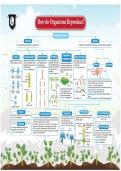
W How do Organisms Reproduce?
REPRODUCTION
ASEXUAL SEXUAL
A new offspring is produced by a single parent Offsprings are produced from the fusion of male and female gametes
Vegetative
Fission Fragmentation Regeneration Budding Spore Formation
Propagation
Organism split into equal Organism simply break up Ability to give rise to A bud develops as an Sporangia contain spores
halves during cell division. into smaller pieces called new individuals from outgrowth, develops in Vegetative propagation is that can develop into new
fragments which grow into their body parts. to tiny individuals, det- a method of plant reprod- individuals. Plants Humans
new individuals. Example-Planaria etc. ach from parent body uction that uses parts of a Example-Rhizopus etc.
Stigma
Example - Spirogyra etc. and become new parent plant to grow new Stamen
Anther
Style
individual. plants.
Filament Pistil
Example- Hydra etc. Parent Petal
leaf Leaf Sepal
Mother Pseudopodia Septa bud Ovary
Amoeba are pulled in
Spiral Spores Sporangium
chloroplast Leaf • A flower having both male and female reproductive
margin part is known as a bisexual flower.
New plant Example - Hibiscus, Mustard etc.
Stolon • A flower having either male or female reproductive
45
Fragments Buds found in the notches part is known as a unisexual flower.
1 2
Cytoplasm Nucleus at the margins of the Example- Papaya, Watermelon etc.
divides divides leaves fall on the ground • Male Reproductive Part: Stamen produces pollen
and form new plants. Rhizoids
grain.
Example:- Bryophyllum Sporangiophore • Female Reproductive Part: Pistil contains egg cell.
Two
daughter cells 4 3
Daughter Amoeba
Fertilization Post Fertilization
Tissue culture Pollination
Parent cell divides into two daughter cells. Fusion of male gamete with female
Example-Amoeba etc. • Tissue culture: New plants are grown by removing tissue
• Transfer of pollen grain from anther
gamete results in the formation of Zygote→Embryo, Ovule→Seed
to the stigma of the same flower is Ovary→Fruit
or cells from the plant's growing tip and placing them in known as self pollination. diploid zygote.
an artificial medium to form a callus. • The transfer of pollen grain from
• The callus is transferred to a hormone rich medium for anther to the stigma of a different Pollen grain Male gamete
flower is known as cross pollination. moves down
Parent cell divides into many small
growth and differentiation, developing into plantlets.
Self Cross
Stigma
the pollen Germination
• Plantlets are then transferred to soil to mature; this tube
daughter cells simultaneously. pollination pollination Dormant embryo within the seed
method helps produce disease-free plants and is widely
Example-Plasmodium etc. used for ornamental plants. Pollen tube becomes active, grows and forms
Ovule
Ovary a seedling or a young plant capable
of independent existence.
Female Plumule- Future stem
Nucleus of
female gamete Radicle- Future root
gamete (Egg)
W How do Organisms Reproduce?
REPRODUCTION
ASEXUAL SEXUAL
A new offspring is produced by a single parent Offsprings are produced from the fusion of male and female gametes
Vegetative
Fission Fragmentation Regeneration Budding Spore Formation
Propagation
Organism split into equal Organism simply break up Ability to give rise to A bud develops as an Sporangia contain spores
halves during cell division. into smaller pieces called new individuals from outgrowth, develops in Vegetative propagation is that can develop into new
fragments which grow into their body parts. to tiny individuals, det- a method of plant reprod- individuals. Plants Humans
new individuals. Example-Planaria etc. ach from parent body uction that uses parts of a Example-Rhizopus etc.
Stigma
Example - Spirogyra etc. and become new parent plant to grow new Stamen
Anther
Style
individual. plants.
Filament Pistil
Example- Hydra etc. Parent Petal
leaf Leaf Sepal
Mother Pseudopodia Septa bud Ovary
Amoeba are pulled in
Spiral Spores Sporangium
chloroplast Leaf • A flower having both male and female reproductive
margin part is known as a bisexual flower.
New plant Example - Hibiscus, Mustard etc.
Stolon • A flower having either male or female reproductive
45
Fragments Buds found in the notches part is known as a unisexual flower.
1 2
Cytoplasm Nucleus at the margins of the Example- Papaya, Watermelon etc.
divides divides leaves fall on the ground • Male Reproductive Part: Stamen produces pollen
and form new plants. Rhizoids
grain.
Example:- Bryophyllum Sporangiophore • Female Reproductive Part: Pistil contains egg cell.
Two
daughter cells 4 3
Daughter Amoeba
Fertilization Post Fertilization
Tissue culture Pollination
Parent cell divides into two daughter cells. Fusion of male gamete with female
Example-Amoeba etc. • Tissue culture: New plants are grown by removing tissue
• Transfer of pollen grain from anther
gamete results in the formation of Zygote→Embryo, Ovule→Seed
to the stigma of the same flower is Ovary→Fruit
or cells from the plant's growing tip and placing them in known as self pollination. diploid zygote.
an artificial medium to form a callus. • The transfer of pollen grain from
• The callus is transferred to a hormone rich medium for anther to the stigma of a different Pollen grain Male gamete
flower is known as cross pollination. moves down
Parent cell divides into many small
growth and differentiation, developing into plantlets.
Self Cross
Stigma
the pollen Germination
• Plantlets are then transferred to soil to mature; this tube
daughter cells simultaneously. pollination pollination Dormant embryo within the seed
method helps produce disease-free plants and is widely
Example-Plasmodium etc. used for ornamental plants. Pollen tube becomes active, grows and forms
Ovule
Ovary a seedling or a young plant capable
of independent existence.
Female Plumule- Future stem
Nucleus of
female gamete Radicle- Future root
gamete (Egg)