Notes lectures Political and Economic Anthropology
Lecture 1: Thinking about economics & the economy anthropologically
We believe the economic & political is intertwined, that’s why it’s taught together
One cannot be understood without an interregression of the other
Basic economics
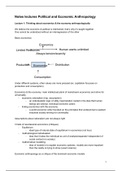
Economics
Limited Resources Human wants unlimited
Always tension/scarcity
Production Economics Distribution
Consumption
Under different systems, other values are more pressed (ex: capitalism focusses on
production and consumption)
Economics & the economy: main intellectual plank of mainstream economics and strive for
universality
- economic rationalism (imp. assumption)
- an individualistic logic of utility maximization rooted in the idea that human
beings are rational, individual economic actors
- linking economics with the economy
- a world economic order founded on the principles that underpinned a western
industrial society striving for universality
Assumptions about rationalism are not always right
3 traits of neoclassical economics (critiques)
- Equilibrium
- ideal type of natural state of equilibrium in economics (not true)
- methodological individualism
- idea that it takes the individual as unit of analysis/separate/ independent of
social context (no society)
- mathematical modelling
- idea of models is to explain economic systems. models are more important
than the reality is trying to show (exact science)
Economic anthropology as a critique of the dominant economic models
1
, - economic choices are made in a socio-cultural context
- faith in economic growth and market as the best means for fair distribution (market
favors the wealthy)
- expert knowledge and elite way of reading the economy and its crisis (we need to
challenge this, where do the interest lie)
- economy as disembodied abstract mechanism or mathematical models devoid of
humans and socio-cultural context (models are more important than context they are
explaining)
- these economic models neither explain nor prevent major crisis
- human actor is brought into the picture when all models fail
Anthropological approach towards the economy
- a historical and critical view rather than a romantic or utopian alternative to
economics
- rom/uto is naive
- take history in consideration
- emic approach: people in everyday life as object of study & observation going back to
classical times
- fieldwork
- insiders view
- etic abstract model: wider scale logics of historical transformation e.g., Sidney mintz
(slavery, sugar and capitalism as an example)
- where we are today as a human society
- wider scale logics
- an approach that goes beyond the etic-emic (enlightenment derived assumption)
distinction: alternative/other economic models
Stages in the development of economic anthropology
- 1870s to 1940
- economy of the primitive man
- economic behavior of the savage
- universality of efficiency and rationality
- diversity of human economics
- exchange & reciprocity
- 1950s to 1960s
- cold war
- the formalist (neoclassical economists) & substantivizes debate
- production (especially in the 1970s)
- 1970s through 3 decades of neoliberal globalization
- neglect of history & political economy
- culture & morality at the expense of class & society
- consumption & agency
The future state of economic anthropology
- distribution as the new privileged concept (Gregory)
- political economy (ben fine)
- history + ethnography + critique (hann en hart)
2
Lecture 1: Thinking about economics & the economy anthropologically
We believe the economic & political is intertwined, that’s why it’s taught together
One cannot be understood without an interregression of the other
Basic economics
Economics
Limited Resources Human wants unlimited
Always tension/scarcity
Production Economics Distribution
Consumption
Under different systems, other values are more pressed (ex: capitalism focusses on
production and consumption)
Economics & the economy: main intellectual plank of mainstream economics and strive for
universality
- economic rationalism (imp. assumption)
- an individualistic logic of utility maximization rooted in the idea that human
beings are rational, individual economic actors
- linking economics with the economy
- a world economic order founded on the principles that underpinned a western
industrial society striving for universality
Assumptions about rationalism are not always right
3 traits of neoclassical economics (critiques)
- Equilibrium
- ideal type of natural state of equilibrium in economics (not true)
- methodological individualism
- idea that it takes the individual as unit of analysis/separate/ independent of
social context (no society)
- mathematical modelling
- idea of models is to explain economic systems. models are more important
than the reality is trying to show (exact science)
Economic anthropology as a critique of the dominant economic models
1
, - economic choices are made in a socio-cultural context
- faith in economic growth and market as the best means for fair distribution (market
favors the wealthy)
- expert knowledge and elite way of reading the economy and its crisis (we need to
challenge this, where do the interest lie)
- economy as disembodied abstract mechanism or mathematical models devoid of
humans and socio-cultural context (models are more important than context they are
explaining)
- these economic models neither explain nor prevent major crisis
- human actor is brought into the picture when all models fail
Anthropological approach towards the economy
- a historical and critical view rather than a romantic or utopian alternative to
economics
- rom/uto is naive
- take history in consideration
- emic approach: people in everyday life as object of study & observation going back to
classical times
- fieldwork
- insiders view
- etic abstract model: wider scale logics of historical transformation e.g., Sidney mintz
(slavery, sugar and capitalism as an example)
- where we are today as a human society
- wider scale logics
- an approach that goes beyond the etic-emic (enlightenment derived assumption)
distinction: alternative/other economic models
Stages in the development of economic anthropology
- 1870s to 1940
- economy of the primitive man
- economic behavior of the savage
- universality of efficiency and rationality
- diversity of human economics
- exchange & reciprocity
- 1950s to 1960s
- cold war
- the formalist (neoclassical economists) & substantivizes debate
- production (especially in the 1970s)
- 1970s through 3 decades of neoliberal globalization
- neglect of history & political economy
- culture & morality at the expense of class & society
- consumption & agency
The future state of economic anthropology
- distribution as the new privileged concept (Gregory)
- political economy (ben fine)
- history + ethnography + critique (hann en hart)
2