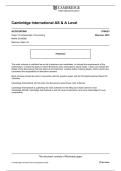
Cambridge International AS & A Level
ACCOUNTING 9706/23
Paper 2 Fundamentals of Accounting May/June 2025
MARK SCHEME
Maximum Mark: 90
Published
This mark scheme is published as an aid to teachers and candidates, to indicate the requirements of the
examination. It shows the basis on which Examiners were instructed to award marks. It does not indicate the
details of the discussions that took place at an Examiners’ meeting before marking began, which would have
considered the acceptability of alternative answers.
Mark schemes should be read in conjunction with the question paper and the Principal Examiner Report for
Teachers.
Cambridge International will not enter into discussions about these mark schemes.
Cambridge International is publishing the mark schemes for the May/June 2025 series for most
Cambridge IGCSE, Cambridge International A and AS Level components, and some Cambridge O Level
components.
This document consists of 16 printed pages.
© Cambridge University Press & Assessment 2025 [Turn over
,9706/23 Cambridge International AS & A Level – Mark Scheme May/June 2025
PUBLISHED
Generic Marking Principles
These general marking principles must be applied by all examiners when marking candidate answers.
They should be applied alongside the specific content of the mark scheme or generic level
descriptions for a question. Each question paper and mark scheme will also comply with these
marking principles.
GENERIC MARKING PRINCIPLE 1:
Marks must be awarded in line with:
• the specific content of the mark scheme or the generic level descriptors for the question
• the specific skills defined in the mark scheme or in the generic level descriptors for the question
• the standard of response required by a candidate as exemplified by the standardisation scripts.
GENERIC MARKING PRINCIPLE 2:
Marks awarded are always whole marks (not half marks, or other fractions).
GENERIC MARKING PRINCIPLE 3:
Marks must be awarded positively:
• marks are awarded for correct/valid answers, as defined in the mark scheme. However, credit
is given for valid answers which go beyond the scope of the syllabus and mark scheme,
referring to your Team Leader as appropriate
• marks are awarded when candidates clearly demonstrate what they know and can do
• marks are not deducted for errors
• marks are not deducted for omissions
• answers should only be judged on the quality of spelling, punctuation and grammar when these
features are specifically assessed by the question as indicated by the mark scheme. The
meaning, however, should be unambiguous.
GENERIC MARKING PRINCIPLE 4:
Rules must be applied consistently, e.g. in situations where candidates have not followed
instructions or in the application of generic level descriptors.
GENERIC MARKING PRINCIPLE 5:
Marks should be awarded using the full range of marks defined in the mark scheme for the question
(however; the use of the full mark range may be limited according to the quality of the candidate
responses seen).
GENERIC MARKING PRINCIPLE 6:
Marks awarded are based solely on the requirements as defined in the mark scheme. Marks should
not be awarded with grade thresholds or grade descriptors in mind.
© Cambridge University Press & Assessment 2025 Page 2 of 16
, 9706/23 Cambridge International AS & A Level – Mark Scheme May/June 2025
PUBLISHED
Social Science-Specific Marking Principles
(for point-based marking)
1 Components using point-based marking:
• Point marking is often used to reward knowledge, understanding and application of skills.
We give credit where the candidate’s answer shows relevant knowledge, understanding
and application of skills in answering the question. We do not give credit where the answer
shows confusion.
From this it follows that we:
a DO credit answers which are worded differently from the mark scheme if they clearly
convey the same meaning (unless the mark scheme requires a specific term)
b DO credit alternative answers/examples which are not written in the mark scheme if they
are correct
c DO credit answers where candidates give more than one correct answer in one
prompt/numbered/scaffolded space where extended writing is required rather than list-type
answers. For example, questions that require n reasons (e.g. State two reasons …).
d DO NOT credit answers simply for using a ‘key term’ unless that is all that is required.
(Check for evidence it is understood and not used wrongly.)
e DO NOT credit answers which are obviously self-contradicting or trying to cover all
possibilities
f DO NOT give further credit for what is effectively repetition of a correct point already
credited unless the language itself is being tested. This applies equally to ‘mirror
statements’ (i.e. polluted/not polluted).
g DO NOT require spellings to be correct, unless this is part of the test. However spellings of
syllabus terms must allow for clear and unambiguous separation from other syllabus terms
with which they may be confused (e.g. Corrasion/Corrosion)
2 Presentation of mark scheme:
• Slashes (/) or the word ‘or’ separate alternative ways of making the same point.
• Semi colons (;) bullet points (•) or figures in brackets (1) separate different points.
• Content in the answer column in brackets is for examiner information/context to clarify the
marking but is not required to earn the mark (except Accounting syllabuses where they
indicate negative numbers).
3 Calculation questions:
• The mark scheme will show the steps in the most likely correct method(s), the mark for
each step, the correct answer(s) and the mark for each answer
• If working/explanation is considered essential for full credit, this will be indicated in the
question paper and in the mark scheme. In all other instances, the correct answer to a
calculation should be given full credit, even if no supporting working is shown.
• Where the candidate uses a valid method which is not covered by the mark scheme,
award equivalent marks for reaching equivalent stages.
• Where an answer makes use of a candidate’s own incorrect figure from previous working,
the ‘own figure rule’ applies: full marks will be given if a correct and complete method is
used. Further guidance will be included in the mark scheme where necessary and any
exceptions to this general principle will be noted.
© Cambridge University Press & Assessment 2025 Page 3 of 16
ACCOUNTING 9706/23
Paper 2 Fundamentals of Accounting May/June 2025
MARK SCHEME
Maximum Mark: 90
Published
This mark scheme is published as an aid to teachers and candidates, to indicate the requirements of the
examination. It shows the basis on which Examiners were instructed to award marks. It does not indicate the
details of the discussions that took place at an Examiners’ meeting before marking began, which would have
considered the acceptability of alternative answers.
Mark schemes should be read in conjunction with the question paper and the Principal Examiner Report for
Teachers.
Cambridge International will not enter into discussions about these mark schemes.
Cambridge International is publishing the mark schemes for the May/June 2025 series for most
Cambridge IGCSE, Cambridge International A and AS Level components, and some Cambridge O Level
components.
This document consists of 16 printed pages.
© Cambridge University Press & Assessment 2025 [Turn over
,9706/23 Cambridge International AS & A Level – Mark Scheme May/June 2025
PUBLISHED
Generic Marking Principles
These general marking principles must be applied by all examiners when marking candidate answers.
They should be applied alongside the specific content of the mark scheme or generic level
descriptions for a question. Each question paper and mark scheme will also comply with these
marking principles.
GENERIC MARKING PRINCIPLE 1:
Marks must be awarded in line with:
• the specific content of the mark scheme or the generic level descriptors for the question
• the specific skills defined in the mark scheme or in the generic level descriptors for the question
• the standard of response required by a candidate as exemplified by the standardisation scripts.
GENERIC MARKING PRINCIPLE 2:
Marks awarded are always whole marks (not half marks, or other fractions).
GENERIC MARKING PRINCIPLE 3:
Marks must be awarded positively:
• marks are awarded for correct/valid answers, as defined in the mark scheme. However, credit
is given for valid answers which go beyond the scope of the syllabus and mark scheme,
referring to your Team Leader as appropriate
• marks are awarded when candidates clearly demonstrate what they know and can do
• marks are not deducted for errors
• marks are not deducted for omissions
• answers should only be judged on the quality of spelling, punctuation and grammar when these
features are specifically assessed by the question as indicated by the mark scheme. The
meaning, however, should be unambiguous.
GENERIC MARKING PRINCIPLE 4:
Rules must be applied consistently, e.g. in situations where candidates have not followed
instructions or in the application of generic level descriptors.
GENERIC MARKING PRINCIPLE 5:
Marks should be awarded using the full range of marks defined in the mark scheme for the question
(however; the use of the full mark range may be limited according to the quality of the candidate
responses seen).
GENERIC MARKING PRINCIPLE 6:
Marks awarded are based solely on the requirements as defined in the mark scheme. Marks should
not be awarded with grade thresholds or grade descriptors in mind.
© Cambridge University Press & Assessment 2025 Page 2 of 16
, 9706/23 Cambridge International AS & A Level – Mark Scheme May/June 2025
PUBLISHED
Social Science-Specific Marking Principles
(for point-based marking)
1 Components using point-based marking:
• Point marking is often used to reward knowledge, understanding and application of skills.
We give credit where the candidate’s answer shows relevant knowledge, understanding
and application of skills in answering the question. We do not give credit where the answer
shows confusion.
From this it follows that we:
a DO credit answers which are worded differently from the mark scheme if they clearly
convey the same meaning (unless the mark scheme requires a specific term)
b DO credit alternative answers/examples which are not written in the mark scheme if they
are correct
c DO credit answers where candidates give more than one correct answer in one
prompt/numbered/scaffolded space where extended writing is required rather than list-type
answers. For example, questions that require n reasons (e.g. State two reasons …).
d DO NOT credit answers simply for using a ‘key term’ unless that is all that is required.
(Check for evidence it is understood and not used wrongly.)
e DO NOT credit answers which are obviously self-contradicting or trying to cover all
possibilities
f DO NOT give further credit for what is effectively repetition of a correct point already
credited unless the language itself is being tested. This applies equally to ‘mirror
statements’ (i.e. polluted/not polluted).
g DO NOT require spellings to be correct, unless this is part of the test. However spellings of
syllabus terms must allow for clear and unambiguous separation from other syllabus terms
with which they may be confused (e.g. Corrasion/Corrosion)
2 Presentation of mark scheme:
• Slashes (/) or the word ‘or’ separate alternative ways of making the same point.
• Semi colons (;) bullet points (•) or figures in brackets (1) separate different points.
• Content in the answer column in brackets is for examiner information/context to clarify the
marking but is not required to earn the mark (except Accounting syllabuses where they
indicate negative numbers).
3 Calculation questions:
• The mark scheme will show the steps in the most likely correct method(s), the mark for
each step, the correct answer(s) and the mark for each answer
• If working/explanation is considered essential for full credit, this will be indicated in the
question paper and in the mark scheme. In all other instances, the correct answer to a
calculation should be given full credit, even if no supporting working is shown.
• Where the candidate uses a valid method which is not covered by the mark scheme,
award equivalent marks for reaching equivalent stages.
• Where an answer makes use of a candidate’s own incorrect figure from previous working,
the ‘own figure rule’ applies: full marks will be given if a correct and complete method is
used. Further guidance will be included in the mark scheme where necessary and any
exceptions to this general principle will be noted.
© Cambridge University Press & Assessment 2025 Page 3 of 16