PROBLEM 7. GENERALIZED ANXIETY 1
DISORDER
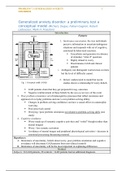
Generalized anxiety disorder: a preliminary test a
conceptual model (Michel J. Dugas, Fabien Gagnon, Robert
Ladouceur, Mark H. Freeston)
Introduction
Features
1. Intolerance uncertainty: the way individuals
perceive information in uncertain/ambiguous
situations and responds with set of cognitive,
emotional & behavioral reactions.
Exacerbates and generates (in absence
of stimulus) “what if” questions.
Highly related to worry
Discriminates GAD and clinical
patients
o Ambiguity can distinguish worriers/non-worriers
but the level of difficulty cannot.
2. Beliefs: underscored in model but recent
studies shown a relationship bt worry-beliefs
GAD patients claim that they get prepared for neg. outcomes
Negative reinforcement of those beliefs by the non-occurrence of the event
3. Poor problem orientation: set of metacognitive processes that reflect awareness and
appraisal of everyday problems and one’s own problem solving ability.
Changes in problem-solving confidence can have a causal effect on catastrophic
worrying.
Poor perceived control
Worrying >poor problem orientation not related to problem-solving skills (one
study)
4. Cognitive avoidance
Worry made up of semantic cognitive activities and “verbal” thought (rather than
mental images)
Worry >less somatic activation
Avoidance of mental images and peripheral physiological activation > decrease in
emotional processing threatening material.
Hypotheses:
A. Intolerance of uncertainty, beliefs about worry, poor problem orientation and cognitive
avoidance will discrimate GAD patients from non-clinical controls
B. Intolerance of uncertainty will be the most important in explaining differences.
Method
Subjects: 24 GAD patients, 20 controls > GAD patients had an additional diagnosis.
, PROBLEM 7. GENERALIZED ANXIETY 2
DISORDER
Symptom Measures:
Anxiety disorders interview schedule (ADIS-IV)
Penn state worry questionnaire (PSWQ)
Worry & Anxiety Questionnaire (WAQ)
Beck Anxiety Inventory (BAI): state anxiety
Beck depression Inventroy- abridge (BDI-A)
Process Measures:
Intolerance Uncertainty (IU)
Why worry? (WW): for beliefs about worry
White bear suppression inventory (WBSI): supression of thoughts
Social problem solving inventroy- abridged (SPSI): problem orientation and problem
solving skills.
Results
Hypothesis was confirmed
All variables except from problem solving skills were highly related to discrimimant
function and IU was the most important one in explaining group differences.
So, IU key feature of GAD
Further examination by using these variables to clessify group membership and compare them to
symptom variables.
Process variables > 82% correct classification (18/24 GAD and 18/20 CG)
Symptom variables > 91% correct (22/24 GAD, 18/20 CG)
So, process varibles were equally effective to symptom variables for classifying non-
clinical subjects but not quite as effective for GAD classification.
Potential problems with the study
Specificity assessment : By comparison to clinical control trial (some studies showed there
is specificity- GAD vs anxiety disorders- higher IU, porrer orientation and superior
problem-solving knowledge)
Rate of comorbidity: all disorders were mild, not likely to have influences the discriminant
capacity
GAD patient’s higher depression: recent studies showed that there is a narrow possibility
of depression influencing the discriminant ability
Need to distinguish between IU and worry: studies did show they are separate constructs.
Treatment implications
Overestimation/underestimation of pros/cons-beliefs in worrying: cognitive and
behavioral strtegies to decrease IU and acknowledge that the attempt to control future by
worrying is not viable option.
Two types of worries
i. About immediate problems: should stop avoiding but also avoid the attempts to
gather detailed end excessive info for situation
ii. About future events: cognitive exposure to adress avoidance esp. for threatening
mental images.
o By using response prevention
o Cognitive exposure helps with IU decrease as well
DISORDER
Generalized anxiety disorder: a preliminary test a
conceptual model (Michel J. Dugas, Fabien Gagnon, Robert
Ladouceur, Mark H. Freeston)
Introduction
Features
1. Intolerance uncertainty: the way individuals
perceive information in uncertain/ambiguous
situations and responds with set of cognitive,
emotional & behavioral reactions.
Exacerbates and generates (in absence
of stimulus) “what if” questions.
Highly related to worry
Discriminates GAD and clinical
patients
o Ambiguity can distinguish worriers/non-worriers
but the level of difficulty cannot.
2. Beliefs: underscored in model but recent
studies shown a relationship bt worry-beliefs
GAD patients claim that they get prepared for neg. outcomes
Negative reinforcement of those beliefs by the non-occurrence of the event
3. Poor problem orientation: set of metacognitive processes that reflect awareness and
appraisal of everyday problems and one’s own problem solving ability.
Changes in problem-solving confidence can have a causal effect on catastrophic
worrying.
Poor perceived control
Worrying >poor problem orientation not related to problem-solving skills (one
study)
4. Cognitive avoidance
Worry made up of semantic cognitive activities and “verbal” thought (rather than
mental images)
Worry >less somatic activation
Avoidance of mental images and peripheral physiological activation > decrease in
emotional processing threatening material.
Hypotheses:
A. Intolerance of uncertainty, beliefs about worry, poor problem orientation and cognitive
avoidance will discrimate GAD patients from non-clinical controls
B. Intolerance of uncertainty will be the most important in explaining differences.
Method
Subjects: 24 GAD patients, 20 controls > GAD patients had an additional diagnosis.
, PROBLEM 7. GENERALIZED ANXIETY 2
DISORDER
Symptom Measures:
Anxiety disorders interview schedule (ADIS-IV)
Penn state worry questionnaire (PSWQ)
Worry & Anxiety Questionnaire (WAQ)
Beck Anxiety Inventory (BAI): state anxiety
Beck depression Inventroy- abridge (BDI-A)
Process Measures:
Intolerance Uncertainty (IU)
Why worry? (WW): for beliefs about worry
White bear suppression inventory (WBSI): supression of thoughts
Social problem solving inventroy- abridged (SPSI): problem orientation and problem
solving skills.
Results
Hypothesis was confirmed
All variables except from problem solving skills were highly related to discrimimant
function and IU was the most important one in explaining group differences.
So, IU key feature of GAD
Further examination by using these variables to clessify group membership and compare them to
symptom variables.
Process variables > 82% correct classification (18/24 GAD and 18/20 CG)
Symptom variables > 91% correct (22/24 GAD, 18/20 CG)
So, process varibles were equally effective to symptom variables for classifying non-
clinical subjects but not quite as effective for GAD classification.
Potential problems with the study
Specificity assessment : By comparison to clinical control trial (some studies showed there
is specificity- GAD vs anxiety disorders- higher IU, porrer orientation and superior
problem-solving knowledge)
Rate of comorbidity: all disorders were mild, not likely to have influences the discriminant
capacity
GAD patient’s higher depression: recent studies showed that there is a narrow possibility
of depression influencing the discriminant ability
Need to distinguish between IU and worry: studies did show they are separate constructs.
Treatment implications
Overestimation/underestimation of pros/cons-beliefs in worrying: cognitive and
behavioral strtegies to decrease IU and acknowledge that the attempt to control future by
worrying is not viable option.
Two types of worries
i. About immediate problems: should stop avoiding but also avoid the attempts to
gather detailed end excessive info for situation
ii. About future events: cognitive exposure to adress avoidance esp. for threatening
mental images.
o By using response prevention
o Cognitive exposure helps with IU decrease as well