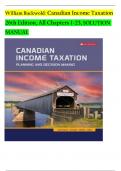
Solution Manual for Canadian Income Taxation
26th Edition by William Buckwold
All chapters 1-23 Covered
,TABLE OF CONTENT
Chapter 1 Taxation Its Role in Decision Making Chapter 2
Fundamentals of Tax Planning
Chapter 3 Liability for Tax, Income Determination, and Administration of the Income Tax System Chapter 4 Income
from Employment
Chapter 5 Income from Business
Chapter 6 The Acquisition, Use, and Disposal of Depreciable Property Chapter 7
Income from Property
Chapter 8 Gains and Losses on the Disposition of Capital Property-Capital Gains
Chapter 9 Other Income, Other Deductions, and Special Rules for Completing Net Income for Tax Purposes Chapter 10
Individuals: Determination of Taxable Income and Taxes Payable
Chapter 11 Corporations-An Introduction
Chapter 12 Organization, Capital Structures, and Income Distributions of Corporations Chapter 13 The
Canadian-Controlled Private Corporation
Chapter 14 Multiple Corporations and Their Reorganization Chapter 15
Partnerships
Chapter 16 Limited Partnerships and Joint Ventures Chapter
17 Trusts
Chapter 18 Business Acquisitions and Divestitures-Assets versus Shares Chapter 19
Business Acquisitions and Divestitures-Tax-Deferred Sales Chapter 20 Domestic and
International Business Expansion
Chapter 21 Tax Aspects of Corporate Financing Chapter 22
Introduction to GST/HST
Chapter 23 Business Valuations
Chapter 1
Taxation – It’s Role in Business Decision Making
Review Questions
1. If income tax is imposed after profits have been determined, why is taxation relevant to
business decision making?
2. Most business decisions involve the evaluation of alternative courses of action. For example, a
marketing manager may be responsible for choosing a strategy for establishing sales in new
geographical territories. Briefly explain how the tax factor can be an integral part of this decision.
3. What are the fundamental variables of the income tax system that decision-makers should be
familiar with so that they can apply tax issues to their areas of responsibility?
4. What is an “after-tax” approach to decision making?
,Solutions to Review Questions
R1-1 Once profit is determined, the Income Tax Act determines the amount of income tax that results.
However, at all levels of management, alternative courses of action are evaluated. In many cases,
the choice of one alternative over the other may affect both the amount and the timing of future
taxes on income generated from that activity. Therefore, the person making those decisions has a
direct input into future after-tax cash flow. Obviously, decisions that reduce or postpone the
payment of tax affect the ultimate return on investment and, in turn, the value of the enterprise.
Including the tax variable as a part of the formal decision process will ultimately lead to improved
after-tax cash flow.
R1-2 Expansion can be achieved in new geographic areas through direct selling, or by establishing a
formal presence in the new territory with a branch office or a separate corporation. The new
territories may also cross provincial or international boundaries. Provincial income tax rates vary
amongst the provinces. The amount of income that is subject to tax in the new province will be
different for each of the three alternatives mentioned above. For example, with direct selling, none
of the income is taxed in the new province, but with a separate corporation, all of the income is
taxed in the new province. Because the tax cost is different in each case, taxation is a relevant
part of the decision and must be included in any cost-benefit analysis that compares the three
alternatives [Reg. 400-402.1].
R1-3 A basic understanding of the following variables will significantly strengthen a decision maker's
ability to apply tax issues to their area of responsibility.
Types of Income - Employment, Business, Property, Capital gains
Taxable Entities - Individuals, Corporations, Trusts
Alternative Business - Corporation, Proprietorship, Partnership, Limited
Structures partnership, Joint arrangement, Income trust
Tax Jurisdictions - Federal, Provincial, Foreign
R1-4 All cash flow decisions, whether related to revenues, expenses, asset acquisitions or divestitures,
or debt and equity restructuring, will impact the amount and timing of the tax cost. Therefore, cash
flow exists only on an after tax basis, and, the tax impacts whether or not the ultimate result of the
decision is successful. An after-tax approach to decision- making requires each decision-maker
to think "after-tax" for every decision at the time the decision is being made, and, to consider
alternative courses of action to minimize the tax cost, in the same way that decisions are made
regarding other types of costs.
Failure to apply an after-tax approach at the time that decisions are made may provide
inaccurate information for evaluation, and, result in a permanently inefficient tax structure.
, CHAPTER 2
FUNDAMENTALS OF TAX PLANNING
Review Questions
1. “Tax planning and tax avoidance mean the same thing.” Is this statement true? Explain.
2. What distinguishes tax evasion from tax avoidance and tax planning?
3. Does Canada Revenue Agency deal with all tax avoidance activities in the same way? Explain.
4. The purpose of tax planning is to reduce or defer the tax costs associated with financial
transactions. What are the general types of tax planning activities? Briefly explain how each of
them may reduce or defer the tax cost.
5. “It is always better to pay tax later rather than sooner.” Is this statement true? Explain.
6. When corporate tax rates are 13% and tax rates for individuals are 40%, is it always better for the
individual to transfer their business to a corporation?
7. “As long as all of the income tax rules are known, a tax plan can be developed with
certainty.” Is this statement true? Explain.
8. What basic skills are required to develop a good tax plan?
9. An entrepreneur is developing a new business venture and is planning to raise equity capital
from individual investors. Their adviser indicates that the venture could be structured as a
corporation (i.e., shares are issued to the investors) or as a limited partnership (i.e., partnership
units are sold). Both structures provide limited liability for the investors. Should the entrepreneur
consider the tax positions of the individual investors? Explain. Without dealing with specific tax
rules, what general tax factors should an investor consider before making an investment?
10. What is a tax avoidance transaction?
11. “If a transaction (or a series of transactions) that results in a tax benefit was not undertaken
primarily for bona fide business, investment, or family purposes, the general anti- avoidance
rule will apply and eliminate the tax benefit.” Is this statement true? Explain.
26th Edition by William Buckwold
All chapters 1-23 Covered
,TABLE OF CONTENT
Chapter 1 Taxation Its Role in Decision Making Chapter 2
Fundamentals of Tax Planning
Chapter 3 Liability for Tax, Income Determination, and Administration of the Income Tax System Chapter 4 Income
from Employment
Chapter 5 Income from Business
Chapter 6 The Acquisition, Use, and Disposal of Depreciable Property Chapter 7
Income from Property
Chapter 8 Gains and Losses on the Disposition of Capital Property-Capital Gains
Chapter 9 Other Income, Other Deductions, and Special Rules for Completing Net Income for Tax Purposes Chapter 10
Individuals: Determination of Taxable Income and Taxes Payable
Chapter 11 Corporations-An Introduction
Chapter 12 Organization, Capital Structures, and Income Distributions of Corporations Chapter 13 The
Canadian-Controlled Private Corporation
Chapter 14 Multiple Corporations and Their Reorganization Chapter 15
Partnerships
Chapter 16 Limited Partnerships and Joint Ventures Chapter
17 Trusts
Chapter 18 Business Acquisitions and Divestitures-Assets versus Shares Chapter 19
Business Acquisitions and Divestitures-Tax-Deferred Sales Chapter 20 Domestic and
International Business Expansion
Chapter 21 Tax Aspects of Corporate Financing Chapter 22
Introduction to GST/HST
Chapter 23 Business Valuations
Chapter 1
Taxation – It’s Role in Business Decision Making
Review Questions
1. If income tax is imposed after profits have been determined, why is taxation relevant to
business decision making?
2. Most business decisions involve the evaluation of alternative courses of action. For example, a
marketing manager may be responsible for choosing a strategy for establishing sales in new
geographical territories. Briefly explain how the tax factor can be an integral part of this decision.
3. What are the fundamental variables of the income tax system that decision-makers should be
familiar with so that they can apply tax issues to their areas of responsibility?
4. What is an “after-tax” approach to decision making?
,Solutions to Review Questions
R1-1 Once profit is determined, the Income Tax Act determines the amount of income tax that results.
However, at all levels of management, alternative courses of action are evaluated. In many cases,
the choice of one alternative over the other may affect both the amount and the timing of future
taxes on income generated from that activity. Therefore, the person making those decisions has a
direct input into future after-tax cash flow. Obviously, decisions that reduce or postpone the
payment of tax affect the ultimate return on investment and, in turn, the value of the enterprise.
Including the tax variable as a part of the formal decision process will ultimately lead to improved
after-tax cash flow.
R1-2 Expansion can be achieved in new geographic areas through direct selling, or by establishing a
formal presence in the new territory with a branch office or a separate corporation. The new
territories may also cross provincial or international boundaries. Provincial income tax rates vary
amongst the provinces. The amount of income that is subject to tax in the new province will be
different for each of the three alternatives mentioned above. For example, with direct selling, none
of the income is taxed in the new province, but with a separate corporation, all of the income is
taxed in the new province. Because the tax cost is different in each case, taxation is a relevant
part of the decision and must be included in any cost-benefit analysis that compares the three
alternatives [Reg. 400-402.1].
R1-3 A basic understanding of the following variables will significantly strengthen a decision maker's
ability to apply tax issues to their area of responsibility.
Types of Income - Employment, Business, Property, Capital gains
Taxable Entities - Individuals, Corporations, Trusts
Alternative Business - Corporation, Proprietorship, Partnership, Limited
Structures partnership, Joint arrangement, Income trust
Tax Jurisdictions - Federal, Provincial, Foreign
R1-4 All cash flow decisions, whether related to revenues, expenses, asset acquisitions or divestitures,
or debt and equity restructuring, will impact the amount and timing of the tax cost. Therefore, cash
flow exists only on an after tax basis, and, the tax impacts whether or not the ultimate result of the
decision is successful. An after-tax approach to decision- making requires each decision-maker
to think "after-tax" for every decision at the time the decision is being made, and, to consider
alternative courses of action to minimize the tax cost, in the same way that decisions are made
regarding other types of costs.
Failure to apply an after-tax approach at the time that decisions are made may provide
inaccurate information for evaluation, and, result in a permanently inefficient tax structure.
, CHAPTER 2
FUNDAMENTALS OF TAX PLANNING
Review Questions
1. “Tax planning and tax avoidance mean the same thing.” Is this statement true? Explain.
2. What distinguishes tax evasion from tax avoidance and tax planning?
3. Does Canada Revenue Agency deal with all tax avoidance activities in the same way? Explain.
4. The purpose of tax planning is to reduce or defer the tax costs associated with financial
transactions. What are the general types of tax planning activities? Briefly explain how each of
them may reduce or defer the tax cost.
5. “It is always better to pay tax later rather than sooner.” Is this statement true? Explain.
6. When corporate tax rates are 13% and tax rates for individuals are 40%, is it always better for the
individual to transfer their business to a corporation?
7. “As long as all of the income tax rules are known, a tax plan can be developed with
certainty.” Is this statement true? Explain.
8. What basic skills are required to develop a good tax plan?
9. An entrepreneur is developing a new business venture and is planning to raise equity capital
from individual investors. Their adviser indicates that the venture could be structured as a
corporation (i.e., shares are issued to the investors) or as a limited partnership (i.e., partnership
units are sold). Both structures provide limited liability for the investors. Should the entrepreneur
consider the tax positions of the individual investors? Explain. Without dealing with specific tax
rules, what general tax factors should an investor consider before making an investment?
10. What is a tax avoidance transaction?
11. “If a transaction (or a series of transactions) that results in a tax benefit was not undertaken
primarily for bona fide business, investment, or family purposes, the general anti- avoidance
rule will apply and eliminate the tax benefit.” Is this statement true? Explain.