Gregor Mendel was:
a) an English scientist who carried out research with Charles Darwin
b) a little known Central European monk
c) an early 20th century Dutch biologist who carried out genetics research -
ANSWER B
Which of the following statements is true about Mendel?
a) His discoveries concerning genetic inheritance were generally accepted by the scientific
community when he published them during the mid 19th century.
b) He believed that genetic traits of parents will usually blend in their children.
c) His ideas about genetics apply equally to plants and animals. - ANSWER C
Mendel believed that the characteristics of pea plants are determined by the:
a) inheritance of units or factors from both parents
b) inheritance of units or factors from one parent
c) relative health of the parent plants at the time of pollination - ANSWER A
An allele is:
a) another word for a gene
b) a homozygous genotype
c) a heterozygous genotype
d) one of several possible forms of a gene - ANSWER D
1
,Phenotype refers to the ______________________ of an individual.
a) genetic makeup
b) actual physical appearance
c) recessive alleles - ANSWER B
When the genotype consists of a dominant and a recessive allele, the phenotype will be like
_________________ allele.
a) the dominant
b) the recessive
c) neither - ANSWER A
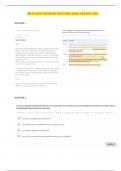
Assuming that both parent plants in the diagram below are homozygous, why would all of
the f1 generation have yellow phenotypes?
Help Getting Started
diagram showing the result of cross-pollination in the first 2 offspring generations--in
generation f1 all are yellow peas but in generation f2 the ratio of yellow to green peas is 3 to
1
a) because the f1 genotypes are homozygous
b) because yellow is dominant over green
c) because both parents passed on yellow alleles - ANSWER B
The idea that different pairs of alleles are passed to offspring independently is Mendel's
principle of:
a) unit inheritance
b) segregation
c) independent assortment - ANSWER C
In the diagram below, what accounts for the green pea seed in the f2 generation?
2
, Help Getting Started
diagram showing the result of cross-pollination in the first 2 offspring generations--in
generation f1 all are yellow peas but in generation f2 the ratio of yellow to green peas is 3 to
1
a) On average, 1 out of 4 offspring of heterozygous parents will be homozygous recessive.
b) The yellow allele is dominant over the green one.
c) The f1 generation parents are homozygous yellow. - ANSWER A
The idea that for any particular trait, the pair of alleles of each parent separate and only one
allele from each parent passes to an offspring is Mendel's principle of:
a) independent assortment
b) hybridization
c) segregation - ANSWER C
Two identical parental generations with a yellow smooth phenotype are crossed. The
offspring include the following phenotypes: yellow smooth, yellow wrinkled, green smooth,
and green wrinkled. This is an example of?
a. a monohybrid cross
b. a pure-breeding line
c. a recombinant type
d. a late-onset condition
e. Quadhybrid cross - ANSWER C
What are the two basic rules of probability?
A) The Product Rule
B) The Law of Segregation
C) The Sum Rule
D) Both A and B
E) All of the above - ANSWER D
3
a) an English scientist who carried out research with Charles Darwin
b) a little known Central European monk
c) an early 20th century Dutch biologist who carried out genetics research -
ANSWER B
Which of the following statements is true about Mendel?
a) His discoveries concerning genetic inheritance were generally accepted by the scientific
community when he published them during the mid 19th century.
b) He believed that genetic traits of parents will usually blend in their children.
c) His ideas about genetics apply equally to plants and animals. - ANSWER C
Mendel believed that the characteristics of pea plants are determined by the:
a) inheritance of units or factors from both parents
b) inheritance of units or factors from one parent
c) relative health of the parent plants at the time of pollination - ANSWER A
An allele is:
a) another word for a gene
b) a homozygous genotype
c) a heterozygous genotype
d) one of several possible forms of a gene - ANSWER D
1
,Phenotype refers to the ______________________ of an individual.
a) genetic makeup
b) actual physical appearance
c) recessive alleles - ANSWER B
When the genotype consists of a dominant and a recessive allele, the phenotype will be like
_________________ allele.
a) the dominant
b) the recessive
c) neither - ANSWER A
Assuming that both parent plants in the diagram below are homozygous, why would all of
the f1 generation have yellow phenotypes?
Help Getting Started
diagram showing the result of cross-pollination in the first 2 offspring generations--in
generation f1 all are yellow peas but in generation f2 the ratio of yellow to green peas is 3 to
1
a) because the f1 genotypes are homozygous
b) because yellow is dominant over green
c) because both parents passed on yellow alleles - ANSWER B
The idea that different pairs of alleles are passed to offspring independently is Mendel's
principle of:
a) unit inheritance
b) segregation
c) independent assortment - ANSWER C
In the diagram below, what accounts for the green pea seed in the f2 generation?
2
, Help Getting Started
diagram showing the result of cross-pollination in the first 2 offspring generations--in
generation f1 all are yellow peas but in generation f2 the ratio of yellow to green peas is 3 to
1
a) On average, 1 out of 4 offspring of heterozygous parents will be homozygous recessive.
b) The yellow allele is dominant over the green one.
c) The f1 generation parents are homozygous yellow. - ANSWER A
The idea that for any particular trait, the pair of alleles of each parent separate and only one
allele from each parent passes to an offspring is Mendel's principle of:
a) independent assortment
b) hybridization
c) segregation - ANSWER C
Two identical parental generations with a yellow smooth phenotype are crossed. The
offspring include the following phenotypes: yellow smooth, yellow wrinkled, green smooth,
and green wrinkled. This is an example of?
a. a monohybrid cross
b. a pure-breeding line
c. a recombinant type
d. a late-onset condition
e. Quadhybrid cross - ANSWER C
What are the two basic rules of probability?
A) The Product Rule
B) The Law of Segregation
C) The Sum Rule
D) Both A and B
E) All of the above - ANSWER D
3