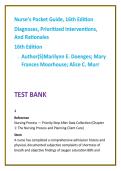
Nurse's Pocket Guide, 16th Edition
Diagnoses, Prioritized Interventions,
And Rationales
16th Edition
• Author(S)Marilynn E. Doenges; Mary
Frances Moorhouse; Alice C. Murr
TEST BANK
1. Reference
The Nursing Process — Assessment & Diagnostic Reasoning
(Chapter 1)
Stem
A 68-year-old post-op patient is alert but reports “shortness of
breath” and has an O₂ saturation of 88% on room air. Breath
sounds are diminished in the bases, and respirations are
,28/min. Using the nursing process, which immediate step
should the nurse perform next?
A. Formulate a nursing diagnosis of Impaired Gas Exchange.
B. Implement oxygen therapy per protocol.
C. Continue to monitor vital signs and reassess in 30 minutes.
D. Document the findings and notify the surgeon during rounds.
Correct answer: B
Rationales
Correct Option (B): Chapter 1 emphasizes that after assessment
identifies abnormal, potentially life-threatening data, the nurse
initiates appropriate immediate interventions
(safety/airway/oxygen). Providing oxygen is an immediate,
priority nursing action to address hypoxemia and stabilize the
client.
Incorrect A: Formulating a diagnosis is essential but secondary
to immediate stabilization when the patient is hypoxic.
Diagnosis follows assessment and early interventions.
Incorrect C: Waiting and reassessing would delay correction of
hypoxemia and is unsafe given SpO₂ 88% and tachypnea.
Incorrect D: Documentation and notifying are necessary but not
first—stabilization (oxygen) takes priority.
Teaching point: Immediate life-threatening assessment findings
require prompt interventions before diagnosis.
,Citation: Doenges, M. E., Moorhouse, M. F., & Murr, A. C.
(2022). Nurse’s Pocket Guide (16th ed.). The Nursing Process
section.
2. Reference
The Nursing Process — Problem-focused vs. Risk Diagnoses
(Chapter 1)
Stem
A nurse documents that a client has “Risk for Falls” related to
generalized weakness after chemotherapy. Which
documentation element most clearly distinguishes this as a risk
diagnosis rather than a problem-focused diagnosis?
A. Presence of an actual fall in the last 24 hours.
B. Subjective report of dizziness when standing.
C. Observation of unsteady gait during ambulation.
D. No history of falls but documented muscle weakness.
Correct answer: D
Rationales
Correct Option (D): Chapter 1 clarifies that risk diagnoses
identify vulnerability before an actual problem occurs; absence
of the problem (no history of falls) but presence of risk factors
(muscle weakness) defines a risk diagnosis.
Incorrect A: An actual fall would make the diagnosis problem-
focused (e.g., Risk for Falls → changed to Impaired Physical
Mobility or Fall, actual).
, Incorrect B & C: Subjective dizziness and observed unsteady
gait are evidentiary cues for an actual problem (problem-
focused), not solely risk status.
Teaching point: Risk diagnoses = no current problem, presence
of risk factors only.
Citation: Doenges, M. E., Moorhouse, M. F., & Murr, A. C.
(2022). Nurse’s Pocket Guide (16th ed.). The Nursing Process
section.
3. Reference
Outcome/Goal Writing — Specific, Measurable, Time-framed
(Chapter 1)
Stem
A client with newly diagnosed type 2 diabetes has the nursing
diagnosis “Ineffective Health Management.” Which outcome
statement best reflects a properly constructed patient-centered
expected outcome as taught in Chapter 1?
A. “Client will demonstrate improved blood glucose control.”
B. “Client will state understanding of diabetes at discharge.”
C. “Client will demonstrate proper insulin injection technique by
discharge.”
D. “Client will manage medications appropriately.”
Correct answer: C
Diagnoses, Prioritized Interventions,
And Rationales
16th Edition
• Author(S)Marilynn E. Doenges; Mary
Frances Moorhouse; Alice C. Murr
TEST BANK
1. Reference
The Nursing Process — Assessment & Diagnostic Reasoning
(Chapter 1)
Stem
A 68-year-old post-op patient is alert but reports “shortness of
breath” and has an O₂ saturation of 88% on room air. Breath
sounds are diminished in the bases, and respirations are
,28/min. Using the nursing process, which immediate step
should the nurse perform next?
A. Formulate a nursing diagnosis of Impaired Gas Exchange.
B. Implement oxygen therapy per protocol.
C. Continue to monitor vital signs and reassess in 30 minutes.
D. Document the findings and notify the surgeon during rounds.
Correct answer: B
Rationales
Correct Option (B): Chapter 1 emphasizes that after assessment
identifies abnormal, potentially life-threatening data, the nurse
initiates appropriate immediate interventions
(safety/airway/oxygen). Providing oxygen is an immediate,
priority nursing action to address hypoxemia and stabilize the
client.
Incorrect A: Formulating a diagnosis is essential but secondary
to immediate stabilization when the patient is hypoxic.
Diagnosis follows assessment and early interventions.
Incorrect C: Waiting and reassessing would delay correction of
hypoxemia and is unsafe given SpO₂ 88% and tachypnea.
Incorrect D: Documentation and notifying are necessary but not
first—stabilization (oxygen) takes priority.
Teaching point: Immediate life-threatening assessment findings
require prompt interventions before diagnosis.
,Citation: Doenges, M. E., Moorhouse, M. F., & Murr, A. C.
(2022). Nurse’s Pocket Guide (16th ed.). The Nursing Process
section.
2. Reference
The Nursing Process — Problem-focused vs. Risk Diagnoses
(Chapter 1)
Stem
A nurse documents that a client has “Risk for Falls” related to
generalized weakness after chemotherapy. Which
documentation element most clearly distinguishes this as a risk
diagnosis rather than a problem-focused diagnosis?
A. Presence of an actual fall in the last 24 hours.
B. Subjective report of dizziness when standing.
C. Observation of unsteady gait during ambulation.
D. No history of falls but documented muscle weakness.
Correct answer: D
Rationales
Correct Option (D): Chapter 1 clarifies that risk diagnoses
identify vulnerability before an actual problem occurs; absence
of the problem (no history of falls) but presence of risk factors
(muscle weakness) defines a risk diagnosis.
Incorrect A: An actual fall would make the diagnosis problem-
focused (e.g., Risk for Falls → changed to Impaired Physical
Mobility or Fall, actual).
, Incorrect B & C: Subjective dizziness and observed unsteady
gait are evidentiary cues for an actual problem (problem-
focused), not solely risk status.
Teaching point: Risk diagnoses = no current problem, presence
of risk factors only.
Citation: Doenges, M. E., Moorhouse, M. F., & Murr, A. C.
(2022). Nurse’s Pocket Guide (16th ed.). The Nursing Process
section.
3. Reference
Outcome/Goal Writing — Specific, Measurable, Time-framed
(Chapter 1)
Stem
A client with newly diagnosed type 2 diabetes has the nursing
diagnosis “Ineffective Health Management.” Which outcome
statement best reflects a properly constructed patient-centered
expected outcome as taught in Chapter 1?
A. “Client will demonstrate improved blood glucose control.”
B. “Client will state understanding of diabetes at discharge.”
C. “Client will demonstrate proper insulin injection technique by
discharge.”
D. “Client will manage medications appropriately.”
Correct answer: C