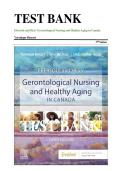
Nurse's Pocket Guide, 16th Edition
Diagnoses, Prioritized Interventions,
And Rationales
16th Edition
• Author(S)Marilynn E. Doenges; Mary
Frances Moorhouse; Alice C. Murr
TEST BANK
Q1
Reference: The Nursing Process — Assessment & Data
Collection (Chapter 1)
Stem: A 68-year-old man admitted with congestive heart failure
(CHF) has 3+ pitting edema in both ankles, weight gain of 4 kg in
48 hours, and reports increased shortness of breath when lying
flat. During the initial nursing assessment, which action best
fulfills the assessment step of the nursing process?
,A. Immediately begin diuretic administration to reduce edema.
B. Cluster objective data with subjective report and document
findings accurately.
C. Write a nursing diagnosis of Excess Fluid Volume and initiate
interventions.
D. Teach the patient low-sodium diet to prevent further weight
gain.
Correct answer: B
Rationale — Correct (B): Chapter 1 emphasizes that assessment
is the systematic collection, organization, and documentation of
subjective and objective data; clustering related data is required
before making diagnoses or planning interventions. Accurate
documentation and data clustering allow valid identification of
nursing diagnoses and appropriate planning.
Rationales — Incorrect:
A. Beginning diuretics is a physician/medication action and is
premature without nursing data clustering and collaborative
orders.
C. Writing a diagnosis before completing clustering and analysis
violates the sequential nursing process.
D. Teaching is an intervention appropriate later in planning; it
does not complete assessment.
Teaching point: Assessment = collect, cluster, document before
diagnosing.
,Citation (APA): Doenges, M. E., Moorhouse, M. F., & Murr, A. C.
(2022). Nurse’s Pocket Guide (16th ed.). Nursing process and
planning client care section.
Q2
Reference: The Nursing Process — Diagnosis & Data Clustering
(Chapter 1)
Stem: A nurse notes the following after assessment: respiratory
rate 28, SpO₂ 90% on room air, bibasilar crackles, activity
intolerance, and patient complaint “I get breathless going to the
bathroom.” Which is the best immediate nursing diagnosis
statement using data clustering?
A. Ineffective Airway Clearance related to secretions.
B. Impaired Gas Exchange related to pulmonary congestion as
evidenced by SpO₂ 90% and bibasilar crackles.
C. Anxiety related to breathlessness.
D. Activity Intolerance related to deconditioning.
Correct answer: B
Rationale — Correct (B): Chapter 1 instructs nurses to cluster
defining characteristics (objective and subjective) and select the
diagnosis that best fits the cluster. Low SpO₂, crackles,
tachypnea, and dyspnea cluster concordantly with Impaired Gas
Exchange. This reflects correct diagnostic reasoning.
, Rationales — Incorrect:
A. Ineffective Airway Clearance implies secretion obstruction;
crackles and low SpO₂ fit impaired gas exchange more directly.
C. Anxiety may be present but is not the priority diagnosis given
objective respiratory compromise.
D. Activity intolerance could appear but does not address
immediate oxygenation issue.
Teaching point: Cluster objective + subjective cues to choose
the diagnosis that explains the problem.
Citation (APA): Doenges, M. E., Moorhouse, M. F., & Murr, A. C.
(2022). Nurse’s Pocket Guide (16th ed.). Nursing process and
planning client care section.
Q3
Reference: Planning — Desired Outcomes / Evaluation Criteria
(Chapter 1)
Stem: A patient with impaired skin integrity has a wound.
Which outcome statement best follows guidelines from Chapter
1 for writing desired outcomes?
A. The patient will not get worse.
B. Wound will heal.
C. Patient’s wound edges will approximate and decrease in size
by 30% in 2 weeks.
D. Nurse will perform wound care twice daily.
Diagnoses, Prioritized Interventions,
And Rationales
16th Edition
• Author(S)Marilynn E. Doenges; Mary
Frances Moorhouse; Alice C. Murr
TEST BANK
Q1
Reference: The Nursing Process — Assessment & Data
Collection (Chapter 1)
Stem: A 68-year-old man admitted with congestive heart failure
(CHF) has 3+ pitting edema in both ankles, weight gain of 4 kg in
48 hours, and reports increased shortness of breath when lying
flat. During the initial nursing assessment, which action best
fulfills the assessment step of the nursing process?
,A. Immediately begin diuretic administration to reduce edema.
B. Cluster objective data with subjective report and document
findings accurately.
C. Write a nursing diagnosis of Excess Fluid Volume and initiate
interventions.
D. Teach the patient low-sodium diet to prevent further weight
gain.
Correct answer: B
Rationale — Correct (B): Chapter 1 emphasizes that assessment
is the systematic collection, organization, and documentation of
subjective and objective data; clustering related data is required
before making diagnoses or planning interventions. Accurate
documentation and data clustering allow valid identification of
nursing diagnoses and appropriate planning.
Rationales — Incorrect:
A. Beginning diuretics is a physician/medication action and is
premature without nursing data clustering and collaborative
orders.
C. Writing a diagnosis before completing clustering and analysis
violates the sequential nursing process.
D. Teaching is an intervention appropriate later in planning; it
does not complete assessment.
Teaching point: Assessment = collect, cluster, document before
diagnosing.
,Citation (APA): Doenges, M. E., Moorhouse, M. F., & Murr, A. C.
(2022). Nurse’s Pocket Guide (16th ed.). Nursing process and
planning client care section.
Q2
Reference: The Nursing Process — Diagnosis & Data Clustering
(Chapter 1)
Stem: A nurse notes the following after assessment: respiratory
rate 28, SpO₂ 90% on room air, bibasilar crackles, activity
intolerance, and patient complaint “I get breathless going to the
bathroom.” Which is the best immediate nursing diagnosis
statement using data clustering?
A. Ineffective Airway Clearance related to secretions.
B. Impaired Gas Exchange related to pulmonary congestion as
evidenced by SpO₂ 90% and bibasilar crackles.
C. Anxiety related to breathlessness.
D. Activity Intolerance related to deconditioning.
Correct answer: B
Rationale — Correct (B): Chapter 1 instructs nurses to cluster
defining characteristics (objective and subjective) and select the
diagnosis that best fits the cluster. Low SpO₂, crackles,
tachypnea, and dyspnea cluster concordantly with Impaired Gas
Exchange. This reflects correct diagnostic reasoning.
, Rationales — Incorrect:
A. Ineffective Airway Clearance implies secretion obstruction;
crackles and low SpO₂ fit impaired gas exchange more directly.
C. Anxiety may be present but is not the priority diagnosis given
objective respiratory compromise.
D. Activity intolerance could appear but does not address
immediate oxygenation issue.
Teaching point: Cluster objective + subjective cues to choose
the diagnosis that explains the problem.
Citation (APA): Doenges, M. E., Moorhouse, M. F., & Murr, A. C.
(2022). Nurse’s Pocket Guide (16th ed.). Nursing process and
planning client care section.
Q3
Reference: Planning — Desired Outcomes / Evaluation Criteria
(Chapter 1)
Stem: A patient with impaired skin integrity has a wound.
Which outcome statement best follows guidelines from Chapter
1 for writing desired outcomes?
A. The patient will not get worse.
B. Wound will heal.
C. Patient’s wound edges will approximate and decrease in size
by 30% in 2 weeks.
D. Nurse will perform wound care twice daily.