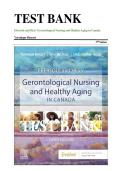
Nurse's Pocket Guide, 16th Edition
Diagnoses, Prioritized Interventions,
And Rationales
16th Edition
• Author(S)Marilynn E. Doenges; Mary
Frances Moorhouse; Alice C. Murr
TEST BANK
1
Reference
Nursing Process — Priority Step After Data Collection (Chapter
1: The Nursing Process and Planning Client Care)
Stem
A nurse has completed a comprehensive admission history and
physical, documented subjective complaints of shortness of
breath and objective findings of oxygen saturation 88% and
,bilateral crackles. According to the nursing process sequence
presented in Chapter 1, what is the nurse’s next best action?
A. Implement oxygen therapy and reassess.
B. Formulate nursing diagnoses based on clustered assessment
data.
C. Write long-term goals for discharge planning.
D. Complete discharge teaching and patient education.
Correct answer: B
Rationales
Correct (B): Chapter 1 describes that after assessment
(collection of subjective and objective data) the next step is
diagnosis—analyzing collected data and identifying client
needs/problems. Clustering cues into problems is the logical
next action before planning interventions.
A: Implementation follows planning; immediate interventions
may be needed clinically, but from the nursing-process order
the correct next cognitive step to organize care is diagnosis;
immediate life-threatening actions would be implemented
concurrently, but the scenario asks for the next process step.
C: Goal setting (planning) occurs after diagnosis—writing long-
term goals before identifying diagnosis risks mismatched care.
D: Discharge teaching is part of planning/implementation and
occurs later; it is premature before diagnoses and goals are
identified.
Teaching point: After assessment, analyze data and state
nursing diagnoses before setting goals and interventions.
,Citation: Doenges, M. E., Moorhouse, M. F., & Murr, A. C.
(2022). Nurse’s Pocket Guide (16th ed.). Chapter 1.
2
Reference
Assessment — Subjective vs. Objective Data (Chapter 1: The
Nursing Process and Planning Client Care)
Stem
A 68-year-old client tells the nurse, “I feel like I can’t catch my
breath.” On exam the nurse notes respiratory rate 26/min and
accessory muscle use. Which item from this encounter is
correctly classified as subjective data?
A. Respiratory rate 26/min.
B. Accessory muscle use.
C. Report of “I feel like I can’t catch my breath.”
D. Oxygen saturation 92%.
Correct answer: C
Rationales
Correct (C): Chapter 1 defines the database as subjective
(client-reported) and objective (observed/measured). The
client’s statement is subjective data.
A: Respiratory rate is objective—measured and observed.
B: Accessory muscle use is an objective sign observed by the
nurse.
, D: Oxygen saturation is an objective, instrument-measured
value.
Teaching point: Subjective data = what the client reports;
objective data = what the nurse observes or measures.
Citation: Doenges, M. E., Moorhouse, M. F., & Murr, A. C.
(2022). Nurse’s Pocket Guide (16th ed.). Chapter 1.
3
Reference
Data Validation — Resolving Conflicting Information (Chapter 1:
The Nursing Process and Planning Client Care)
Stem
A home health nurse notes that a client’s spouse reports the
client has been drinking fluids well, but the nurse’s intake
record shows minimal oral intake for 24 hours. According to
Chapter 1, what is the nurse’s most appropriate immediate
action?
A. Accept the spouse’s report and document adequate intake.
B. Validate the discrepancy by asking the client and reviewing
measurement records.
C. Ignore the difference; proceed to plan discharge.
D. Write a nursing diagnosis of Fluid Volume Excess.
Correct answer: B
Diagnoses, Prioritized Interventions,
And Rationales
16th Edition
• Author(S)Marilynn E. Doenges; Mary
Frances Moorhouse; Alice C. Murr
TEST BANK
1
Reference
Nursing Process — Priority Step After Data Collection (Chapter
1: The Nursing Process and Planning Client Care)
Stem
A nurse has completed a comprehensive admission history and
physical, documented subjective complaints of shortness of
breath and objective findings of oxygen saturation 88% and
,bilateral crackles. According to the nursing process sequence
presented in Chapter 1, what is the nurse’s next best action?
A. Implement oxygen therapy and reassess.
B. Formulate nursing diagnoses based on clustered assessment
data.
C. Write long-term goals for discharge planning.
D. Complete discharge teaching and patient education.
Correct answer: B
Rationales
Correct (B): Chapter 1 describes that after assessment
(collection of subjective and objective data) the next step is
diagnosis—analyzing collected data and identifying client
needs/problems. Clustering cues into problems is the logical
next action before planning interventions.
A: Implementation follows planning; immediate interventions
may be needed clinically, but from the nursing-process order
the correct next cognitive step to organize care is diagnosis;
immediate life-threatening actions would be implemented
concurrently, but the scenario asks for the next process step.
C: Goal setting (planning) occurs after diagnosis—writing long-
term goals before identifying diagnosis risks mismatched care.
D: Discharge teaching is part of planning/implementation and
occurs later; it is premature before diagnoses and goals are
identified.
Teaching point: After assessment, analyze data and state
nursing diagnoses before setting goals and interventions.
,Citation: Doenges, M. E., Moorhouse, M. F., & Murr, A. C.
(2022). Nurse’s Pocket Guide (16th ed.). Chapter 1.
2
Reference
Assessment — Subjective vs. Objective Data (Chapter 1: The
Nursing Process and Planning Client Care)
Stem
A 68-year-old client tells the nurse, “I feel like I can’t catch my
breath.” On exam the nurse notes respiratory rate 26/min and
accessory muscle use. Which item from this encounter is
correctly classified as subjective data?
A. Respiratory rate 26/min.
B. Accessory muscle use.
C. Report of “I feel like I can’t catch my breath.”
D. Oxygen saturation 92%.
Correct answer: C
Rationales
Correct (C): Chapter 1 defines the database as subjective
(client-reported) and objective (observed/measured). The
client’s statement is subjective data.
A: Respiratory rate is objective—measured and observed.
B: Accessory muscle use is an objective sign observed by the
nurse.
, D: Oxygen saturation is an objective, instrument-measured
value.
Teaching point: Subjective data = what the client reports;
objective data = what the nurse observes or measures.
Citation: Doenges, M. E., Moorhouse, M. F., & Murr, A. C.
(2022). Nurse’s Pocket Guide (16th ed.). Chapter 1.
3
Reference
Data Validation — Resolving Conflicting Information (Chapter 1:
The Nursing Process and Planning Client Care)
Stem
A home health nurse notes that a client’s spouse reports the
client has been drinking fluids well, but the nurse’s intake
record shows minimal oral intake for 24 hours. According to
Chapter 1, what is the nurse’s most appropriate immediate
action?
A. Accept the spouse’s report and document adequate intake.
B. Validate the discrepancy by asking the client and reviewing
measurement records.
C. Ignore the difference; proceed to plan discharge.
D. Write a nursing diagnosis of Fluid Volume Excess.
Correct answer: B