7 Research Methods
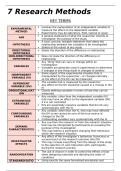
KEY TERMS
Involves the manipulation of an independent variable to
EXPERIMENTAL
measure the effect on the dependent variable
METHOD
Experiments may be laboratory, field, natural or quasi
A general statement of what the researcher intends to
AIM
investigate; the purpose of the study
A clear, precise, testable statement that states the
HYPOTHESIS relationship between the variables to be investigated
Stated at the outset of any study
DIRECTIONAL States the direction of the difference or relationship
HYPOTHESIS
NON-DIRECTIONAL Does not state the direction of the difference or
HYPOTHESIS relationship
Any ‘thing’ that can vary or change within an
investigation
VARIABLES
Variables are generally used in experiments to determine
if changes in one thing result in changes of another
Some aspect of the experimental situation that is
INDEPENDENT
manipulated by the researcher – or changes naturally –
VARIABLE (IV)
so the effect on the DV can be measured
The variable that is measured by the researcher
DEPENDENT
Any effect on the DV should be caused in a change in the
VARIABLE (DV)
IV
OPERATIONALISAT Clearly defining variables in terms of how they can be
ION measured
Any variable, other than the independent variable (IV)
that may have an effect on the dependent variable (DV)
EXTRANEOUS
if it is not controlled
VARIABLES
EVs are essentially nuisance variables that do not vary
systematically with the IV
Any variable, other than the IV, that may have affected
CONFOUNDING the DV so we cannot be sure of the true source of
VARIABLES changes to the DV
Confounding variables vary systematically with the IV
Any cue from the research or from the research situation
that may be interpreted by participants as revealing the
DEMAND
purpose of the investigation
CHARACTERISTICS
This may lead to a participant changing their behaviour
within the research situation
Any effect of the investigator’s behaviour (conscious or
unconscious) on the research outcome (the DV)
INVESTIGATOR This may include everything from the design of the study
EFFECTS to the selection of, and interaction with, participants
during the research process
The use of chance in order to control the effects of bias
RANDOMISATION when designing materials and deciding the order of
conditions
STANDARDISATIO Using exactly the same formalised procedures and
, N instructions for all participants in a research study
The different ways in which the testing of participants
EXPERIMENTAL
can be organised in relation to the experimental
DESIGN
conditions
INDEPENDENT Participants are allocated to different groups where each
GROUPS DESIGN group represents one experimental condition
REPEATED All participants take part in all conditions of the
MEASURES experiment
Pairs of participants are first matched on some
MATCHED PAIRS variable(s) that may affect the DV
DESIGN Then one member of the pair is assigned to Condition A
and the other to Condition B
An attempt to control for participant variables in an
RANDOM independent groups design which ensures that each
ALLOCATION participant has the same chance of being in one
condition as any other
An attempt to control for the effects of order in a
COUNTERBALANCI repeated measures design: half the participants
NG experience the conditions in one order, and the other half
in the opposite order
An experiment that takes place in a controlled
LABORATORY environment within which the researcher manipulates
EXPERIMENT the IV and records the effect on the DV, whilst
maintaining strict control of the extraneous variables
An experiment that takes place in a natural setting within
FIELD
which the researcher manipulates the IV and records the
EXPERIMENT
effect on the DV
An experiment where the change in the IV is not brought
NATURAL about by the researcher but would have happened even
EXPERIMENT if the researcher had not been there
The researcher records the effect on the DV
A study that is almost an experiment but lacks key
ingredients
QUASI- The IV has not been determined by anyone (the
EXPERIMENT researcher or any other person) – the ‘variables’ simply
exist, such as being old or young
Strictly speaking this is not an experiment
A group of people who are the focus of the researcher’s
POPULATION
interest, from which a smaller sample is drawn
A group of people who take part in a research
investigation
SAMPLE The sample is drawn from a (target) population and is
presumed to be representative of that population (IE. It
stands ‘fairly’ for the population being studied
SAMPLING The method used to select people from the population
TECHNIQUES
In the context of sampling, when certain groups may be
over or under-represented within the sample selected
For instance, there may be too many younger people/of
BIAS
one ethnic origin in a sample
This limits the extent to which generalisation can be
made to the target population
GENERALISATION The extent to which findings and conclusions from a
particular investigation can be broadly applied to the
, population
This made possible if the sample of participants is
representative of the population
These arise when a conflict exists between the rights of
ETHICAL ISSUES participants in research studies and the goals of research
to produce authentic, valid and worthwhile data
INFORMED
CONSENT
PRESUMPTIVE
CONSENT
PRIOR GENERAL
CONSENT
RETROSPECTIVE
CONSENT
DEBRIEFING
A quasi-legal document produced by the British
Psychological Society (BPS) that instructs psychologists
BPS CODE OF in the UK about what behaviour is and is not acceptable
ETHICS when dealing with participants
It is built around four major principles: respect,
competence, responsibility and integrity
A small-scale version of an investigation that takes place
before the real investigation is conducted
PILOT STUDY The aim is to check that procedures, materials,
measuring scales etc. work and to allow the researcher
to make changes or modifications if necessary
NATURALISTIC Watching and recording behaviour in the setting within
OBSERVATION which it would normally occur
Watching and recording behaviour within a structured
CONTROLLED
environment (IE. One where some variables are
OBSERVATION
managed)
COVERT Participants’ behaviour is watched and recorded without
OBSERVATION their knowledge and consent
OVERT Participants’ behaviour is watched and recorded with
OBSERVATION their knowledge and consent
PARTICIPANT The researcher becomes a member of the group whose
OBSERVATION behaviour he/she is watching and recording
NON-PARTICIPANT The researcher remains outside of the group whose
OBSERVATION behaviour he/she is watching and recording
BEHAVIOURAL When a target behaviour is broken up into components
CATEGORIES that are observable and measurable
A target behaviour or event is first established then the
EVENT SAMPLING
researcher records this event every time it occurs
A target individual or group is first established then the
TIME SAMPLING researcher records their behaviour in a fixed time frame,
say, every 60 seconds
Any method in which a person is asked to state or
SELF-REPORT
explain their own feelings, opinions, behaviours and/or
TECHNIQUE
experiences related to a given topic
A set of written questions (sometimes referred to as
QUESTIONNAIRE ‘items’) used to assess a person’s thoughts and/or
experiences
INTERVIEW A ‘live’ encounter (face-to-face or on the phone) where
, one person (the interviewer) asks a set of questions to
assess an interviewee’s thoughts and/or experiences
The questions may be pre-set (as in a structured
interview) or may develop as the interview goes along
(unstructured interview)
Questions for which there is no fixed choice of response
OPEN QUESTIONS and respondents can answer in any way they wish (EG.
“Why do you smoke?”)
Questions for which there is a fixed choice of responses
CLOSED
determined by the question setter (EG. “Do you
QUESTIONS
smoke?”)
A mathematical technique in which a researcher
CORRELATION investigates an association between to variables, called
co-variables
The variables investigate within a correlation (EG. Height
+ weight)
They are not referred to as the independent and
CO-VARIABLES
dependent variables because a correlation investigates
the association between the variables, rather than trying
to show a cause and effect relationship
As one co-variable increases, so does the other
POSITIVE
EG. Number of people in a room + noise = positive
CORRELATION
correlation
As one co-variable increases, the other decreases
NEGATIVE
EG. Number of people in a room + amount of personal
CORRELATION
space = negative correlation
ZERO When there is not relationship between the co-variables
CORRELATION EG. Number of people in Manchester + rainfall in Peru
INTERVENING ‘Other reasons’ for correlations
VARIABLES
Data that is expressed in words and non-numerical
QUALITATIVE
(although may be converted to numbers for purpose of
DATA
analysis)
QUANTITATIVE Data that can be counted, usually given as numbers
DATA
Information that has been obtain first-hand by the
researcher for the purposes of a research project
PRIMARY DATA In psychology, such data is often gathered directly from
participants as part of an experiment, self-report or
observation
Information that has already been collected by someone
else and so pre-dates the current research project
SECONDARY DATA
In psychology, such data might include the work of other
psychologists or government statistics
‘Research about research’, refers to the process of
combining results from a number of studies on a
particular topic to provide an overall view
META-ANALYSIS
This may involve a qualitative review of conclusions
and/or a quantitative analysis of the results producing an
effect size
DESCRIPTIVE The use of graphs, tables and summary statistics to
STATISTICS identify trends and analyse sets of data
MEASURES OF The general term for any measure of the average value
CENTRAL in a set of data
KEY TERMS
Involves the manipulation of an independent variable to
EXPERIMENTAL
measure the effect on the dependent variable
METHOD
Experiments may be laboratory, field, natural or quasi
A general statement of what the researcher intends to
AIM
investigate; the purpose of the study
A clear, precise, testable statement that states the
HYPOTHESIS relationship between the variables to be investigated
Stated at the outset of any study
DIRECTIONAL States the direction of the difference or relationship
HYPOTHESIS
NON-DIRECTIONAL Does not state the direction of the difference or
HYPOTHESIS relationship
Any ‘thing’ that can vary or change within an
investigation
VARIABLES
Variables are generally used in experiments to determine
if changes in one thing result in changes of another
Some aspect of the experimental situation that is
INDEPENDENT
manipulated by the researcher – or changes naturally –
VARIABLE (IV)
so the effect on the DV can be measured
The variable that is measured by the researcher
DEPENDENT
Any effect on the DV should be caused in a change in the
VARIABLE (DV)
IV
OPERATIONALISAT Clearly defining variables in terms of how they can be
ION measured
Any variable, other than the independent variable (IV)
that may have an effect on the dependent variable (DV)
EXTRANEOUS
if it is not controlled
VARIABLES
EVs are essentially nuisance variables that do not vary
systematically with the IV
Any variable, other than the IV, that may have affected
CONFOUNDING the DV so we cannot be sure of the true source of
VARIABLES changes to the DV
Confounding variables vary systematically with the IV
Any cue from the research or from the research situation
that may be interpreted by participants as revealing the
DEMAND
purpose of the investigation
CHARACTERISTICS
This may lead to a participant changing their behaviour
within the research situation
Any effect of the investigator’s behaviour (conscious or
unconscious) on the research outcome (the DV)
INVESTIGATOR This may include everything from the design of the study
EFFECTS to the selection of, and interaction with, participants
during the research process
The use of chance in order to control the effects of bias
RANDOMISATION when designing materials and deciding the order of
conditions
STANDARDISATIO Using exactly the same formalised procedures and
, N instructions for all participants in a research study
The different ways in which the testing of participants
EXPERIMENTAL
can be organised in relation to the experimental
DESIGN
conditions
INDEPENDENT Participants are allocated to different groups where each
GROUPS DESIGN group represents one experimental condition
REPEATED All participants take part in all conditions of the
MEASURES experiment
Pairs of participants are first matched on some
MATCHED PAIRS variable(s) that may affect the DV
DESIGN Then one member of the pair is assigned to Condition A
and the other to Condition B
An attempt to control for participant variables in an
RANDOM independent groups design which ensures that each
ALLOCATION participant has the same chance of being in one
condition as any other
An attempt to control for the effects of order in a
COUNTERBALANCI repeated measures design: half the participants
NG experience the conditions in one order, and the other half
in the opposite order
An experiment that takes place in a controlled
LABORATORY environment within which the researcher manipulates
EXPERIMENT the IV and records the effect on the DV, whilst
maintaining strict control of the extraneous variables
An experiment that takes place in a natural setting within
FIELD
which the researcher manipulates the IV and records the
EXPERIMENT
effect on the DV
An experiment where the change in the IV is not brought
NATURAL about by the researcher but would have happened even
EXPERIMENT if the researcher had not been there
The researcher records the effect on the DV
A study that is almost an experiment but lacks key
ingredients
QUASI- The IV has not been determined by anyone (the
EXPERIMENT researcher or any other person) – the ‘variables’ simply
exist, such as being old or young
Strictly speaking this is not an experiment
A group of people who are the focus of the researcher’s
POPULATION
interest, from which a smaller sample is drawn
A group of people who take part in a research
investigation
SAMPLE The sample is drawn from a (target) population and is
presumed to be representative of that population (IE. It
stands ‘fairly’ for the population being studied
SAMPLING The method used to select people from the population
TECHNIQUES
In the context of sampling, when certain groups may be
over or under-represented within the sample selected
For instance, there may be too many younger people/of
BIAS
one ethnic origin in a sample
This limits the extent to which generalisation can be
made to the target population
GENERALISATION The extent to which findings and conclusions from a
particular investigation can be broadly applied to the
, population
This made possible if the sample of participants is
representative of the population
These arise when a conflict exists between the rights of
ETHICAL ISSUES participants in research studies and the goals of research
to produce authentic, valid and worthwhile data
INFORMED
CONSENT
PRESUMPTIVE
CONSENT
PRIOR GENERAL
CONSENT
RETROSPECTIVE
CONSENT
DEBRIEFING
A quasi-legal document produced by the British
Psychological Society (BPS) that instructs psychologists
BPS CODE OF in the UK about what behaviour is and is not acceptable
ETHICS when dealing with participants
It is built around four major principles: respect,
competence, responsibility and integrity
A small-scale version of an investigation that takes place
before the real investigation is conducted
PILOT STUDY The aim is to check that procedures, materials,
measuring scales etc. work and to allow the researcher
to make changes or modifications if necessary
NATURALISTIC Watching and recording behaviour in the setting within
OBSERVATION which it would normally occur
Watching and recording behaviour within a structured
CONTROLLED
environment (IE. One where some variables are
OBSERVATION
managed)
COVERT Participants’ behaviour is watched and recorded without
OBSERVATION their knowledge and consent
OVERT Participants’ behaviour is watched and recorded with
OBSERVATION their knowledge and consent
PARTICIPANT The researcher becomes a member of the group whose
OBSERVATION behaviour he/she is watching and recording
NON-PARTICIPANT The researcher remains outside of the group whose
OBSERVATION behaviour he/she is watching and recording
BEHAVIOURAL When a target behaviour is broken up into components
CATEGORIES that are observable and measurable
A target behaviour or event is first established then the
EVENT SAMPLING
researcher records this event every time it occurs
A target individual or group is first established then the
TIME SAMPLING researcher records their behaviour in a fixed time frame,
say, every 60 seconds
Any method in which a person is asked to state or
SELF-REPORT
explain their own feelings, opinions, behaviours and/or
TECHNIQUE
experiences related to a given topic
A set of written questions (sometimes referred to as
QUESTIONNAIRE ‘items’) used to assess a person’s thoughts and/or
experiences
INTERVIEW A ‘live’ encounter (face-to-face or on the phone) where
, one person (the interviewer) asks a set of questions to
assess an interviewee’s thoughts and/or experiences
The questions may be pre-set (as in a structured
interview) or may develop as the interview goes along
(unstructured interview)
Questions for which there is no fixed choice of response
OPEN QUESTIONS and respondents can answer in any way they wish (EG.
“Why do you smoke?”)
Questions for which there is a fixed choice of responses
CLOSED
determined by the question setter (EG. “Do you
QUESTIONS
smoke?”)
A mathematical technique in which a researcher
CORRELATION investigates an association between to variables, called
co-variables
The variables investigate within a correlation (EG. Height
+ weight)
They are not referred to as the independent and
CO-VARIABLES
dependent variables because a correlation investigates
the association between the variables, rather than trying
to show a cause and effect relationship
As one co-variable increases, so does the other
POSITIVE
EG. Number of people in a room + noise = positive
CORRELATION
correlation
As one co-variable increases, the other decreases
NEGATIVE
EG. Number of people in a room + amount of personal
CORRELATION
space = negative correlation
ZERO When there is not relationship between the co-variables
CORRELATION EG. Number of people in Manchester + rainfall in Peru
INTERVENING ‘Other reasons’ for correlations
VARIABLES
Data that is expressed in words and non-numerical
QUALITATIVE
(although may be converted to numbers for purpose of
DATA
analysis)
QUANTITATIVE Data that can be counted, usually given as numbers
DATA
Information that has been obtain first-hand by the
researcher for the purposes of a research project
PRIMARY DATA In psychology, such data is often gathered directly from
participants as part of an experiment, self-report or
observation
Information that has already been collected by someone
else and so pre-dates the current research project
SECONDARY DATA
In psychology, such data might include the work of other
psychologists or government statistics
‘Research about research’, refers to the process of
combining results from a number of studies on a
particular topic to provide an overall view
META-ANALYSIS
This may involve a qualitative review of conclusions
and/or a quantitative analysis of the results producing an
effect size
DESCRIPTIVE The use of graphs, tables and summary statistics to
STATISTICS identify trends and analyse sets of data
MEASURES OF The general term for any measure of the average value
CENTRAL in a set of data