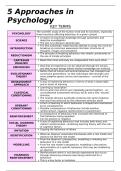
5 Approaches in
Psychology
KEY TERMS
The scientific study of the human mind and its functions, especially
PSYCHOLOGY those functions affecting behaviour in a given context
A means of acquiring knowledge through systematic and
SCIENCE objective investigation
The aim is to discover general laws
The first systematic experimental attempt to study the mind be
INTROSPECTION breaking up conscious awareness into basic structures of
thoughts, images and sensations
The principle of breaking behaviour into simple constituents or
REDUCTIONISM the use of simple principles
CARTESIAN Belief that mind and body are independent from each other
DUALISM
Idea that all experience can be obtained through the senses,
EMPIRICISM and that human beings inherit neither knowledge nor instincts
Notion that all human and animal behaviour has changed over
EVOLUTIONARY successive generations, so that individuals with stronger and
THEORY more adaptive genes survive and reproduce – survival of the
fittest
BEHAVIOURIST A way of explaining behaviour in terms of what is observable
APPROACH and in terms of learning
Learning by association
Occurs when two stimuli are repeatedly paired together – an
CLASSICAL unconditioned (unlearned) stimulus (UCS) and a new ‘neutral’
CONDITIONING stimulus
The neutral stimulus eventually produces the same response
that was first produced by the unlearned stimulus alone
A form of learning in which behaviour is shaped and maintained
OPERANT by its consequences
CONDITIONING Possible consequences of behaviour include positive
reinforcement, negative reinforcement or punishment
A consequence of behaviour that increases the likelihood of
REINFORCEMENT that behaviour being repeated
Can be positive or negative
A way of explaining behaviour that includes both direct and
SOCIAL LEARNING
indirect reinforcement, combining learning theory with the role
THEORY of cognitive factors
IMITATION Copying the behaviour of others
When an observer associates themselves with a role model and
IDENTIFICATION wants to be like the role model
From the observer’s perspective, modelling is imitating the
behaviour of a role model
MODELLING From the role model’s perspective, modelling is the precise
demonstration of a specific behaviour that may be imitated by
an observer
Reinforcement which is not directly experienced but occurs
VICARIOUS through observing someone else being reinforced for a
REINFORCEMENT behaviour
This is a key factor in limitation
, MEDIATIONAL Cognitive factors (IE thinking) that influence learning and come
PROCESSES between stimulus and response
A perspective that emphasises the importance of physical
BIOLOGICAL
processes in the body such as genetic inheritance and neutral
APPROACH function
They make up chromosomes and consist of DNA which codes
the physical features of an organism (such as eye colour,
GENES height) and psychological features (such as mental disorder,
intelligence)
Genes are transmitted from parents to offspring (IE inherited)
BIOLOGICAL An arrangement or organisation of parts to form an organ,
STRUCTURE system or living thing
Relating to chemicals in the brain that regulate psychological
NEUROCHEMISTRY functioning
GENOTYPE The particular set of genes that a person possesses
The characteristics of an individual determined by both genes
PHENOTYPE and the environment
The change in inherited characteristics in a biological
EVOLUTION population over successive generations
KEY PSYCHOLOGISTS & DATES
RENE DESCARTES JOHN LOCKE CHARLES DARWIN
WILHELM WUNDT (1879) WATSON (1913) SKINNER (1953)
FREUD ROGERS & MASLOW ALBERT BANDURA
PAVLOV (1902) WATSON & RAYNER (1920)
Origins of Psychology
, WUNDT AND INTROSPECTION
WUNDT’S LAB
The first ever lab dedicated to psychological enquiry was opened by
WILHELM WUNDT in Leipzig, Germany in 1879 – called the Institute for
Experimental Psychology
o The objective was to document and describe the nature of human
consciousness
o This method became known as introspection –
It involved WUNDT and his co-workers recording their own
conscious thoughts, with the aim of breaking these down into
their constituent parts without sacrificing any of the properties of
the whole
Isolating the structure of consciousness in this way is called
structuralism (sometimes called reductionism)
CONTROLLED METHODS
This early attempt to investigate the mind may seem naïve, but some of those
methods and techniques would still be recognised today as ‘scientific’
o All introspections were recorded under strictly controlled conditions
using the same stimulus every time (such as a ticking metronome)
o The same standardised instructions were issued to all participants this
allowed procedures to be repeated (replicated) every single time
Therefore, WUNDT’s work was significant in that it marked the separation of
the modern scientific psychology from its broader philosophical roots
THE EMERGENCE OF PSYCHOLOGY AS A
SCIENCE
WATSON AND THE EARLY BEHAVIOURISTS
By the beginning of the 20th century, the scientific status and value of
introspection was being questioned by many – specifically behaviourist
WATSON (1913)
o He worried about the subjective data produced by introspection that
made it difficult to establish general principles
o Also, he criticised the focus on ‘private’ mental processes and
proposed that a truly scientific psychology should restrict itself to studying
observable & measurable aspects
Therefore, the behaviourist approach was established, and also the
emergence of psychology as a science
SCIENTIFIC APPROACH
WATSON (1913) and SKINNER (1953) brought the language, rigour and
methods of the natural sciences into psychology
The behaviourist focus on the scientific processes involved in learning, with
the use of carefully controlled lab experiments – carried on like this for 50
years
Psychology
KEY TERMS
The scientific study of the human mind and its functions, especially
PSYCHOLOGY those functions affecting behaviour in a given context
A means of acquiring knowledge through systematic and
SCIENCE objective investigation
The aim is to discover general laws
The first systematic experimental attempt to study the mind be
INTROSPECTION breaking up conscious awareness into basic structures of
thoughts, images and sensations
The principle of breaking behaviour into simple constituents or
REDUCTIONISM the use of simple principles
CARTESIAN Belief that mind and body are independent from each other
DUALISM
Idea that all experience can be obtained through the senses,
EMPIRICISM and that human beings inherit neither knowledge nor instincts
Notion that all human and animal behaviour has changed over
EVOLUTIONARY successive generations, so that individuals with stronger and
THEORY more adaptive genes survive and reproduce – survival of the
fittest
BEHAVIOURIST A way of explaining behaviour in terms of what is observable
APPROACH and in terms of learning
Learning by association
Occurs when two stimuli are repeatedly paired together – an
CLASSICAL unconditioned (unlearned) stimulus (UCS) and a new ‘neutral’
CONDITIONING stimulus
The neutral stimulus eventually produces the same response
that was first produced by the unlearned stimulus alone
A form of learning in which behaviour is shaped and maintained
OPERANT by its consequences
CONDITIONING Possible consequences of behaviour include positive
reinforcement, negative reinforcement or punishment
A consequence of behaviour that increases the likelihood of
REINFORCEMENT that behaviour being repeated
Can be positive or negative
A way of explaining behaviour that includes both direct and
SOCIAL LEARNING
indirect reinforcement, combining learning theory with the role
THEORY of cognitive factors
IMITATION Copying the behaviour of others
When an observer associates themselves with a role model and
IDENTIFICATION wants to be like the role model
From the observer’s perspective, modelling is imitating the
behaviour of a role model
MODELLING From the role model’s perspective, modelling is the precise
demonstration of a specific behaviour that may be imitated by
an observer
Reinforcement which is not directly experienced but occurs
VICARIOUS through observing someone else being reinforced for a
REINFORCEMENT behaviour
This is a key factor in limitation
, MEDIATIONAL Cognitive factors (IE thinking) that influence learning and come
PROCESSES between stimulus and response
A perspective that emphasises the importance of physical
BIOLOGICAL
processes in the body such as genetic inheritance and neutral
APPROACH function
They make up chromosomes and consist of DNA which codes
the physical features of an organism (such as eye colour,
GENES height) and psychological features (such as mental disorder,
intelligence)
Genes are transmitted from parents to offspring (IE inherited)
BIOLOGICAL An arrangement or organisation of parts to form an organ,
STRUCTURE system or living thing
Relating to chemicals in the brain that regulate psychological
NEUROCHEMISTRY functioning
GENOTYPE The particular set of genes that a person possesses
The characteristics of an individual determined by both genes
PHENOTYPE and the environment
The change in inherited characteristics in a biological
EVOLUTION population over successive generations
KEY PSYCHOLOGISTS & DATES
RENE DESCARTES JOHN LOCKE CHARLES DARWIN
WILHELM WUNDT (1879) WATSON (1913) SKINNER (1953)
FREUD ROGERS & MASLOW ALBERT BANDURA
PAVLOV (1902) WATSON & RAYNER (1920)
Origins of Psychology
, WUNDT AND INTROSPECTION
WUNDT’S LAB
The first ever lab dedicated to psychological enquiry was opened by
WILHELM WUNDT in Leipzig, Germany in 1879 – called the Institute for
Experimental Psychology
o The objective was to document and describe the nature of human
consciousness
o This method became known as introspection –
It involved WUNDT and his co-workers recording their own
conscious thoughts, with the aim of breaking these down into
their constituent parts without sacrificing any of the properties of
the whole
Isolating the structure of consciousness in this way is called
structuralism (sometimes called reductionism)
CONTROLLED METHODS
This early attempt to investigate the mind may seem naïve, but some of those
methods and techniques would still be recognised today as ‘scientific’
o All introspections were recorded under strictly controlled conditions
using the same stimulus every time (such as a ticking metronome)
o The same standardised instructions were issued to all participants this
allowed procedures to be repeated (replicated) every single time
Therefore, WUNDT’s work was significant in that it marked the separation of
the modern scientific psychology from its broader philosophical roots
THE EMERGENCE OF PSYCHOLOGY AS A
SCIENCE
WATSON AND THE EARLY BEHAVIOURISTS
By the beginning of the 20th century, the scientific status and value of
introspection was being questioned by many – specifically behaviourist
WATSON (1913)
o He worried about the subjective data produced by introspection that
made it difficult to establish general principles
o Also, he criticised the focus on ‘private’ mental processes and
proposed that a truly scientific psychology should restrict itself to studying
observable & measurable aspects
Therefore, the behaviourist approach was established, and also the
emergence of psychology as a science
SCIENTIFIC APPROACH
WATSON (1913) and SKINNER (1953) brought the language, rigour and
methods of the natural sciences into psychology
The behaviourist focus on the scientific processes involved in learning, with
the use of carefully controlled lab experiments – carried on like this for 50
years