
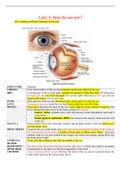
Case 3: How do we see?
LG1: Anatomy and basic functions of the eye.
ANATOMY OF THE EYE
STRUCTURE Function
CORNEA Clear front window of the eye that transmits and focuses light into the eye
IRIS Coloured part of the eye that helps regulate the amount of light that enters when there
is bright light, the iris closes the pupil to let in less light; when there is low light, the iris
opens up the pupil to let in more light
PUPIL Dark aperture in the iris that determines how much light is let into the eye
LENS Transparent structure inside the eye that focuses light rays onto the retina
RETINA Nerve layer that lines the back of the eye, senses light & creates electrical impulses that
travel through the optic nerve to the brain; consists of 2 layers:
- Sensory retina: contains nerve cells that process visual information and send it
to the brain
- Retina pigment epithelium (RPE): lies between the sensory retina and the wall
of the eye
MACULA Small central area in the retina that contains special light-sensitive cells and allows us to
see fine details clear
OPTIC NERVE Connects the eye to the brain and carries the electrical impulses formed by the retina to
the visual cortex of the brain; a bundle of more than a million nerve fibers ; the brain
controls what we see and combines the images; the retina sees images upside down but
the brain turns it right
VITREOUS Clear, jelly-like substance that fills the middle of the eye
HUMOR
BLIND-SPOT / The area of the retina that connects with the optic nerve; a blind spot which is normally
OPTIC DISK compensated by the other eye and the imagination of the brain
CHOROID Layer containing blood vessels that lines the back of the eye and is located between the
retina (inner layer) & the sclera (outer layer)
, CILIARY Structure containing muscle and is located behind the iris, which focuses the lens
BODY
FOVEA The centre of the macula which provides the sharp vision
SCLERA The white outer coat of the eye, surrounding the iris
The eye can be subdivided into three sections of chambers:
1. Anterior chamber the part of the eye between the cornea and the iris
2. Posterior chamber between the iris and the lens
3. Vitreous chamber between the lens and the back of the eye (retina & optic nerve)
the anterior & posterior chamber are filled with a clear watery fluid called aqueous humor
and the vitreous chamber is filled with vitreous humor
Photoreceptors nerve cells that convert light into neural impulses:
Rods – are responsible for vision at low light levels (scotopic vision); they do not mediate
colour vision and have a low spatial acuity; usually located around the boundary of retina
Cones – are active at higher light level (photopic vision); are capable of colour vision and
they are responsible for high spatial acuity. The central fovea is populated exclusively by
cones. There are 3 Types of cones which will refer to as:
- The short-wavelength sensitive cones – S-cones
- The middle-wavelength sensitive cones – M-cones
- The long-wavelength sensitive cones – L-cones
The light waves where both are operational are called mesopic vision
RODS CONES
More photopigments Less photopigments
Slow response long integration time Fast response short integration time
High amplification Less amplification
Highly sensitive Lower absolute sensitivity
Low acuity (sharpnes) High acuity
Achromatic one type of pigment (B/W Chromatic three types of pigments (green
vision) blue red)
Disks are pinched of and become intracellular Disks are part of the outer membrane
organelles
LG1: Anatomy and basic functions of the eye.
ANATOMY OF THE EYE
STRUCTURE Function
CORNEA Clear front window of the eye that transmits and focuses light into the eye
IRIS Coloured part of the eye that helps regulate the amount of light that enters when there
is bright light, the iris closes the pupil to let in less light; when there is low light, the iris
opens up the pupil to let in more light
PUPIL Dark aperture in the iris that determines how much light is let into the eye
LENS Transparent structure inside the eye that focuses light rays onto the retina
RETINA Nerve layer that lines the back of the eye, senses light & creates electrical impulses that
travel through the optic nerve to the brain; consists of 2 layers:
- Sensory retina: contains nerve cells that process visual information and send it
to the brain
- Retina pigment epithelium (RPE): lies between the sensory retina and the wall
of the eye
MACULA Small central area in the retina that contains special light-sensitive cells and allows us to
see fine details clear
OPTIC NERVE Connects the eye to the brain and carries the electrical impulses formed by the retina to
the visual cortex of the brain; a bundle of more than a million nerve fibers ; the brain
controls what we see and combines the images; the retina sees images upside down but
the brain turns it right
VITREOUS Clear, jelly-like substance that fills the middle of the eye
HUMOR
BLIND-SPOT / The area of the retina that connects with the optic nerve; a blind spot which is normally
OPTIC DISK compensated by the other eye and the imagination of the brain
CHOROID Layer containing blood vessels that lines the back of the eye and is located between the
retina (inner layer) & the sclera (outer layer)
, CILIARY Structure containing muscle and is located behind the iris, which focuses the lens
BODY
FOVEA The centre of the macula which provides the sharp vision
SCLERA The white outer coat of the eye, surrounding the iris
The eye can be subdivided into three sections of chambers:
1. Anterior chamber the part of the eye between the cornea and the iris
2. Posterior chamber between the iris and the lens
3. Vitreous chamber between the lens and the back of the eye (retina & optic nerve)
the anterior & posterior chamber are filled with a clear watery fluid called aqueous humor
and the vitreous chamber is filled with vitreous humor
Photoreceptors nerve cells that convert light into neural impulses:
Rods – are responsible for vision at low light levels (scotopic vision); they do not mediate
colour vision and have a low spatial acuity; usually located around the boundary of retina
Cones – are active at higher light level (photopic vision); are capable of colour vision and
they are responsible for high spatial acuity. The central fovea is populated exclusively by
cones. There are 3 Types of cones which will refer to as:
- The short-wavelength sensitive cones – S-cones
- The middle-wavelength sensitive cones – M-cones
- The long-wavelength sensitive cones – L-cones
The light waves where both are operational are called mesopic vision
RODS CONES
More photopigments Less photopigments
Slow response long integration time Fast response short integration time
High amplification Less amplification
Highly sensitive Lower absolute sensitivity
Low acuity (sharpnes) High acuity
Achromatic one type of pigment (B/W Chromatic three types of pigments (green
vision) blue red)
Disks are pinched of and become intracellular Disks are part of the outer membrane
organelles


