

Organisational Performance
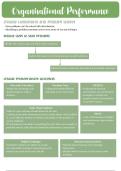
Creative thinkinging and problem solving
• New problems can’t be solved with old solutions.
• Identifying a problem customers aren’t even aware of yet and solving it.
Possible Steps to solve problems
Identify the resource gap and obtain these resources
Explain the impact on the business and consider solutions
Choose the best solution(s) and explain it in breadth and depth
Creative problem-solving techniques
Pros and Cons chart: Decision Tree: PESTLE:
• Weighs the advantages and • A diagram showing di erent • Analysing the external
disadvantages to make a outcomes to the same event. environment, you can develop
decision. strategies to comabt any
negaitve factors and capitalise
on positive factors.
Value Chain Analysis:
• Value for your customer should alwaus be the aim.
• Looking at the entire business process to decide where value is added SWOT:
in a cost-e ective manner to enhance the quality of the product or • Look at the business strengths
service rendered. and weaknesses opportunities
• If the business is involved in something that isn’t their core strength, it and threats.
probably doesn’t add value and should be eliminated or outsourced.
Delphi Technique: Resource-based analysis:
• Getting the opinion of experts on a topic. • Find out what resources are of strategic
• It is a good idea to keep it anonymous so the importance.
experts can speak freely and critically. • Identify which resources can be used to solve
problems.
ff ff
, Balanced Scorecard:
• Used to describe the key outcomes the business wants to measure in order to improve these outcomes.
• Forces management to focus on issues that are important because they create value.
• Strategies can be developed to create/maintain/improve the competitive advantage of the business.
Financial Internal
• Maximise the utilisation of assets and • Innovation of products/services.
minimising costs. • Management of operations.
• Social investment.
Customer Learning and growth
• How customers see the business. • How do employees improve to create value.
• What are their expectations? • Looks at the intangible assets in the business.
• Leadership, accountability, culture and
teamwork are important.
Some definitions
Strategic management: Top management analyses events that take place in the business environment.
Decisions and strategies are taken to respond to the analysis.
Trend: something that develops over time.
Crisis: something that comes as a surprise.
Vision: a statement about what your business wants to become.
Mission: A description of what the business does and the purpose of the business.
Generic strategies
Low cost strategy
• Lowest cost in the industry.
• The workforce must be committed to saving costs, by:
1. Having access to cheap raw materials.
2. Costs can be reduced through e ciency, using mass production, technology and re-engineering of
activities.
• Activities that don’t o er cost bene ts should be eliminated or outsourced.
Focus (niche market) strategy
• All e orts are aimed at a unique market segment (based in age, culture, hobbies or anything that makes them a
unique group.
• This group has di erent needs (distinct preferences).
• Must be big enough or have growth potential.
• Businesses often overlook these markets because they are viewed as not “worthwhile”.
• The business must have expert knowledge on the market to produce the products/services.
Differentiation
• Provide a unique product/service to ensure customer loyalty. The business can charge a premium price.
• Uniqueness can be based on:
Quality After-sales Product Distribution or
support features marketing e orts
• Should be di cult to copy AND must be continuously re-developed.
ff ffffi ff ff ffi fi
Creative thinkinging and problem solving
• New problems can’t be solved with old solutions.
• Identifying a problem customers aren’t even aware of yet and solving it.
Possible Steps to solve problems
Identify the resource gap and obtain these resources
Explain the impact on the business and consider solutions
Choose the best solution(s) and explain it in breadth and depth
Creative problem-solving techniques
Pros and Cons chart: Decision Tree: PESTLE:
• Weighs the advantages and • A diagram showing di erent • Analysing the external
disadvantages to make a outcomes to the same event. environment, you can develop
decision. strategies to comabt any
negaitve factors and capitalise
on positive factors.
Value Chain Analysis:
• Value for your customer should alwaus be the aim.
• Looking at the entire business process to decide where value is added SWOT:
in a cost-e ective manner to enhance the quality of the product or • Look at the business strengths
service rendered. and weaknesses opportunities
• If the business is involved in something that isn’t their core strength, it and threats.
probably doesn’t add value and should be eliminated or outsourced.
Delphi Technique: Resource-based analysis:
• Getting the opinion of experts on a topic. • Find out what resources are of strategic
• It is a good idea to keep it anonymous so the importance.
experts can speak freely and critically. • Identify which resources can be used to solve
problems.
ff ff
, Balanced Scorecard:
• Used to describe the key outcomes the business wants to measure in order to improve these outcomes.
• Forces management to focus on issues that are important because they create value.
• Strategies can be developed to create/maintain/improve the competitive advantage of the business.
Financial Internal
• Maximise the utilisation of assets and • Innovation of products/services.
minimising costs. • Management of operations.
• Social investment.
Customer Learning and growth
• How customers see the business. • How do employees improve to create value.
• What are their expectations? • Looks at the intangible assets in the business.
• Leadership, accountability, culture and
teamwork are important.
Some definitions
Strategic management: Top management analyses events that take place in the business environment.
Decisions and strategies are taken to respond to the analysis.
Trend: something that develops over time.
Crisis: something that comes as a surprise.
Vision: a statement about what your business wants to become.
Mission: A description of what the business does and the purpose of the business.
Generic strategies
Low cost strategy
• Lowest cost in the industry.
• The workforce must be committed to saving costs, by:
1. Having access to cheap raw materials.
2. Costs can be reduced through e ciency, using mass production, technology and re-engineering of
activities.
• Activities that don’t o er cost bene ts should be eliminated or outsourced.
Focus (niche market) strategy
• All e orts are aimed at a unique market segment (based in age, culture, hobbies or anything that makes them a
unique group.
• This group has di erent needs (distinct preferences).
• Must be big enough or have growth potential.
• Businesses often overlook these markets because they are viewed as not “worthwhile”.
• The business must have expert knowledge on the market to produce the products/services.
Differentiation
• Provide a unique product/service to ensure customer loyalty. The business can charge a premium price.
• Uniqueness can be based on:
Quality After-sales Product Distribution or
support features marketing e orts
• Should be di cult to copy AND must be continuously re-developed.
ff ffffi ff ff ffi fi


