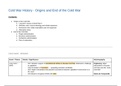
Cold War History - Origins and End of the Cold War
Contents:
1. Origins of the Cold War
a. Long term causes & World War II
b. Orthodox view: result of ideology and USSR expansion
c. Revisionist view: dollar imperialism and US expansion
d. Alternative views
2. End of the Cold War
a. Regan administration
b. Brezhnev administration
c. Gorbachev administration
d. Rise of nationalism
COLD WAR - ORIGINS
Event / Theme Details / Significance Historiography
Long Term / - 1917 Western support of a nti-Bolshevik Whites in Russian Civil War; Bolshevik’s challenge Foglesong: Allied
WWII to capitalism intervention in Russian
- 1919 Formation of C omintern → spreading revolution worldwide Civil War was like “early
- 1927 Stalin’s declaration that peaceful coexistence between capitalism+communism is in Cold War”
the “past”
- US refusal to recognise USSR until 1 933 Alexis de Tocqueville
, - 1936-38 Stalin’s Great P urge (1935): US and USSR
- 1938 M
unich Pact, Soviets further resented Western appeasement of Hitler were by nature
- 1939 N azi-Soviet Pact + 1940 annexation of Baltic states expansionist powers
During 1941-45 ‘marriage of convenience’: → Common concern for
- 1943 Casablanca and Cairo conference: FDR & Churchill attended without Stalin wartime alliance (Nazi
- 1943 T ehran conference: Allies delayed opening a second front + tensions over timing of Germany) disappeared,
pulling out of oil-rich middle east leaving two radically
- 1945 US a brupt termination of Lend-Lease to USSR - immediate end of war material different political / social
shipments from US to USSR after the surrender of Germany showed the U.S. had no / economic / ideological
intentions to support USSR systems
- 28m USSR casualties + destroyed economy; 400,000 US casualties + production output
increased 90%
Ideology / USSR E. Europe ‘satellite states’ Soviet economic
expansion - Disagreement about future of G ermany (Yalta+Potsdam) and E. Europe (Potsdam)→ advisor V arga predicted
hostility that US would cut
(Orthodox View) - Potsdam: West wanted prosperous Germany, USSR wanted retribution → conflict of military expenditures,
interest giving opportunity for
- Making independent sovereign states Soviet “satellites” & use of s alami tactics → violated Soviet expansion
promises from Yalta (Declaration of Liberated Europe)
- Stalin’s attitude to Warsaw Uprising and the London Poles 1943 appalled the West Schlesinger: "Leninism
- 1948 C zechoslovak coup → confirmed monolithic view, Marshall Plan passed and totalitarianism …
made post-war
1946 USSR veto of Baruch Plan (to keep nuclear weapons under UN control) collaboration between
Germany Russia and America...
- Soviet eastern-zone was to deliver food + raw materials, whilst western-zone’s industrial inherently impossible."
products paid for USSR reparations → but Soviets stopped sending to exploit economic
resources Kennan: S talin needed
- Berlin Blockade in response to Marshall Plan & new currency in W Germany & massive a hostile world to
electoral losses for Communist parties → Airlift → Blockade ended in 1949 → NATO legitimize his autocratic
rule
Contents:
1. Origins of the Cold War
a. Long term causes & World War II
b. Orthodox view: result of ideology and USSR expansion
c. Revisionist view: dollar imperialism and US expansion
d. Alternative views
2. End of the Cold War
a. Regan administration
b. Brezhnev administration
c. Gorbachev administration
d. Rise of nationalism
COLD WAR - ORIGINS
Event / Theme Details / Significance Historiography
Long Term / - 1917 Western support of a nti-Bolshevik Whites in Russian Civil War; Bolshevik’s challenge Foglesong: Allied
WWII to capitalism intervention in Russian
- 1919 Formation of C omintern → spreading revolution worldwide Civil War was like “early
- 1927 Stalin’s declaration that peaceful coexistence between capitalism+communism is in Cold War”
the “past”
- US refusal to recognise USSR until 1 933 Alexis de Tocqueville
, - 1936-38 Stalin’s Great P urge (1935): US and USSR
- 1938 M
unich Pact, Soviets further resented Western appeasement of Hitler were by nature
- 1939 N azi-Soviet Pact + 1940 annexation of Baltic states expansionist powers
During 1941-45 ‘marriage of convenience’: → Common concern for
- 1943 Casablanca and Cairo conference: FDR & Churchill attended without Stalin wartime alliance (Nazi
- 1943 T ehran conference: Allies delayed opening a second front + tensions over timing of Germany) disappeared,
pulling out of oil-rich middle east leaving two radically
- 1945 US a brupt termination of Lend-Lease to USSR - immediate end of war material different political / social
shipments from US to USSR after the surrender of Germany showed the U.S. had no / economic / ideological
intentions to support USSR systems
- 28m USSR casualties + destroyed economy; 400,000 US casualties + production output
increased 90%
Ideology / USSR E. Europe ‘satellite states’ Soviet economic
expansion - Disagreement about future of G ermany (Yalta+Potsdam) and E. Europe (Potsdam)→ advisor V arga predicted
hostility that US would cut
(Orthodox View) - Potsdam: West wanted prosperous Germany, USSR wanted retribution → conflict of military expenditures,
interest giving opportunity for
- Making independent sovereign states Soviet “satellites” & use of s alami tactics → violated Soviet expansion
promises from Yalta (Declaration of Liberated Europe)
- Stalin’s attitude to Warsaw Uprising and the London Poles 1943 appalled the West Schlesinger: "Leninism
- 1948 C zechoslovak coup → confirmed monolithic view, Marshall Plan passed and totalitarianism …
made post-war
1946 USSR veto of Baruch Plan (to keep nuclear weapons under UN control) collaboration between
Germany Russia and America...
- Soviet eastern-zone was to deliver food + raw materials, whilst western-zone’s industrial inherently impossible."
products paid for USSR reparations → but Soviets stopped sending to exploit economic
resources Kennan: S talin needed
- Berlin Blockade in response to Marshall Plan & new currency in W Germany & massive a hostile world to
electoral losses for Communist parties → Airlift → Blockade ended in 1949 → NATO legitimize his autocratic
rule