Thirds Written Test Massachusetts Stationary Engineer 3rd
Class Questions With Complete Solutions
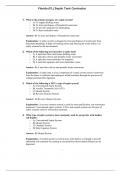
Common explanation of impulse turbine? What is a common
description of an impulse turbine?
An impulse turbine is a rotary heat engine that uses the impact
of high velocity steam from a nozzle to create a force acting on a
blade that is mounted on a wheel. The majority of the pressure
drop occurs in the nozzle, the pressure in the blade area stays
constant but the velocity drops off in the moving blades
considerably.
Explanation of what a reaction turbine is and what happens to
the steam in the nozzle and blades
A reaction turbine is a rotary heat engine that makes use of the
reactive forces produced by a flow of steam through the turbine
blades. The difference in the momentum of the flow entering
and leaving the rotating blades provides the mechanical
movement. A pressure drop occurs throughout all stages of this
type of turbine.
What are the test done on boiler water? What would you test
your water for?
Tests for boiler feed water include but are not limited to
conductivity (dissolved solids), pH, Silica, iron, alkalinity, and
hardness. These tests are done in an effort to control corrosion,
scale, dissolved gas, and sludge build up in the boiler.
, What is phosphate used for in boilers and how does it affect ph
and why
Phosphates are a chemical additive (antiscalant) to feedwater
that bonds with calcium and magnesium to form a sludge that
can then be removed via bottom blowdown. Disodium and
trisodium phosphate have higher pH values and typically
increase boiler water pH.
According to state what is a 3rd class plant
A third class plant has up to 150BHP (Solid Fuel), 500BHP
(Liquid/gas fuel), and 50HP Heat Engines.
What are the requirements for mounting 2 safety valves on a
boiler?
Boilers with over 500 sqft of heating surface are required to
have at least 2 safety valves. ASME Section 1 - when not more
than two valves of different sizes are mounted singly, the
cpacity of the smaller valve shall be not less than 50% of that of
the larger valve.
What is the equivalent inches of mercury (hg) to 34 feet of
water?
34 feet of water is equal to 30 inches of mercury. (1 PSIA)
What are the ways heat is transferred in a boiler?
Conduction, Convection, and Radiation. Conduction happens
when two objects of different temperatures come into physical
contact and heat is transferred as a result (flue gas heating the
tube sheet). Convection is heat that is transferred within a liquid
Class Questions With Complete Solutions
Common explanation of impulse turbine? What is a common
description of an impulse turbine?
An impulse turbine is a rotary heat engine that uses the impact
of high velocity steam from a nozzle to create a force acting on a
blade that is mounted on a wheel. The majority of the pressure
drop occurs in the nozzle, the pressure in the blade area stays
constant but the velocity drops off in the moving blades
considerably.
Explanation of what a reaction turbine is and what happens to
the steam in the nozzle and blades
A reaction turbine is a rotary heat engine that makes use of the
reactive forces produced by a flow of steam through the turbine
blades. The difference in the momentum of the flow entering
and leaving the rotating blades provides the mechanical
movement. A pressure drop occurs throughout all stages of this
type of turbine.
What are the test done on boiler water? What would you test
your water for?
Tests for boiler feed water include but are not limited to
conductivity (dissolved solids), pH, Silica, iron, alkalinity, and
hardness. These tests are done in an effort to control corrosion,
scale, dissolved gas, and sludge build up in the boiler.
, What is phosphate used for in boilers and how does it affect ph
and why
Phosphates are a chemical additive (antiscalant) to feedwater
that bonds with calcium and magnesium to form a sludge that
can then be removed via bottom blowdown. Disodium and
trisodium phosphate have higher pH values and typically
increase boiler water pH.
According to state what is a 3rd class plant
A third class plant has up to 150BHP (Solid Fuel), 500BHP
(Liquid/gas fuel), and 50HP Heat Engines.
What are the requirements for mounting 2 safety valves on a
boiler?
Boilers with over 500 sqft of heating surface are required to
have at least 2 safety valves. ASME Section 1 - when not more
than two valves of different sizes are mounted singly, the
cpacity of the smaller valve shall be not less than 50% of that of
the larger valve.
What is the equivalent inches of mercury (hg) to 34 feet of
water?
34 feet of water is equal to 30 inches of mercury. (1 PSIA)
What are the ways heat is transferred in a boiler?
Conduction, Convection, and Radiation. Conduction happens
when two objects of different temperatures come into physical
contact and heat is transferred as a result (flue gas heating the
tube sheet). Convection is heat that is transferred within a liquid