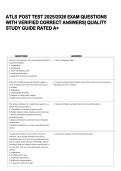
ATLS POST TEST 2025/2026 EXAM QUESTIONS
WITH VERIFIED CORRECT ANSWERS| QUALITY
STUDY GUIDE RATED A+
QUESTIONS ANSWERS
Which of the following is the recommended Method for C. Warm (40 degrees) water
treatment frostbite?
A. Vasodilators
B. Anticigulants
C. Warm (40 degrees) water
D. Padding and elevation
E. Application of heat from a hairdryer
Which of the following physical findings suggest a D. Presence of deep tendon reflexes. Spinal shock refers to loss of muscle toe
cause of hypotension other than spinal cord injury? (flaccidty) and loss of reflexes.
A. Priapism
B. Bradycardia
C. Diaphragmatic breathing
D. Presence of deep tendon reflexes
E. Ability to flex forearms but not extend them
The primary indication for transferring A patient to a C. Resource limitations as determined by the transferring doctor
higher level trauma center is:
A. Unavailibility of surgeon or operating staff
B. Multiple system injuries, including severe head injury
C. Resource limitations as determined by the
transferring doctor
D. Resource limitations as determined by the hospital
administration
E. Widened mediastinum on chest x-ray following blunt
trauma
A young man sustains a rifle wound to the mid- A. Laparotomy because of hemodynamic abnormality
abdomen. He is brought promptly to the ED by
prehospital personnel. His skin is cool and diaphoretic,
and his systolic blood pressure is 58mmHg. Warmed
crystalloid fluids are initiated without improvement in
his vital signs. The next, most appropriate, step is to
perform:
A. a laparotomy
B. An abdominal CT-scan
C. Diagnostic laparoscopy
D. Abdominal ultrasonography
E. A diagnostic peritoneal lavage
,A 42-year-old man is trapped from the waist down E. Bilateral compartment syndrome
beneath his overturned tractor for several hours before
medical assistance arrives. He is awake and alert until
just before arriving in the ED. He is now unconscious
and responds only to painful stimuli by moaning. His
pupils are 3mm in diameter and symmetrically reactive
to light. Prehospital personnel indicate that they have
not seen the patient move either of his lower
extremities. On examination in the ED, no movement of
his lower extremities are detected, even in response to
painful stimuli. The most likely cause for this finding is:
A. An epidural hematoma
B. A pelvic fracture
C. Central cord syndrome
D. Intracerebral hemorrhage
E. Bilateral compartment syndrome
A 6-year-o boy is struck by an automobile and brought D. Percutaneous peripheral veins in the upper extremities
to the ED. He is lethargic, but withdraws purposefully
from painful stimuli. His blood pressure is 90mmHg
systolic, heart rate 140 beats per minute and his
respiratory rate is 36 breaths per minute. The preferred
route of venous access in this patient is:
A. Percutaneous femoral vein cannulation
B. Cutdown on the saphenous vein at the ankle
C. Intraosseous catheter placement in the proximal tibia
D. Percutaneous peripheral veins in the upper
extremities
E. Central venous access via the subclavian or internal
jugular vein
A young man sustains a gunshot wound to the C. Control internal hemorrhage operatively
abdomen and is brought promptly to the ED by
prehospital personnel. His skin is cool and diaphoretic,
and he is confused. His pulse is thready and his femoral
pulse is only weakly palpable. The definitive treatment
in managing this patient is to:
A. Administer O-negative blood
B. Apply external warming devices
C. Control internal hemorrhage operatively
D. Apply a pneumatic antishock garment (PASG)
E. Infuse large volumes of intravenous crystalloid
solutions.
,Regarding shock in the child, which of the following is D. The absolute volume of blood loss required to produce shock is the same as
FALSE? in adults
A. Vital signs are age-related
B. Children have greater physiologic reserves than do
adults
C. Tachycardia is the primary physiologic response to
hypovolemia
D. The absolute volume of blood loss required to
produce shock is the same as in adults
E. An initial fluid bolus for resuscitation should
approximate 20ml/kg Ringers Lactate
A 33-year-old man is struck by a car travelling at D. Perform diagnostic peritoneal lavage or FAST
56km/h (35mph). He has obvious fractures of the left
tibia near the knee, pain in the pelvic area, and severe
dyspnea. His heart rate is 182 beats per minute, and his
respiratory rate is 48 breaths per minute with no breath
sounds heard in the left chest. A tension pneumothorax
is relieved by immediate needle decompression and
tube thoracostomy. Subsequently, his heart rate
decreases to 144 beats per minute, his respirartory rate
decreases to 36 breaths per minute and his blood
pressure is 81/53 mmHg. Warmed Ringers lactate is
adminstered intravenously. The next priority should be
to:
A. Perform external fixation of the pelvis
B. Obtain abdominal and pelvic CT-scans
C. Perform arterial embolization of the pelvic vessel
D. Perform diagnostic peritoneal lavage or FAST
E. Perform a urethrogram and cystogram
A 42-year-old man, injured in a motor vehicle crash, A. Obtain a chest x-ray
suffers a closed head injury, multiple palpable left rib
fractures, and bilateral femur fractures. He is intubated
orotracheally without difficulty. Initially, his ventilations
are easily assisted with a bag-mask device. It becomes
more difficult to ventilate the patient over the next 5
minutes, and his hemoglobin oxygen saturation level
decreases from 98% to 89%. The most appropriate next
step is to:
A. Obtain a chest x-ray
B. Decrease the tidal volume
C. Decrease PEEP
D. Increase the rate of assisted ventilations
E. Perform needle decompression of the left chest.
, A 30-year-old man sustains a severely comminuted, B. Tamponade of the wound with a pressure dressing
open, distal right femur fracture in a motorcycle crash.
The wound is actively bleeding. Normal sensation is
present over the lateral aspect of the foot but
decreased over the medial foot and great toe. Normal
motion of the foot is observed. Dorsalis pedis and
posterior tibial pulses are easily palpable on the left,
but heard only by Doppler on the right. Immediate
efforts to improve circulation to the injured extremity
should involve:
A. Immediate angiography
B. Tamponade of the wound with a pressure dressing
C. Wound exploration and removal of bony fragments
D. Realignment of the fracture segments with a traction
splint
E. Fasciotomy of all four compartments in the lower
extremity
An 18-yeard-old, unhelmeted motorcyclist is brought E. The patient probably has an acute epidural hematoma
by ambulance to the ED following a crash. He had
decreased level of consciousness at the scene, but then
was alert and conversational during transportation.
Now his GCS is only 11. Which of the following
statements is TRUE?
A. Cerebral perfusion is intact
B. Intravascular volume status is normal
C. The patient is in a postictal state
D. Intra-abdominal visceral injury is unlikely
E. The patient probably has an acute epidural
hematoma
A previously healthy, 70kg (175 pound) man suffers an E. His systolic blood pressure will be maintained with an elevated diastolic
estimated acute blood loss of two liters. Which one of pressure.
the following statements apply to this patient?
A. His pulse pressure will be widened
B. His urinary output will be at the lower limits of normal
C. He will have tachycardia, but no change in systolic
blood pressure
D. His systolic blood pressure will be decreased with a
narrowed, pulse pressure
E. His systolic blood pressure will be maintained with an
elevated diastolic pressure.
The physioclogic hypervolemia of pregnancy has D. Increasing the volume of blood loss to produce shock
clinical significance in the management of the severely
injured gravid woman by
A. Reducing the need for blood transfusion
B. Increasing the risk of pulmonary edema
C. Complicating the management of closed head injury
D. Increasing the volume of blood loss to produce
shock/maternal hypotension
E. Reducing the volume of crystalloid required for
resuscitation
WITH VERIFIED CORRECT ANSWERS| QUALITY
STUDY GUIDE RATED A+
QUESTIONS ANSWERS
Which of the following is the recommended Method for C. Warm (40 degrees) water
treatment frostbite?
A. Vasodilators
B. Anticigulants
C. Warm (40 degrees) water
D. Padding and elevation
E. Application of heat from a hairdryer
Which of the following physical findings suggest a D. Presence of deep tendon reflexes. Spinal shock refers to loss of muscle toe
cause of hypotension other than spinal cord injury? (flaccidty) and loss of reflexes.
A. Priapism
B. Bradycardia
C. Diaphragmatic breathing
D. Presence of deep tendon reflexes
E. Ability to flex forearms but not extend them
The primary indication for transferring A patient to a C. Resource limitations as determined by the transferring doctor
higher level trauma center is:
A. Unavailibility of surgeon or operating staff
B. Multiple system injuries, including severe head injury
C. Resource limitations as determined by the
transferring doctor
D. Resource limitations as determined by the hospital
administration
E. Widened mediastinum on chest x-ray following blunt
trauma
A young man sustains a rifle wound to the mid- A. Laparotomy because of hemodynamic abnormality
abdomen. He is brought promptly to the ED by
prehospital personnel. His skin is cool and diaphoretic,
and his systolic blood pressure is 58mmHg. Warmed
crystalloid fluids are initiated without improvement in
his vital signs. The next, most appropriate, step is to
perform:
A. a laparotomy
B. An abdominal CT-scan
C. Diagnostic laparoscopy
D. Abdominal ultrasonography
E. A diagnostic peritoneal lavage
,A 42-year-old man is trapped from the waist down E. Bilateral compartment syndrome
beneath his overturned tractor for several hours before
medical assistance arrives. He is awake and alert until
just before arriving in the ED. He is now unconscious
and responds only to painful stimuli by moaning. His
pupils are 3mm in diameter and symmetrically reactive
to light. Prehospital personnel indicate that they have
not seen the patient move either of his lower
extremities. On examination in the ED, no movement of
his lower extremities are detected, even in response to
painful stimuli. The most likely cause for this finding is:
A. An epidural hematoma
B. A pelvic fracture
C. Central cord syndrome
D. Intracerebral hemorrhage
E. Bilateral compartment syndrome
A 6-year-o boy is struck by an automobile and brought D. Percutaneous peripheral veins in the upper extremities
to the ED. He is lethargic, but withdraws purposefully
from painful stimuli. His blood pressure is 90mmHg
systolic, heart rate 140 beats per minute and his
respiratory rate is 36 breaths per minute. The preferred
route of venous access in this patient is:
A. Percutaneous femoral vein cannulation
B. Cutdown on the saphenous vein at the ankle
C. Intraosseous catheter placement in the proximal tibia
D. Percutaneous peripheral veins in the upper
extremities
E. Central venous access via the subclavian or internal
jugular vein
A young man sustains a gunshot wound to the C. Control internal hemorrhage operatively
abdomen and is brought promptly to the ED by
prehospital personnel. His skin is cool and diaphoretic,
and he is confused. His pulse is thready and his femoral
pulse is only weakly palpable. The definitive treatment
in managing this patient is to:
A. Administer O-negative blood
B. Apply external warming devices
C. Control internal hemorrhage operatively
D. Apply a pneumatic antishock garment (PASG)
E. Infuse large volumes of intravenous crystalloid
solutions.
,Regarding shock in the child, which of the following is D. The absolute volume of blood loss required to produce shock is the same as
FALSE? in adults
A. Vital signs are age-related
B. Children have greater physiologic reserves than do
adults
C. Tachycardia is the primary physiologic response to
hypovolemia
D. The absolute volume of blood loss required to
produce shock is the same as in adults
E. An initial fluid bolus for resuscitation should
approximate 20ml/kg Ringers Lactate
A 33-year-old man is struck by a car travelling at D. Perform diagnostic peritoneal lavage or FAST
56km/h (35mph). He has obvious fractures of the left
tibia near the knee, pain in the pelvic area, and severe
dyspnea. His heart rate is 182 beats per minute, and his
respiratory rate is 48 breaths per minute with no breath
sounds heard in the left chest. A tension pneumothorax
is relieved by immediate needle decompression and
tube thoracostomy. Subsequently, his heart rate
decreases to 144 beats per minute, his respirartory rate
decreases to 36 breaths per minute and his blood
pressure is 81/53 mmHg. Warmed Ringers lactate is
adminstered intravenously. The next priority should be
to:
A. Perform external fixation of the pelvis
B. Obtain abdominal and pelvic CT-scans
C. Perform arterial embolization of the pelvic vessel
D. Perform diagnostic peritoneal lavage or FAST
E. Perform a urethrogram and cystogram
A 42-year-old man, injured in a motor vehicle crash, A. Obtain a chest x-ray
suffers a closed head injury, multiple palpable left rib
fractures, and bilateral femur fractures. He is intubated
orotracheally without difficulty. Initially, his ventilations
are easily assisted with a bag-mask device. It becomes
more difficult to ventilate the patient over the next 5
minutes, and his hemoglobin oxygen saturation level
decreases from 98% to 89%. The most appropriate next
step is to:
A. Obtain a chest x-ray
B. Decrease the tidal volume
C. Decrease PEEP
D. Increase the rate of assisted ventilations
E. Perform needle decompression of the left chest.
, A 30-year-old man sustains a severely comminuted, B. Tamponade of the wound with a pressure dressing
open, distal right femur fracture in a motorcycle crash.
The wound is actively bleeding. Normal sensation is
present over the lateral aspect of the foot but
decreased over the medial foot and great toe. Normal
motion of the foot is observed. Dorsalis pedis and
posterior tibial pulses are easily palpable on the left,
but heard only by Doppler on the right. Immediate
efforts to improve circulation to the injured extremity
should involve:
A. Immediate angiography
B. Tamponade of the wound with a pressure dressing
C. Wound exploration and removal of bony fragments
D. Realignment of the fracture segments with a traction
splint
E. Fasciotomy of all four compartments in the lower
extremity
An 18-yeard-old, unhelmeted motorcyclist is brought E. The patient probably has an acute epidural hematoma
by ambulance to the ED following a crash. He had
decreased level of consciousness at the scene, but then
was alert and conversational during transportation.
Now his GCS is only 11. Which of the following
statements is TRUE?
A. Cerebral perfusion is intact
B. Intravascular volume status is normal
C. The patient is in a postictal state
D. Intra-abdominal visceral injury is unlikely
E. The patient probably has an acute epidural
hematoma
A previously healthy, 70kg (175 pound) man suffers an E. His systolic blood pressure will be maintained with an elevated diastolic
estimated acute blood loss of two liters. Which one of pressure.
the following statements apply to this patient?
A. His pulse pressure will be widened
B. His urinary output will be at the lower limits of normal
C. He will have tachycardia, but no change in systolic
blood pressure
D. His systolic blood pressure will be decreased with a
narrowed, pulse pressure
E. His systolic blood pressure will be maintained with an
elevated diastolic pressure.
The physioclogic hypervolemia of pregnancy has D. Increasing the volume of blood loss to produce shock
clinical significance in the management of the severely
injured gravid woman by
A. Reducing the need for blood transfusion
B. Increasing the risk of pulmonary edema
C. Complicating the management of closed head injury
D. Increasing the volume of blood loss to produce
shock/maternal hypotension
E. Reducing the volume of crystalloid required for
resuscitation