.
Summary Financial statement Analysis & Valuation
Inhoud
1 Lecture week 1: FSA .............................................................................................................................. 2
2 Lecture week 2: FSA ............................................................................................................................ 17
3 Lecture week 3: FSA ............................................................................................................................ 31
4 Lecture week 4: FSA ............................................................................................................................ 45
5 Week 4 Article: Hand et al (2017), The use of Residual income valuation Methods by U.S. Sell-side
equity analysts............................................................................................................................................. 55
6 Lecture week 5: FSA ............................................................................................................................ 59
7 Week 5 Article: Bradshaw (2004), “How Do Analysts Use Their Earnings Forecasts in Generating
Stock Recommendations?” ......................................................................................................................... 67
8 Lecture week 6: FSA ............................................................................................................................ 73
9 Week 6 Article: Dechow et al. (2021), Implied Equity Duration: A Measure of Pandemic Shutdown
Risk 79
1
, .
1 Lecture week 1: FSA
Financial Statement Analysis
Financial statements provide a lens on a company’s business. They reflect the performance of the
company or the financial position at the end of the period.
Managers use FS to:
- Monitor and evaluate the performance
- Communicate with external stakeholders (bank, shareholders, non-financial shareholders)
- Understand what changes to make in their operating and financial policies
Bankers use FS to decide on the terms of a loan
Analysts use FS to forecast performance and value the company.
In this course, we take the perspective of an outside quiet analyst who evaluates:
- The company’s current performance
- The quality of the FS numbers reflecting the underlying business of the company
- The sustainability of current performance as a basis for future performance forecast. This means if a
company does very well, we want to understand if this performance recurs in the future or goes back to
normal levels, so understand both accounting and the business of the company.
- The value of the company as a whole (enterprise value) and the value of equity.
So... We rather focus on the tools needed to extract information from financial statements, rather than
the application of a specific set of accounting standards such as IFRS.
- Many of the companies we analyze use US GAAP instead of IFRS
- Differences in reporting are typically small; if not, we will identify and discuss these differences (lease
accounting for example)
- Regardless of the standards applied, the toolbox we provide should be helpful in the analysis of any
company.
Useful information analyzing financial statements.
What information do we need to analyze financial statements? What are the primary sources of
information we will rely on? Those are:
1. Income statements (“Statements of Operations”)
2. Balance sheets (“Statements of Financial Position”)
3. Statements of cash flows, to better understand the quality of the information in the income
statement and to better understand how the IS and the BS are connected.
4. Statements of changes in equity
5. Statements of comprehensive income
6. Notes to the financial statements, give a lot of information to better understand the numbers that are
in the IS or BS.
Some additional useful information to analyze financial statements are:
7. Company press releases/ interim statements
2
, .
8. Management discussion and analysis (MD&A) and performance expectations, might be helpful to
calculate a forecast of future performances.
Why do we need Financial statement analyzes?
How do we determine the valuation of a company and a share of its equity? Particular the valuation of
an equity share.
So, assume u have shares in a particular company. In the long run, common shareholders care about
receiving a return on their investments. So interested in:
- Either a constant periodic payoff (a cash dividend)
- And/or the ability to liquidate the investment at a higher price (sell the investment in two or three years.
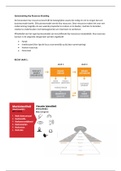
The photo (right) is the expected/required payoff structure
from buying an equity share. This works for example the
following way:
In year 0 you invest a certain amount in the equity of a
company. Let’s assume we expect a certain rate of return
on our investment, given the risk profile of this investment
(Re). We expect the company’s share price to increase
from year 0 to year 1. And then we expect that from year 1
and year 2 that there will also be an increase in stock
price, based on our Re. Let’s assume that the company also gives dividends in year 1 and year 2. These
dividends will be the cash that u receive from the investment, which is going to be valuable to us that is
realized. But following this payment of dividend to its shareholders, the dividend also decreases the
share price of the company, because they give it to us as investors. The remaining equity value lowers,
which means a reduction of the share price. The value to us in investing in this particular company in
year 0, is determined by the dividend that we get in the first year, the second year, AND the price at
which we can sell our equity stake again after two years.
Thus: we can view the value of an equity share as a present value of expected future dividends. This
includes a liquidating dividend at the end of the investment horizon or the end of the company’s life.
3
, .
Discounted Dividend Model (DDM)
To put this in perspective, to make it more formal,
we can use the Dividend Discount Model (DDM).
The value of the investment in the equity of a
company is determined by the present value of all the future expected dividends that are going to be
realized in the future.
So in this case, we have dividends realized in year 1 and year 2, and then we have the value P at which
we can sell the investment after two years (P). It tells us that if we want to determine the value of a
share, we need to form expectations of the dividend to be paid out in future periods. So how much
dividend will the company payout in the future?
Discounted Cash Flow Model (DCF)
We will also discuss in this course that there are some problems with the DDM, some companies have
problems with this DDM model, it’s not practical. In practice, analysts and investors use Discounted Cash
Flow model. In practice, this is a common way to express the value of a common share.
These models focus on the present
value of future expected free cash
flows. We will deal with this model later
on. What is important here, is to
determine the value of the equity, we
need to form expectations of what will
happen in the future. So future free cash flows.
Alternative models express value in terms of expected future earnings. To determine the value, we need
to make forecasts of the performance. That future bottom-line earnings.
It’s important to mention that the task of valuation is different from observing the stock price of a
company. Because the value of a company can be very different from the stock price. We can have stock
market bubbles, in which all companies have stock prices that deviate a lot from their true value (for
example, bitcoin). We don’t know what the underlying value of this currency is. Therefore, the price is
purely determined by the economic supply and demand. A very recent example is GameStop stock, this
is an example of a big difference in stock and value of the company.
So, the stock price is based on market supply and demand
We will focus particularly on the intrinsic or fundamental value of a company, based on this we make a
comparison of how the company is valued on the stock market. To see whether we can make investment
recommendations based on these differences.
4
Summary Financial statement Analysis & Valuation
Inhoud
1 Lecture week 1: FSA .............................................................................................................................. 2
2 Lecture week 2: FSA ............................................................................................................................ 17
3 Lecture week 3: FSA ............................................................................................................................ 31
4 Lecture week 4: FSA ............................................................................................................................ 45
5 Week 4 Article: Hand et al (2017), The use of Residual income valuation Methods by U.S. Sell-side
equity analysts............................................................................................................................................. 55
6 Lecture week 5: FSA ............................................................................................................................ 59
7 Week 5 Article: Bradshaw (2004), “How Do Analysts Use Their Earnings Forecasts in Generating
Stock Recommendations?” ......................................................................................................................... 67
8 Lecture week 6: FSA ............................................................................................................................ 73
9 Week 6 Article: Dechow et al. (2021), Implied Equity Duration: A Measure of Pandemic Shutdown
Risk 79
1
, .
1 Lecture week 1: FSA
Financial Statement Analysis
Financial statements provide a lens on a company’s business. They reflect the performance of the
company or the financial position at the end of the period.
Managers use FS to:
- Monitor and evaluate the performance
- Communicate with external stakeholders (bank, shareholders, non-financial shareholders)
- Understand what changes to make in their operating and financial policies
Bankers use FS to decide on the terms of a loan
Analysts use FS to forecast performance and value the company.
In this course, we take the perspective of an outside quiet analyst who evaluates:
- The company’s current performance
- The quality of the FS numbers reflecting the underlying business of the company
- The sustainability of current performance as a basis for future performance forecast. This means if a
company does very well, we want to understand if this performance recurs in the future or goes back to
normal levels, so understand both accounting and the business of the company.
- The value of the company as a whole (enterprise value) and the value of equity.
So... We rather focus on the tools needed to extract information from financial statements, rather than
the application of a specific set of accounting standards such as IFRS.
- Many of the companies we analyze use US GAAP instead of IFRS
- Differences in reporting are typically small; if not, we will identify and discuss these differences (lease
accounting for example)
- Regardless of the standards applied, the toolbox we provide should be helpful in the analysis of any
company.
Useful information analyzing financial statements.
What information do we need to analyze financial statements? What are the primary sources of
information we will rely on? Those are:
1. Income statements (“Statements of Operations”)
2. Balance sheets (“Statements of Financial Position”)
3. Statements of cash flows, to better understand the quality of the information in the income
statement and to better understand how the IS and the BS are connected.
4. Statements of changes in equity
5. Statements of comprehensive income
6. Notes to the financial statements, give a lot of information to better understand the numbers that are
in the IS or BS.
Some additional useful information to analyze financial statements are:
7. Company press releases/ interim statements
2
, .
8. Management discussion and analysis (MD&A) and performance expectations, might be helpful to
calculate a forecast of future performances.
Why do we need Financial statement analyzes?
How do we determine the valuation of a company and a share of its equity? Particular the valuation of
an equity share.
So, assume u have shares in a particular company. In the long run, common shareholders care about
receiving a return on their investments. So interested in:
- Either a constant periodic payoff (a cash dividend)
- And/or the ability to liquidate the investment at a higher price (sell the investment in two or three years.
The photo (right) is the expected/required payoff structure
from buying an equity share. This works for example the
following way:
In year 0 you invest a certain amount in the equity of a
company. Let’s assume we expect a certain rate of return
on our investment, given the risk profile of this investment
(Re). We expect the company’s share price to increase
from year 0 to year 1. And then we expect that from year 1
and year 2 that there will also be an increase in stock
price, based on our Re. Let’s assume that the company also gives dividends in year 1 and year 2. These
dividends will be the cash that u receive from the investment, which is going to be valuable to us that is
realized. But following this payment of dividend to its shareholders, the dividend also decreases the
share price of the company, because they give it to us as investors. The remaining equity value lowers,
which means a reduction of the share price. The value to us in investing in this particular company in
year 0, is determined by the dividend that we get in the first year, the second year, AND the price at
which we can sell our equity stake again after two years.
Thus: we can view the value of an equity share as a present value of expected future dividends. This
includes a liquidating dividend at the end of the investment horizon or the end of the company’s life.
3
, .
Discounted Dividend Model (DDM)
To put this in perspective, to make it more formal,
we can use the Dividend Discount Model (DDM).
The value of the investment in the equity of a
company is determined by the present value of all the future expected dividends that are going to be
realized in the future.
So in this case, we have dividends realized in year 1 and year 2, and then we have the value P at which
we can sell the investment after two years (P). It tells us that if we want to determine the value of a
share, we need to form expectations of the dividend to be paid out in future periods. So how much
dividend will the company payout in the future?
Discounted Cash Flow Model (DCF)
We will also discuss in this course that there are some problems with the DDM, some companies have
problems with this DDM model, it’s not practical. In practice, analysts and investors use Discounted Cash
Flow model. In practice, this is a common way to express the value of a common share.
These models focus on the present
value of future expected free cash
flows. We will deal with this model later
on. What is important here, is to
determine the value of the equity, we
need to form expectations of what will
happen in the future. So future free cash flows.
Alternative models express value in terms of expected future earnings. To determine the value, we need
to make forecasts of the performance. That future bottom-line earnings.
It’s important to mention that the task of valuation is different from observing the stock price of a
company. Because the value of a company can be very different from the stock price. We can have stock
market bubbles, in which all companies have stock prices that deviate a lot from their true value (for
example, bitcoin). We don’t know what the underlying value of this currency is. Therefore, the price is
purely determined by the economic supply and demand. A very recent example is GameStop stock, this
is an example of a big difference in stock and value of the company.
So, the stock price is based on market supply and demand
We will focus particularly on the intrinsic or fundamental value of a company, based on this we make a
comparison of how the company is valued on the stock market. To see whether we can make investment
recommendations based on these differences.
4