

Week 1
Chapter 1: Introduction
1.2 Methods of Knowing and Acquiring Knowledge
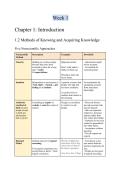
Five Nonscientific Approaches
Nonscientific Description Examples Downfalls
Method
Tenacity Holding on to ideas simply Opposites attract. - Information might
because they have been not be accurate.
accepted as facts for a long Don’t walk under a - No method for
time = habit ladder or black cat. correcting ideas.
Or superstitions.
Wearing a lucky hat
for an exam.
Intuition Information is true because it A person assumes that No mechanism for
“feels right”, a hunch, a gut people who talk fast separating accurate
feeling or an instinct. are more confident. from inaccurate
knowledge.
A teacher believes
students learn better in
the morning.
Authority Consulting an expert or Google it, read about - Does not always
(method of website to read the works of it, watch it or ask provide accurate info
faith because experts. people. (can be biased)
people accept - Info can represent
in faith any subjective, personal
information opinion rather than
that is given) true expert knowledge.
- Expertise in one area
cannot be generalized
into other topics.
- Acceptance without
question.
- Not all experts are
experts
Rational Seeking answers by logical Having a frightening - Conclusion is not
Model reasoning. experience with a dog true unless both the
causes fear of dogs in premise statements are
Two premise statements (we the future. (premise) true.
accept them as facts) = final - People are not good
logical conclusion Amy has a fear of dogs. at logical reasoning.
, (premise)
Therefore, Amy had a
frightening experience
with a dog in her past.
(logical statement)
Empirical Answers questions by direct Checking the oil in the - We cannot fully trust
Method observation or personal car by looking at the in our senses.
experience. All knowledge is dipstick. - Your perception can
acquired through senses. be altered from your
Learning your weight prior knowledge,
by scaling yourself. expectations, feelings
and beliefs.
- Can be time
consuming and
dangerous.
1.3 The Scientific Method
Approach to acquiring knowledge that involves formulating specific questions and systematically
finding answers.
Step 1: Observe behavior or other phenomenon
- You do inductive reasoning. (reaching a general conclusion based on a few specific examples)
Step 2: Form a hypothesis = explanation for your observation
- Identifying other factors or variables that are associated with your observation.
- Hypothesis is a general statement, prediction is a specific statement
Step 3: Use your hypothesis to generate a testable prediction
- We use deduction now where we have a general statement and make specific deductions.
- Prediction must be testable
Step 4: Evaluate the prediction by making systematic, planned observations (data collection)
- After the testable prediction has been made (the rational method), to evaluate the prediction
we use direct observation (empirical method).
, - Data collections section.
Step 5: Use of observation to support, refute, or refine the original hypothesis
- You compare your hypothesis with the actual observation that is being made.
The scientific method is not a linear process, it is a circular process that leads to a tentative answer.
Observations lead to a hypothesis and a prediction, which lead to more observations, which lead to
another hypothesis, and so on.
Three important principles of the scientific method
1. Science is empirical
a. Answers are obtained by making systematic and structured observations.
2. Science is public
a. Other individuals should be able to repeat the same step-by-step process that led to
the observations so they can replicate the observations for themselves.
b. It is used for verification purposes.
3. Science is objective
a. The observations are structured so the researcher’s biases and beliefs do not influence
the outcome of the study.
Science Pseudoscience
Refutable hypothesis, falsifiability Rigid beliefs with no possibility of alteration
Objective and unbiased Subjective evidence (cherry picking success)
Adaptation of new evidence Ignore unsupporting evidence
Grounded in past science Creation of new disciplines and techniques
1.4 The Research Process
Quantitative and Qualitative Research
Quantitative Qualitative
Examines variables that vary in quantity (size, Examine participants and take extensive notes.
magnitude, duration, amount)
Numerical scores Narrative reports
, Develop a test Talk to people and take notes
10 Steps of the Research Process & WL 3
→ This is a circular process NOT a linear process.
1. Find a research idea
a. Identify the general topic and review the background literature.
b. We use the method of induction: a relatively small set of specific observations form
the basis for forming a general statement about a larger set of possible observations.
i. Selecting a topic
ii. Reviewing the literature
iii. Formulating a research question
2. Form a hypothesis or a tentative answer (prediction)
a. If your question is about the description of a variable you can skip this step.
i. This step is only important if there is a relationship between variables.
b. Hypothesis is general, prediction is specific.
c. Identify the factors, or variables that are associated with your observation.
d. Variables are characteristics or conditions that change or have different values for
different individuals.
e. Formulate a hypothesis, or a possible explanation (tentative answer) for your
observation.
3. Determine how you will define and measure your variables
a. Plan to evaluate the validity and reliability of your measurement procedures.
b. Transform the hypothesis into an empirically testable form.
c. You need to determine how to manipulate the IV.
d. You also need to determine how to measure the DV.
e. Need to consider which other variables might be involved (determine confounders).
f. Manipulation check
i. Assessing whether the manipulation was effective.
ii. It is measured in a small sample using pre-test and after exposure to stimulus.
4. Identify the participants
a. How many participants (humans) or subjects (nonhumans), characteristics, how they
will be selected, where to find them and ethical codes (e.g. children need permission).
5. Select a research strategy
a. Consider internal and external validity and decide between experimental, descriptive,
correlational, nonexperimental or quasi-experimental strategy.
6. Select a research design
a. Decide among between-subjects, within-subjects, factorial, or single-case designs.
7. Conduct the study
a. Collect the data.
8. Evaluate the data
a. Statistics section
9. Report the results
10. Refine or reformulate your research idea
Chapter 1: Introduction
1.2 Methods of Knowing and Acquiring Knowledge
Five Nonscientific Approaches
Nonscientific Description Examples Downfalls
Method
Tenacity Holding on to ideas simply Opposites attract. - Information might
because they have been not be accurate.
accepted as facts for a long Don’t walk under a - No method for
time = habit ladder or black cat. correcting ideas.
Or superstitions.
Wearing a lucky hat
for an exam.
Intuition Information is true because it A person assumes that No mechanism for
“feels right”, a hunch, a gut people who talk fast separating accurate
feeling or an instinct. are more confident. from inaccurate
knowledge.
A teacher believes
students learn better in
the morning.
Authority Consulting an expert or Google it, read about - Does not always
(method of website to read the works of it, watch it or ask provide accurate info
faith because experts. people. (can be biased)
people accept - Info can represent
in faith any subjective, personal
information opinion rather than
that is given) true expert knowledge.
- Expertise in one area
cannot be generalized
into other topics.
- Acceptance without
question.
- Not all experts are
experts
Rational Seeking answers by logical Having a frightening - Conclusion is not
Model reasoning. experience with a dog true unless both the
causes fear of dogs in premise statements are
Two premise statements (we the future. (premise) true.
accept them as facts) = final - People are not good
logical conclusion Amy has a fear of dogs. at logical reasoning.
, (premise)
Therefore, Amy had a
frightening experience
with a dog in her past.
(logical statement)
Empirical Answers questions by direct Checking the oil in the - We cannot fully trust
Method observation or personal car by looking at the in our senses.
experience. All knowledge is dipstick. - Your perception can
acquired through senses. be altered from your
Learning your weight prior knowledge,
by scaling yourself. expectations, feelings
and beliefs.
- Can be time
consuming and
dangerous.
1.3 The Scientific Method
Approach to acquiring knowledge that involves formulating specific questions and systematically
finding answers.
Step 1: Observe behavior or other phenomenon
- You do inductive reasoning. (reaching a general conclusion based on a few specific examples)
Step 2: Form a hypothesis = explanation for your observation
- Identifying other factors or variables that are associated with your observation.
- Hypothesis is a general statement, prediction is a specific statement
Step 3: Use your hypothesis to generate a testable prediction
- We use deduction now where we have a general statement and make specific deductions.
- Prediction must be testable
Step 4: Evaluate the prediction by making systematic, planned observations (data collection)
- After the testable prediction has been made (the rational method), to evaluate the prediction
we use direct observation (empirical method).
, - Data collections section.
Step 5: Use of observation to support, refute, or refine the original hypothesis
- You compare your hypothesis with the actual observation that is being made.
The scientific method is not a linear process, it is a circular process that leads to a tentative answer.
Observations lead to a hypothesis and a prediction, which lead to more observations, which lead to
another hypothesis, and so on.
Three important principles of the scientific method
1. Science is empirical
a. Answers are obtained by making systematic and structured observations.
2. Science is public
a. Other individuals should be able to repeat the same step-by-step process that led to
the observations so they can replicate the observations for themselves.
b. It is used for verification purposes.
3. Science is objective
a. The observations are structured so the researcher’s biases and beliefs do not influence
the outcome of the study.
Science Pseudoscience
Refutable hypothesis, falsifiability Rigid beliefs with no possibility of alteration
Objective and unbiased Subjective evidence (cherry picking success)
Adaptation of new evidence Ignore unsupporting evidence
Grounded in past science Creation of new disciplines and techniques
1.4 The Research Process
Quantitative and Qualitative Research
Quantitative Qualitative
Examines variables that vary in quantity (size, Examine participants and take extensive notes.
magnitude, duration, amount)
Numerical scores Narrative reports
, Develop a test Talk to people and take notes
10 Steps of the Research Process & WL 3
→ This is a circular process NOT a linear process.
1. Find a research idea
a. Identify the general topic and review the background literature.
b. We use the method of induction: a relatively small set of specific observations form
the basis for forming a general statement about a larger set of possible observations.
i. Selecting a topic
ii. Reviewing the literature
iii. Formulating a research question
2. Form a hypothesis or a tentative answer (prediction)
a. If your question is about the description of a variable you can skip this step.
i. This step is only important if there is a relationship between variables.
b. Hypothesis is general, prediction is specific.
c. Identify the factors, or variables that are associated with your observation.
d. Variables are characteristics or conditions that change or have different values for
different individuals.
e. Formulate a hypothesis, or a possible explanation (tentative answer) for your
observation.
3. Determine how you will define and measure your variables
a. Plan to evaluate the validity and reliability of your measurement procedures.
b. Transform the hypothesis into an empirically testable form.
c. You need to determine how to manipulate the IV.
d. You also need to determine how to measure the DV.
e. Need to consider which other variables might be involved (determine confounders).
f. Manipulation check
i. Assessing whether the manipulation was effective.
ii. It is measured in a small sample using pre-test and after exposure to stimulus.
4. Identify the participants
a. How many participants (humans) or subjects (nonhumans), characteristics, how they
will be selected, where to find them and ethical codes (e.g. children need permission).
5. Select a research strategy
a. Consider internal and external validity and decide between experimental, descriptive,
correlational, nonexperimental or quasi-experimental strategy.
6. Select a research design
a. Decide among between-subjects, within-subjects, factorial, or single-case designs.
7. Conduct the study
a. Collect the data.
8. Evaluate the data
a. Statistics section
9. Report the results
10. Refine or reformulate your research idea


