

Relationships
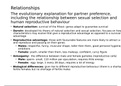
The evolutionary explanation for partner preference,
including the relationship between sexual selection and
human reproductive behaviour
• Natural selection: survival of the fittest- genes adapt to guarantee survival
• Darwin: developed his theory of natural selection and sexual selection, focuses on how
characteristics may evolve that give a reproductive advantage as opposed to a survival
advantage
• Reproductive advantage: those with favourable features are more likely to attract a m
and reproduce and passing on their genes
• Males: respectful, funny, muscular shape, taller then them, good personal hygiene,
ambitions
• Female: youth, smaller then them, less makeup, confident, curvy figure
• Anisogamy: the difference between male and female gametes (reproductive cells)
• Male: sperm- small, 110 million per ejaculation, requires little energy
• Female: egg- large, 1 every 28 days, requires a lot of energy
• Biological differences: give rise to different reproductive behaviour (there is a shortag
fertile females but no shortage of fertile males
,• Anisogamy: gives rise to two types of selection
• Inter-sexual selection: preferred by females, choose quality over quantity
• Females make more biological investment before, during and after birth of the offspring
• consequences for males and females if they invest in the wrong partner, these consequen
are more serious for females
• Females select genetically fit partner who is able and willing to provide resources, leaving
males to compete with other males for the opportunity to mate
• Intra-sexual selection: preferred by females, choose quantity over quality
• The ‘winner’ of this competition is the male that reproduces and passes on their character
that contributed to their victory
• Given rise to dimorphism (evolution of traits that allow for better competition) in humans
• Physical competition: size matters, larger males have this advantage and are more likely to
mate
• Intra-sexual selection: females do not engage in this selection, there’s no evolutionary
advantage towards favouring size
• Behavioural and psychological consequences, by behaving in a certain way to acquire a fe
and to protect them from competing males
• Anisogamy: dictates that the best reproductive strategy is to mate with as many fertile fema
as possible, due to minimal energy required to reproduce and lack of post-conception responsi
• Given rise to behavioural preferences for females that indicate fertility (youth and hour-gla
figure)
, • Evaluation: Buss (1989) hypothesis that factors affecting male choice in men and women are
consistent across cultures. Questionnaire, 10,000 participants, adults, 33 countries, more females
were looking for resources than males, more males were looking for fertility than females.
Representative sample- high reliability, can make generalisations. Questionnaire- could misinterp
questions, easy to replicate, quantitative data, nomothetic, draw conclusions.
• Singh (1993) found that cultures differ on ideal weight for women but their ideal waist-hip ratio
always the same, 0.7 (the hourglass figure) shows that preferences are universal
• Clark and Hatfield (1989) female choosiness is real. Psychology uni students approached othe
students and said ‘I have been noticing you around campus. I find you to be very attractive. Wou
you go to bed with me tonight?’ 0% of females said yes, while 75% of males said yes
• Culture changes faster than evolution: more females in work, less dependent on males so do
rely on them for resources. Theory lacks temporal validity
• Issues and debates: nomothetic evidence (Buss), makes generalisations. No cultural bias- relia
findings. Shows biological determinism. Reductionist- just looks at evolution, we are more than th
factors affecting attraction in romantic relationships: self-
disclosure
• Self-disclosure: sharing information
• Social penetration theory: developed by Altman and Taylor (1973), the gradual process of
revealing your inner self to another person, involves reciprocal exchange of info, leads to a deep
understanding of each other
• Revealing personal information indicates trust, for the relationship to progress, the other mus
also reveal sensitive information
The evolutionary explanation for partner preference,
including the relationship between sexual selection and
human reproductive behaviour
• Natural selection: survival of the fittest- genes adapt to guarantee survival
• Darwin: developed his theory of natural selection and sexual selection, focuses on how
characteristics may evolve that give a reproductive advantage as opposed to a survival
advantage
• Reproductive advantage: those with favourable features are more likely to attract a m
and reproduce and passing on their genes
• Males: respectful, funny, muscular shape, taller then them, good personal hygiene,
ambitions
• Female: youth, smaller then them, less makeup, confident, curvy figure
• Anisogamy: the difference between male and female gametes (reproductive cells)
• Male: sperm- small, 110 million per ejaculation, requires little energy
• Female: egg- large, 1 every 28 days, requires a lot of energy
• Biological differences: give rise to different reproductive behaviour (there is a shortag
fertile females but no shortage of fertile males
,• Anisogamy: gives rise to two types of selection
• Inter-sexual selection: preferred by females, choose quality over quantity
• Females make more biological investment before, during and after birth of the offspring
• consequences for males and females if they invest in the wrong partner, these consequen
are more serious for females
• Females select genetically fit partner who is able and willing to provide resources, leaving
males to compete with other males for the opportunity to mate
• Intra-sexual selection: preferred by females, choose quantity over quality
• The ‘winner’ of this competition is the male that reproduces and passes on their character
that contributed to their victory
• Given rise to dimorphism (evolution of traits that allow for better competition) in humans
• Physical competition: size matters, larger males have this advantage and are more likely to
mate
• Intra-sexual selection: females do not engage in this selection, there’s no evolutionary
advantage towards favouring size
• Behavioural and psychological consequences, by behaving in a certain way to acquire a fe
and to protect them from competing males
• Anisogamy: dictates that the best reproductive strategy is to mate with as many fertile fema
as possible, due to minimal energy required to reproduce and lack of post-conception responsi
• Given rise to behavioural preferences for females that indicate fertility (youth and hour-gla
figure)
, • Evaluation: Buss (1989) hypothesis that factors affecting male choice in men and women are
consistent across cultures. Questionnaire, 10,000 participants, adults, 33 countries, more females
were looking for resources than males, more males were looking for fertility than females.
Representative sample- high reliability, can make generalisations. Questionnaire- could misinterp
questions, easy to replicate, quantitative data, nomothetic, draw conclusions.
• Singh (1993) found that cultures differ on ideal weight for women but their ideal waist-hip ratio
always the same, 0.7 (the hourglass figure) shows that preferences are universal
• Clark and Hatfield (1989) female choosiness is real. Psychology uni students approached othe
students and said ‘I have been noticing you around campus. I find you to be very attractive. Wou
you go to bed with me tonight?’ 0% of females said yes, while 75% of males said yes
• Culture changes faster than evolution: more females in work, less dependent on males so do
rely on them for resources. Theory lacks temporal validity
• Issues and debates: nomothetic evidence (Buss), makes generalisations. No cultural bias- relia
findings. Shows biological determinism. Reductionist- just looks at evolution, we are more than th
factors affecting attraction in romantic relationships: self-
disclosure
• Self-disclosure: sharing information
• Social penetration theory: developed by Altman and Taylor (1973), the gradual process of
revealing your inner self to another person, involves reciprocal exchange of info, leads to a deep
understanding of each other
• Revealing personal information indicates trust, for the relationship to progress, the other mus
also reveal sensitive information


