Pathophysiology Final Exam Study Guide Modules 1-10
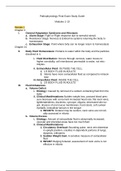
Pathophysiology Final Exam Study Guide Modules 1-10 Module 1 Chapter 2 I. General Adaptation Syndrome and Allostasis a. Alarm Stage: Fight-or-Flight response due to stressful stimuli. b. Resistance Stage: Nervous & Endocrine systems returning the body to homeostasis c. Exhaustion Stage: Point where bofy can no longer return to homeostasis Chapter 24 II. Body Fluid Homeostasis: Pertains to water within the body and the particles dissolved in it. i. Fluid Distribution: Occurs through osmosis, water moves to higher osmolality, cell membranes permeable to water, not electrolytes. ii. Extracellular Fluid: OUTSIDE THE CELL 1. 1/3 BODY FLUID IN ADULTS 2. Infants have more extracellular fluid as compared to intracellular iii. Intracellular Fluid: INSIDE THE CELL 1. 2/3 BODY FLUID IN ADULTS III. Fluid Imbalances a. Volume Deficit i. Etiology: Caused by removal of a sodium-containing fluid from the body ii. Clinical Manifestations:Sudden weight loss, postural blood pressure decrease with concurrent increased heart rate, flat neck veins, lightheadedness, dizziness, syncope, oliguria, decreased skin turgot, dryness of oral mucus membranes, hard stools, soft sunken eyeballs, lonitudinal furrows in the tongue 1. INFANTS: fontanel may be sunken, neck veins are not reliably assessed in infants b. Volume Excess i. Etiology: Amount of extracellular fluid is abnormally increased, vascular and intersitial areas have too much fluid ii. Clinical Manifestations: 1. Circulatory Overload: Bounding pulse, neck vein distention in upright position, crackles in dependent portions of lungs, dyspnea, orthopnea 2. Sudden Weight Gain: A sensitive measure of extracellular fluid 3. INFANT: Bulging fontanel, assessment of neck veins is not effective in infants 4. Edema 5. ADVANCED: Frothy sputum of pulmonary edema IV. Body Fluid Concentration a. Hyponatremia: Serum Sodium conentration below the lower limit of normal i. Clinical Manifestations: 1. Mild Central Nervous System Dysfunction: Malaise, anorexia, nausea, vommiting, headache 2. Severe Central Nervous System Dysfunction: Confusion, lethargy, seizures, coma, fatal cerebral herniation b. Hypernatremia: Serum sodium concentration above upper limit of normal i. Etiology/Causes: Gain of more salt than water, loss of more water than salt c. Interstitial Fluid Volume i. Edema: V. Electrolyte Imbalances a. Serum Potassium i. Hypokalemia: decreased potassium ion concentration in extracellular fluid 1. Etiology: a. Decreased Intake: Usually in conditions that cause a decreased oral intake b. Shift into the cell from extracellular fluid c. Increased Excretion: Renal, through feces, Sweat, GI Tract (Emesis, diarrhea) Diuretics ii. Hyperkalemia: Rise of serum potassium levels above 5 MEQ/L 1. Clinical Manifestations: a. Early, Mild: Intesional Cramping, Diarrhea b. Late, More severe: Musclue weakness: (Ascending, beginning in lower extremities) Cardiac Dysrhythmias, even cardiac arrest b. Serum Calcium i. Clinical manifestations: 1. HYPOa. Clinical Manifestations: i. Hyperexcitability of Neuromuscular cells: possitive trousseau sign, positive chvostek sign (not reliable in infants), parethesias, muscle twitching and cramping, hyperactive reflexes, carpal spasm, pedal spasm, tetany, laryngospasm, seizures, cardiac dyshythmias 2. HYPERa. Clinical Manifestations: decreased neuromuscular excitability, muscle weakness, diminished reflexes, cardiac dysrhythmias, anorexia, nausea, emesis, fatigue, polyuria, constipation, headache, confusion
Document information
- Uploaded on
- March 17, 2021
- Number of pages
- 19
- Written in
- 2020/2021
- Type
- Exam (elaborations)
- Contains
- Questions & answers