Page 1 of 26
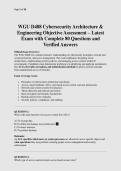
WGU D488 Cybersecurity Architecture &
Engineering Objective Assessment – Latest
Exam with Complete 80 Questions and
Verified Answers
Official Exam Overview:
The WGU D488 OA evaluates learners’ understanding of cybersecurity principles, network and
system protection, and access management. The exam emphasizes designing secure
architectures, implementing security policies, and managing access controls within IT
environments. Candidates must demonstrate proficiency in identifying and applying mechanisms
like ACLs, firewalls, encryption, and authentication methods to protect systems and data
from unauthorized access or breaches.
Exam Coverage Areas:
• Principles of cybersecurity architecture and design
• Access control methods: ACLs, role-based access control, and user permissions
• Network and system security best practices
• Threat detection and malware prevention
• Data encryption and integrity mechanisms
• Backup and recovery strategies
• Security policies, compliance, and auditing
QUESTION 1:
What is the main function of an access control list (ACL)?
A) To encrypt data
B) To define and manage user permissions ✅
C) To detect malware
D) To perform backups
Rationale:
An ACL specifies which users or system processes are allowed to access specific objects and
what operations they may perform, ensuring proper access management and security
enforcement.
QUESTION 2:
Which type of access control restricts access based on user roles?
,A) Discretionary Access Control (DAC)
B) Role-Based Access Control (RBAC) ✅
C) Mandatory Access Control (MAC)
D) Attribute-Based Access Control (ABAC)
Rationale:
RBAC assigns permissions to roles rather than individual users, simplifying access management
for large systems.
QUESTION 3:
Which of the following is a primary benefit of implementing ACLs?
A) Improved malware detection
B) Granular control over user and system access ✅
C) Automated system backups
D) Faster network speed
Rationale:
ACLs provide precise control over which users or processes can access specific files, folders,
or network resources, enhancing security.
QUESTION 4:
An ACL can control access at which of the following levels?
A) File and folder level ✅
B) Hardware only
C) Physical building entry
D) Antivirus updates
Rationale:
ACLs operate at the file, folder, or object level, specifying permissions for read, write,
execute, or delete actions.
QUESTION 5:
Which of the following is NOT a function of an ACL?
A) Define user permissions
B) Limit unauthorized access
C) Encrypt data ✅
D) Specify allowable operations on objects
Rationale:
ACLs do not encrypt data; their primary role is to grant or deny access and manage
permissions for users or processes.
Multiple Choice: What is the main function of an access control list (ACL)?
, a) To encrypt data
b) To define and manage user permissions
c) To detect malware
d) To perform backups
Answer: b) To define and manage user permissions
Rationale: An access control list (ACL) specifies which users or system processes are granted
access to objects and what operations are allowed on given objects.
True/False: The principle of least privilege involves granting users the minimum level of access
necessary to perform their job functions.
Answer: True
Rationale: The principle of least privilege ensures that users are granted only the access rights
they need to perform their job functions, reducing the risk of unauthorized access and security
breaches.
1
WGU D488 Cybersecurity Architecture &
Engineering Objective Assessment – Latest
Exam with Complete 80 Questions and
Verified Answers
Official Exam Overview:
The WGU D488 OA evaluates learners’ understanding of cybersecurity principles, network and
system protection, and access management. The exam emphasizes designing secure
architectures, implementing security policies, and managing access controls within IT
environments. Candidates must demonstrate proficiency in identifying and applying mechanisms
like ACLs, firewalls, encryption, and authentication methods to protect systems and data
from unauthorized access or breaches.
Exam Coverage Areas:
• Principles of cybersecurity architecture and design
• Access control methods: ACLs, role-based access control, and user permissions
• Network and system security best practices
• Threat detection and malware prevention
• Data encryption and integrity mechanisms
• Backup and recovery strategies
• Security policies, compliance, and auditing
QUESTION 1:
What is the main function of an access control list (ACL)?
A) To encrypt data
B) To define and manage user permissions ✅
C) To detect malware
D) To perform backups
Rationale:
An ACL specifies which users or system processes are allowed to access specific objects and
what operations they may perform, ensuring proper access management and security
enforcement.
QUESTION 2:
Which type of access control restricts access based on user roles?
,A) Discretionary Access Control (DAC)
B) Role-Based Access Control (RBAC) ✅
C) Mandatory Access Control (MAC)
D) Attribute-Based Access Control (ABAC)
Rationale:
RBAC assigns permissions to roles rather than individual users, simplifying access management
for large systems.
QUESTION 3:
Which of the following is a primary benefit of implementing ACLs?
A) Improved malware detection
B) Granular control over user and system access ✅
C) Automated system backups
D) Faster network speed
Rationale:
ACLs provide precise control over which users or processes can access specific files, folders,
or network resources, enhancing security.
QUESTION 4:
An ACL can control access at which of the following levels?
A) File and folder level ✅
B) Hardware only
C) Physical building entry
D) Antivirus updates
Rationale:
ACLs operate at the file, folder, or object level, specifying permissions for read, write,
execute, or delete actions.
QUESTION 5:
Which of the following is NOT a function of an ACL?
A) Define user permissions
B) Limit unauthorized access
C) Encrypt data ✅
D) Specify allowable operations on objects
Rationale:
ACLs do not encrypt data; their primary role is to grant or deny access and manage
permissions for users or processes.
Multiple Choice: What is the main function of an access control list (ACL)?
, a) To encrypt data
b) To define and manage user permissions
c) To detect malware
d) To perform backups
Answer: b) To define and manage user permissions
Rationale: An access control list (ACL) specifies which users or system processes are granted
access to objects and what operations are allowed on given objects.
True/False: The principle of least privilege involves granting users the minimum level of access
necessary to perform their job functions.
Answer: True
Rationale: The principle of least privilege ensures that users are granted only the access rights
they need to perform their job functions, reducing the risk of unauthorized access and security
breaches.
1