NUR2063/ PATHOPHYSI NUR2063 SE Essentials of Pathophysiology – Final Exam Review Sheet Covers Material from Modules 2021 solution Rasmussen collage
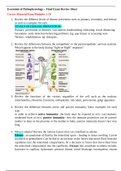
NUR2063/ PATHOPHYSI NUR2063 SE Essentials of Pathophysiology – Final Exam Review Sheet Covers Material from Modules 2021 solution rasmussen collage 1-10 ⦁ Review the different levels of disease prevention such as primary, secondary, and tertiary as well as examples for each. LEVELS OF DISEASE PREVENTION- Primary- prevention of diseases- vaccination, handwashing, educating, social distancing Secondary- early detection before big problems. Eg- pap Smear or screening tests Tertiary- rehabilitation- eg- therapies. ⦁ Review the differences between the sympathetic vs the parasympathetic nervous systems. What happens to the body during “fight-or-flight” response? ⦁ Review the functions of the various organelles of the cell such as the nucleus, mitochondria, ribosome, lysosome, endoplasmic reticulum, peroxisome, golgi apparatus ⦁ Review the difference between active and passive immunity, know examples for each type. in order to achieve active immunity- the body must be exposed to m/o- vaccinations- weakened form of m/o. passive immunity- how the immune protection can be passed- mother to fetus in the placenta or the mother to baby. passive immunity doesn’t last very long. ⦁ What is edema? Review the various factors that can contribute to edema. Edema - accumulation of fluid in the interstitial space - leading to tissue swelling. Can be localized or generalized. Can be due to an increase in the forces that move fluid from the capillaries into the interstitial compartment. Or a decrease in forces that move fluid from the interstitial compartment into the capillaries. Factors that contribute to edema include: Increases in capillary hydrostatic pressure (blood vessel blockage, incompetent venous valves), Increased capillary permeability (inflammation),Congestive heart failure, High blood volume or HTN, Decrease in plasma proteins (such as albumin), Blockage of lymphatic drainage (due to cancer or removal of lymph tissue) ⦁ What is a hypersensitivity? Review the four different types of hypersensitivities: Type I (Anaphylactic), Type II (Cytotoxic), Type III (Immune complex), Type IV (Delayed cell- mediated). Know examples and mediating factors for each type. Too much activation of immune system is hypersensitivity. Type I- IgE, Type II- IgG and IgM, Type III- IgG, Type IV- T- cells. ⦁ Review the differences between benign and malignant tumors. Benign- encapsulated, localized, grows slowly and usually and doesn’t invade, doesn’t usually reoccur after treatment. Malignant- not capsulated, spread, all over body, grows fast, can reoccur. ⦁ Review signs and symptoms of peptic ulcer disease. Signs and symptoms are- pain on empty stomach or 2-3 hours after eating when food moves from stomach to large intestine where the ulcers are. H. Pylori thrives in acidic conditions and breaks down the lining and causes the ulcers to bleed. ⦁ Review differences between functional and mechanical bowel obstructions, know examples for each Inability to move stool. Functional obs- somethings that stops the peristalsis movement of the intestine- paralytic ileus. Causes of functional obs- certain medications like anticholinergics- it activates the flight or fight and person can’t poop, pee, spit or see. Poop and pee due to digestive and genitourinary system is slowed down, and salivary glands stop producing saliva and hence dry mouth and can’t see due to pupil dilation. Opioids and low fiber diet also cause functional obs. Mechanical obs- adhesions, hernia, tumor, impacted feces, volvulus and intussusception (something that blocks the intestinal track. ⦁ Review signs and symptoms of appendicitis. How do we assess for this condition? Appendicitis- inflammation in the vermiform appendix. S/S- RLQ pain and tenderness, nausea, vomiting, fever, diarrhea and systemic signs of inflammation ⦁ Review signs and symptoms of liver disease. Review complications of liver disease such as ascites, hepatic encephalopathy and esophageal varices. How are esophageal varices managed/treated? Jaundice- green/yellow skin due to bilirubin due to impaired bilirubin metabolism. Ascites- accumulation of fluid in peritoneal cavity due to portal hypertension and hypoalbuminemia. Check total protein and albumin and fluid examination. Hepatic Encephalopathy- neuropsychiatric syndrome from too much ammonia. S/s- dementia, asterixis, mild confusion and lethargy to stupor and coma. Cirrhosis- end stage liver disease- irreversible- acute, chronic and toxic hepatitis, metal storage disease and alcoholism. Esophageal Varices- dilated blood vessels in the esophagus. Can rupture due to high blood pressure. We must reduce blood pressure to manage it and put rubber bands to control bleeding when it ruptures. ⦁ What role does albumin play in the blood? What happens to albumin production with liver failure? -Removes excess fluid and waste products, maintains pH, CVA tenderness, GFR. ...............COMPLETE DOCUMENT DOWNLOAD FOR A+ SCORE
Written for
- Institution
-
Rasmussen College
- Course
-
NUR2063 (NUR2063)
Document information
- Uploaded on
- March 16, 2021
- Number of pages
- 13
- Written in
- 2020/2021
- Type
- Other
- Person
- Unknown
Subjects
- nur2063
-
nur2063 pathophysi nur2063 se essentials of pathophysiology – final exam review sheet covers material from modules 2021 solution rasmussen collage
-
⦁ review the different levels of disease pr

Also available in package deal