

Nayim Mohammed
A Series of Missed Opportunities?
Taking a Closer Look at Détente during
the Cold War.
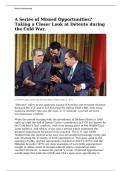
Leonid Brezhnev (left) and Richard Nixon (right) talks in 1973.
“Détente” refers to the apparent easing of hostility and strained relations
between the U.S. and U.S.S.R during the period 1969-1980. This essay
explores whether this was the case, or if “détente” covered up more
inconspicuous conflicts.
While the period starting with the presidency of Richard Nixon in 1969
right up until the end of Jimmy Carter’s presidency in 1979 are known for
the Cold War’s ‘hot’ conflicts, with wars taking place in the Middle East,
Latin America, and Africa, it was also a period which witnessed the
greatest opportunity for peace to be reached. The U.S. and USSR
realised that the nuclear arms race was becoming increasingly costly and
was straining the economy of both superpowers. This gave arise to the
opening of talks, and the agreements reached at SALT I (1972) and the
Helsinki Accords (1975) are clear examples of were both superpowers
sought to utilise areas of mutual interest where cooperation were
reached. However, to deem the period ‘a series of missed opportunities’
would imply that both the USSR and USA’s aims were specifically to
A Series of Missed Opportunities?
Taking a Closer Look at Détente during
the Cold War.
Leonid Brezhnev (left) and Richard Nixon (right) talks in 1973.
“Détente” refers to the apparent easing of hostility and strained relations
between the U.S. and U.S.S.R during the period 1969-1980. This essay
explores whether this was the case, or if “détente” covered up more
inconspicuous conflicts.
While the period starting with the presidency of Richard Nixon in 1969
right up until the end of Jimmy Carter’s presidency in 1979 are known for
the Cold War’s ‘hot’ conflicts, with wars taking place in the Middle East,
Latin America, and Africa, it was also a period which witnessed the
greatest opportunity for peace to be reached. The U.S. and USSR
realised that the nuclear arms race was becoming increasingly costly and
was straining the economy of both superpowers. This gave arise to the
opening of talks, and the agreements reached at SALT I (1972) and the
Helsinki Accords (1975) are clear examples of were both superpowers
sought to utilise areas of mutual interest where cooperation were
reached. However, to deem the period ‘a series of missed opportunities’
would imply that both the USSR and USA’s aims were specifically to


