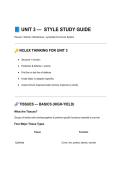
📘 UNIT 3 — STYLE STUDY GUIDE
Tissues • Glands • Membranes • Lymphatic & Immune System
🔑 NCLEX THINKING FOR UNIT 3
● Structure = function
● Protection & defense = priority
● First line vs last line of defense
● Innate (fast) vs adaptive (specific)
● Acute immune response beats memory response in priority
🧬 TISSUES — BASICS (HIGH-YIELD)
What Are Tissues?
Groups of similar cells working together to perform specific functions essential to survival.
Four Major Tissue Types
Tissue Function
Epithelial Cover, line, protect, absorb, secrete
, Connective Support, connect, transport, defend
Muscle Contract to produce movement
Nervous Transmit electrical signals
📌 NCLEX Tip: Damage to epithelial tissue → ↑ infection risk
🧫 EPITHELIAL TISSUE (VERY HIGH-YIELD)
Key Features
● Closely packed cells
● Avascular (no blood vessels)
● Anchored by basement membrane
● Free surface
● Rapid regeneration
Functions
● Protection
● Absorption
● Filtration
● Secretion
Tissues • Glands • Membranes • Lymphatic & Immune System
🔑 NCLEX THINKING FOR UNIT 3
● Structure = function
● Protection & defense = priority
● First line vs last line of defense
● Innate (fast) vs adaptive (specific)
● Acute immune response beats memory response in priority
🧬 TISSUES — BASICS (HIGH-YIELD)
What Are Tissues?
Groups of similar cells working together to perform specific functions essential to survival.
Four Major Tissue Types
Tissue Function
Epithelial Cover, line, protect, absorb, secrete
, Connective Support, connect, transport, defend
Muscle Contract to produce movement
Nervous Transmit electrical signals
📌 NCLEX Tip: Damage to epithelial tissue → ↑ infection risk
🧫 EPITHELIAL TISSUE (VERY HIGH-YIELD)
Key Features
● Closely packed cells
● Avascular (no blood vessels)
● Anchored by basement membrane
● Free surface
● Rapid regeneration
Functions
● Protection
● Absorption
● Filtration
● Secretion