No Subject
From: Heather Dercksen | Sunday 14 Mar, 12:58
To:
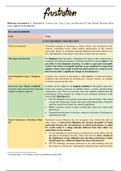
Describe and evaluate the behaviourist approach (16)
describe = AO1 =6 marks = 6 individual points
evaluate = AO3 10 marks = judge from avaible evidence
Behaviourist psychologists believe that behaviour is best explained by the role of the environment. They
follow 4 assumptions when conducting research. The first is that anything worth researching must be
observable and measurable. The second is tabula rasa, which means that all humans and are born as
blank slates. The third is that humans and animals learn n the same way. The final asumption is that
learning occurs through 2 types of conditioning, classical and operant.
Classical conditioning is learning through association, Pavlov conducted a study whereby he was able to
condition dogs to salavate (conditioned response) upon hearing a bell (neutral stimulus). Prior to
conditioning the dogs natural response was towards the food and after the conditioning the dog
associated the food with the bell and salivated.
Operant conditioning was researched by B.S. Skinner, where learning occurs through rewards and
punishment. Skinner's Box was used as well as rats to understand if animals (specifically rats) learned
behaviour through positive and negative reinforcement and punishment. Positive reinforcement refers to
adding something to increase the liklihood of a desired behaviour (example) Negative reinforcement is
taking away something to increase the likelihood of a desoyred behaviour (example). Finally punishment
is used to reduce undesired behaviours (example).
Classical conditioning has been applied to therapy. This is a strength as it was used to develop phobia
treatments which brings about positive change. Systematic desensitisation is a therapy based on
classical conditioning it works by eliminating the learned anxious response that is associated with the
feared object or the situation. It's then possible to eliminate the learned response by replacing it with
another so the patient is no longer on anxious in the presence of the object or situation thus has proven
effective for a range of phobias such as arachnophobia.
From: Heather Dercksen | Sunday 14 Mar, 12:58
To:
Describe and evaluate the behaviourist approach (16)
describe = AO1 =6 marks = 6 individual points
evaluate = AO3 10 marks = judge from avaible evidence
Behaviourist psychologists believe that behaviour is best explained by the role of the environment. They
follow 4 assumptions when conducting research. The first is that anything worth researching must be
observable and measurable. The second is tabula rasa, which means that all humans and are born as
blank slates. The third is that humans and animals learn n the same way. The final asumption is that
learning occurs through 2 types of conditioning, classical and operant.
Classical conditioning is learning through association, Pavlov conducted a study whereby he was able to
condition dogs to salavate (conditioned response) upon hearing a bell (neutral stimulus). Prior to
conditioning the dogs natural response was towards the food and after the conditioning the dog
associated the food with the bell and salivated.
Operant conditioning was researched by B.S. Skinner, where learning occurs through rewards and
punishment. Skinner's Box was used as well as rats to understand if animals (specifically rats) learned
behaviour through positive and negative reinforcement and punishment. Positive reinforcement refers to
adding something to increase the liklihood of a desired behaviour (example) Negative reinforcement is
taking away something to increase the likelihood of a desoyred behaviour (example). Finally punishment
is used to reduce undesired behaviours (example).
Classical conditioning has been applied to therapy. This is a strength as it was used to develop phobia
treatments which brings about positive change. Systematic desensitisation is a therapy based on
classical conditioning it works by eliminating the learned anxious response that is associated with the
feared object or the situation. It's then possible to eliminate the learned response by replacing it with
another so the patient is no longer on anxious in the presence of the object or situation thus has proven
effective for a range of phobias such as arachnophobia.