
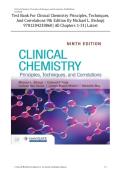
Clinical Chemistry: Principles, Techniques, and Correlations, Ninth Edition
Test bank
Test Bank For Clinical Chemistry Principles, Techniques,
And Correlations 9th Edition By Michael L. Bishop|
9781284238860| All Chapters 1-31| Latest
© Jones & Bartlett Learning, LLC, an Ascend Learning Company 2-1
,Clinical Chemistry: Principles, Techniques, and Correlations, Ninth Edition
Test bank
Table Of Contents
1. Chapter 1 Basic Principles And Practices Of Clinical Chemistry
2. Chapter 2 Laboratory Safety And Regulations
3. Chapter 3 Quality Management In The Clinical Laboratory
4. Chapter 4 Analytic Techniques
5. Chapter 5 Clinical Chemistry Automation
6. Chapter 6 Proteins And Heme Derivatives
7. Chapter 7 Nonprotein Nitrogen Compounds
8. Chapter 8 Enzymes
9. Chapter 9 Carbohydrates
10. Chapter 10 Lipids And Lipoproteins
11. Chapter 11 Electrolytes
12. Chapter 12 Blood Gases, Ph, And Buffer Systems
13. Chapter 13 Basic Endocrinology
14. Chapter 14 Thyroid Function
15. Chapter 15 Hypothalamic And Pituitary Function
16. Chapter 16 Adrenal Function
17. Chapter 17 Gonadal Function
18. Chapter 18 Parathyroid Function
19. Chapter 19 Liver Function
20. Chapter 20 Cardiac Function
21. Chapter 21 Renal Function
22. Chapter 22 Pancreatic Function
23. Chapter 23 Body Fluid Analysis
24. Chapter 24 Pregnancy And Prenatal Testing
25. Chapter 25 Therapeutic Drug Monitoring
26. Chapter 26 Toxicology
27. Chapter 27 Trace Elements, Toxic Elements, And Vitamins
28. Chapter 28 Tumor Markers
29. Chapter 29 Point-Of-Care Testing
30. Chapter 30 Newborn And Pediatric Clinical Chemistry
31. Chapter 31 Geriatric Clinical Chemistry
chapter: chapter 01 – test bank
© Jones & Bartlett Learning, LLC, an Ascend Learning Company 2-2
, Clinical Chemistry: Principles, Techniques, and Correlations, Ninth Edition
Test bank
multiple choice
1. one nanogram is equivalent to how many grams?
A ) 10-6
B ) 10-9
C) 10-12
D) 10-15
ANS: b complexity: rl2
ahead: units of measure
subject: chapter 1
title: basic principles and practices of clinical chemistry
2. how many milliliters of 0.5n naoh are required to make 100 milliliters of 0.2n naoh?
A ) 250
B ) 40
C) 25
D) 4
ANS: b complexity: rl2
ahead: laboratory mathematics and calculations
subject: chapter 1
title: basic principles and practices of clinical chemistry
3. a patient sample for uric acid gave an absorbance reading of 0.4, and the 50 mg/dl standard gave an
absorbance reading of 0.1. what is the concentration of uric acid in the patient's sample in grams per
deciliter?
A ) 0.2
B ) 12.5
C) 125
D) 200
ANS: d complexity: rl2
ahead: laboratory mathematics and calculations
subject: chapter 1
title: basic principles and practices of clinical chemistry
4. how many millimoles of nacl are contained in 300 ml of a 4m solution? (gmw = 58.5)
A ) 70
B ) 120
C) 234
D) 1200
ANS: d complexity: rl2
ahead: laboratory mathematics and calculations
subject: chapter 1
title: basic principles and practices of clinical chemistry
5. how is 10 mg/dl of calcium reported in mmol/l? (gmw = 40)
A ) 2.5
B ) 5.0
C) 10
© Jones & Bartlett Learning, LLC, an Ascend Learning Company 2-3
, Clinical Chemistry: Principles, Techniques, and Correlations, Ninth Edition
Test bank
D) 25
ANS: a complexity: rl2
ahead: laboratory mathematics and calculations
subject: chapter 1
title: basic principles and practices of clinical chemistry
6. how many milliliters of concentrated sulfuric acid (h2s04), g.m.w. = 98 grams, specific gravity = 1.500,
purity = 80%, are needed to make 400 ml of a 2n solution?
A ) 26.1
B ) 32.7
C) 52.3
D) 65.3
ANS: b complexity: rl2
ahead: laboratory mathematics and calculations
subject: chapter 1
title: basic principles and practices of clinical chemistry
7. how many grams of hydrated mgso4 5 h20 (m.w.: mgso4 = 119, h20 = 18) are required to make a
10% solution of mgs04?
A ) 5.7 g/dl
B ) 11.9 g/dl
C) 17.6 g/dl
20.9 g/dl ANS: c complexity: rl2
ahead: laboratory mathematics and calculations
subject: chapter 1
title: basic principles and practices of clinical chemistry
8. what is the molarity (m) of a 4% solution of sodium hydroxide (naoh)? m.w: na = 23, o = 16, h = 1.
A ) 0.1m
B ) 0.25m
C) 1.0m
D) 2.5m
ANS: c complexity: rl2
ahead: laboratory mathematics and calculations
subject: chapter 1
title: basic principles and practices of clinical chemistry
9. 3 mg/dl is equivalent to how many grams per liter?
A ) 0.003
B ) 0.03
C) 0.3
D) 3
ANS: b complexity: rl2
ahead: units of measure
subject: chapter 1
title: basic principles and practices of clinical chemistry
10. what is the normality of a solution containing 4.5 grams of bacl 2 in 400 ml? (gmw = 208)
A ) 1.10
B ) 0.50
© Jones & Bartlett Learning, LLC, an Ascend Learning Company 2-4
Test bank
Test Bank For Clinical Chemistry Principles, Techniques,
And Correlations 9th Edition By Michael L. Bishop|
9781284238860| All Chapters 1-31| Latest
© Jones & Bartlett Learning, LLC, an Ascend Learning Company 2-1
,Clinical Chemistry: Principles, Techniques, and Correlations, Ninth Edition
Test bank
Table Of Contents
1. Chapter 1 Basic Principles And Practices Of Clinical Chemistry
2. Chapter 2 Laboratory Safety And Regulations
3. Chapter 3 Quality Management In The Clinical Laboratory
4. Chapter 4 Analytic Techniques
5. Chapter 5 Clinical Chemistry Automation
6. Chapter 6 Proteins And Heme Derivatives
7. Chapter 7 Nonprotein Nitrogen Compounds
8. Chapter 8 Enzymes
9. Chapter 9 Carbohydrates
10. Chapter 10 Lipids And Lipoproteins
11. Chapter 11 Electrolytes
12. Chapter 12 Blood Gases, Ph, And Buffer Systems
13. Chapter 13 Basic Endocrinology
14. Chapter 14 Thyroid Function
15. Chapter 15 Hypothalamic And Pituitary Function
16. Chapter 16 Adrenal Function
17. Chapter 17 Gonadal Function
18. Chapter 18 Parathyroid Function
19. Chapter 19 Liver Function
20. Chapter 20 Cardiac Function
21. Chapter 21 Renal Function
22. Chapter 22 Pancreatic Function
23. Chapter 23 Body Fluid Analysis
24. Chapter 24 Pregnancy And Prenatal Testing
25. Chapter 25 Therapeutic Drug Monitoring
26. Chapter 26 Toxicology
27. Chapter 27 Trace Elements, Toxic Elements, And Vitamins
28. Chapter 28 Tumor Markers
29. Chapter 29 Point-Of-Care Testing
30. Chapter 30 Newborn And Pediatric Clinical Chemistry
31. Chapter 31 Geriatric Clinical Chemistry
chapter: chapter 01 – test bank
© Jones & Bartlett Learning, LLC, an Ascend Learning Company 2-2
, Clinical Chemistry: Principles, Techniques, and Correlations, Ninth Edition
Test bank
multiple choice
1. one nanogram is equivalent to how many grams?
A ) 10-6
B ) 10-9
C) 10-12
D) 10-15
ANS: b complexity: rl2
ahead: units of measure
subject: chapter 1
title: basic principles and practices of clinical chemistry
2. how many milliliters of 0.5n naoh are required to make 100 milliliters of 0.2n naoh?
A ) 250
B ) 40
C) 25
D) 4
ANS: b complexity: rl2
ahead: laboratory mathematics and calculations
subject: chapter 1
title: basic principles and practices of clinical chemistry
3. a patient sample for uric acid gave an absorbance reading of 0.4, and the 50 mg/dl standard gave an
absorbance reading of 0.1. what is the concentration of uric acid in the patient's sample in grams per
deciliter?
A ) 0.2
B ) 12.5
C) 125
D) 200
ANS: d complexity: rl2
ahead: laboratory mathematics and calculations
subject: chapter 1
title: basic principles and practices of clinical chemistry
4. how many millimoles of nacl are contained in 300 ml of a 4m solution? (gmw = 58.5)
A ) 70
B ) 120
C) 234
D) 1200
ANS: d complexity: rl2
ahead: laboratory mathematics and calculations
subject: chapter 1
title: basic principles and practices of clinical chemistry
5. how is 10 mg/dl of calcium reported in mmol/l? (gmw = 40)
A ) 2.5
B ) 5.0
C) 10
© Jones & Bartlett Learning, LLC, an Ascend Learning Company 2-3
, Clinical Chemistry: Principles, Techniques, and Correlations, Ninth Edition
Test bank
D) 25
ANS: a complexity: rl2
ahead: laboratory mathematics and calculations
subject: chapter 1
title: basic principles and practices of clinical chemistry
6. how many milliliters of concentrated sulfuric acid (h2s04), g.m.w. = 98 grams, specific gravity = 1.500,
purity = 80%, are needed to make 400 ml of a 2n solution?
A ) 26.1
B ) 32.7
C) 52.3
D) 65.3
ANS: b complexity: rl2
ahead: laboratory mathematics and calculations
subject: chapter 1
title: basic principles and practices of clinical chemistry
7. how many grams of hydrated mgso4 5 h20 (m.w.: mgso4 = 119, h20 = 18) are required to make a
10% solution of mgs04?
A ) 5.7 g/dl
B ) 11.9 g/dl
C) 17.6 g/dl
20.9 g/dl ANS: c complexity: rl2
ahead: laboratory mathematics and calculations
subject: chapter 1
title: basic principles and practices of clinical chemistry
8. what is the molarity (m) of a 4% solution of sodium hydroxide (naoh)? m.w: na = 23, o = 16, h = 1.
A ) 0.1m
B ) 0.25m
C) 1.0m
D) 2.5m
ANS: c complexity: rl2
ahead: laboratory mathematics and calculations
subject: chapter 1
title: basic principles and practices of clinical chemistry
9. 3 mg/dl is equivalent to how many grams per liter?
A ) 0.003
B ) 0.03
C) 0.3
D) 3
ANS: b complexity: rl2
ahead: units of measure
subject: chapter 1
title: basic principles and practices of clinical chemistry
10. what is the normality of a solution containing 4.5 grams of bacl 2 in 400 ml? (gmw = 208)
A ) 1.10
B ) 0.50
© Jones & Bartlett Learning, LLC, an Ascend Learning Company 2-4


