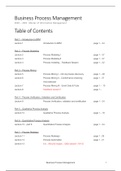
Business Process Management
2020 – 2021 Master of Information Management
Table of Contents
Part 1 – Introduction to BPM
Lecture 1 Introduction to BPM page 1 – 24
Part 2 – Process Modelling
Lecture 2 Process Modeling I page 1 – 37
Lecture 3 Process Modeling II page 1 – 27
Lecture 4 Process modeling – Feedback Session page 1 – 22
Part 3 – Process Mining
Lecture 5 Process Mining I – intro & process discovery page 1 – 48
Lecture 6 Process Mining II – Conformance checking page 1 - 37
And extension
Lecture 7 Process Mining III – Event Data & Tools page 1 – 10
Lecture 8 Feedback session? page 1 –
Part 4 – Process Verification, Validation and Certification
Lecture 9 Process Verification, validation and certification page 1 – 24
Part 5 – Qualitative Process Analysis
Lecture 10 Qualitative Process Analysis page 1 – 18
Part 6 – Quantitative Process Analysis
Lecture 10 – part 6 Quantitative Process Analysis page 1 – 24
Part 7 – Process Redesign
Lecture 11 Process Redesign page 1 - 29
Lecture 12 Process Automation page 1 - 21
Lecture 12 live – lifecycle stages – Q&A session (10/12)
Business Process Management 1
,Lecture 1 - Introduction to BPM
Lecture overview
× The world of Business Process Management (BPM)
× The BPM lifecycle
× Process discovery: as-is process modelling
1. The world of BPM
1.1. Business Process Management: What is it?
× Body of principles, methods and tools to design, analyze, execute and monitor business
processes
Organisations are structured in a way that all their activities are to some extent syncronised and managed. Concept of
a business process: organisations run business processess in order to execute the ultimate strategic goals of the
organisation. Fundamental building block of organisations. A lot of organisations have dedicated teams & people
available to manage and optimize these processes. Combines all these tools/techniques that deal with business
processess. Ultimate goal: improve the processes, more efficient and effective. Domain that has grown over time.
Because of the digitalisation, a lot of organisations think more about their business processes via digital.
Business Process Management 2
, 1.2. Why BPM?
“The first rule of any technology used in a business is that automation applied to an efficient
operation will magnify the efficiency.
The second is that automation applied to an inefficient operation will magnify the inefficiency.”
Important: business process management is not only about automation!!!
True that for a lot of BPM projects, efficiency & gains are being realised with increased digitalisation/automation. Not a
guarantee that automation will lead to more efficiency.
Bill gates: think further to improve its efficiency. Organising the work in better ways.
Change BPs, change how we execute them. Not only to existing processes.
Business Process Management 3
, 1.3. How to engage in BPM?
Distinction between 2 ways of adopting BPM in organisations.
CPI: incremental improvements. Have some kind of maturity in terms of BPM. BPM projects here are typically CPI.
Which measures (typ. Small) will help to improve efficiency & effectiveness of processes.
BPR: more drastic. Still use the BPM methodology, but re-engineer the BPM. Start from scratch. Build up how they
are organised from nothing. Fundamental approach. Don’t stick to certain assumptions & rules in an organisation.
Organisations that are in financial probs for example.
1.4. Our phenomena of interest: Business processes
× Collection of related events, activities and decisions, that involve a number of actors and
objects, and that collectively lead to an outcome that is of value to an organization or its
customers.
× Examples:
• Order-to-Cash
• Quote-to-Order
• Procure-to-Pay
• Application-to-Approval
• Fault-to-Resolution (Issue-to-Resolution)
• Claim-to-Settlement
“If it does not make at least three people mad, it’s not a process.”
Business Process Management 4
2020 – 2021 Master of Information Management
Table of Contents
Part 1 – Introduction to BPM
Lecture 1 Introduction to BPM page 1 – 24
Part 2 – Process Modelling
Lecture 2 Process Modeling I page 1 – 37
Lecture 3 Process Modeling II page 1 – 27
Lecture 4 Process modeling – Feedback Session page 1 – 22
Part 3 – Process Mining
Lecture 5 Process Mining I – intro & process discovery page 1 – 48
Lecture 6 Process Mining II – Conformance checking page 1 - 37
And extension
Lecture 7 Process Mining III – Event Data & Tools page 1 – 10
Lecture 8 Feedback session? page 1 –
Part 4 – Process Verification, Validation and Certification
Lecture 9 Process Verification, validation and certification page 1 – 24
Part 5 – Qualitative Process Analysis
Lecture 10 Qualitative Process Analysis page 1 – 18
Part 6 – Quantitative Process Analysis
Lecture 10 – part 6 Quantitative Process Analysis page 1 – 24
Part 7 – Process Redesign
Lecture 11 Process Redesign page 1 - 29
Lecture 12 Process Automation page 1 - 21
Lecture 12 live – lifecycle stages – Q&A session (10/12)
Business Process Management 1
,Lecture 1 - Introduction to BPM
Lecture overview
× The world of Business Process Management (BPM)
× The BPM lifecycle
× Process discovery: as-is process modelling
1. The world of BPM
1.1. Business Process Management: What is it?
× Body of principles, methods and tools to design, analyze, execute and monitor business
processes
Organisations are structured in a way that all their activities are to some extent syncronised and managed. Concept of
a business process: organisations run business processess in order to execute the ultimate strategic goals of the
organisation. Fundamental building block of organisations. A lot of organisations have dedicated teams & people
available to manage and optimize these processes. Combines all these tools/techniques that deal with business
processess. Ultimate goal: improve the processes, more efficient and effective. Domain that has grown over time.
Because of the digitalisation, a lot of organisations think more about their business processes via digital.
Business Process Management 2
, 1.2. Why BPM?
“The first rule of any technology used in a business is that automation applied to an efficient
operation will magnify the efficiency.
The second is that automation applied to an inefficient operation will magnify the inefficiency.”
Important: business process management is not only about automation!!!
True that for a lot of BPM projects, efficiency & gains are being realised with increased digitalisation/automation. Not a
guarantee that automation will lead to more efficiency.
Bill gates: think further to improve its efficiency. Organising the work in better ways.
Change BPs, change how we execute them. Not only to existing processes.
Business Process Management 3
, 1.3. How to engage in BPM?
Distinction between 2 ways of adopting BPM in organisations.
CPI: incremental improvements. Have some kind of maturity in terms of BPM. BPM projects here are typically CPI.
Which measures (typ. Small) will help to improve efficiency & effectiveness of processes.
BPR: more drastic. Still use the BPM methodology, but re-engineer the BPM. Start from scratch. Build up how they
are organised from nothing. Fundamental approach. Don’t stick to certain assumptions & rules in an organisation.
Organisations that are in financial probs for example.
1.4. Our phenomena of interest: Business processes
× Collection of related events, activities and decisions, that involve a number of actors and
objects, and that collectively lead to an outcome that is of value to an organization or its
customers.
× Examples:
• Order-to-Cash
• Quote-to-Order
• Procure-to-Pay
• Application-to-Approval
• Fault-to-Resolution (Issue-to-Resolution)
• Claim-to-Settlement
“If it does not make at least three people mad, it’s not a process.”
Business Process Management 4