Primer
DEEL 3: Zelfstudie (primer to the nervous system)
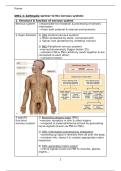
1. Structure & function of nervous system
Nervous system =responsible for reception & processing of sensory
information
->from both external & internal environments
2 major divisions 1) CNS (Central nervous system)
1. Brain (protected by skull), connected with:
2. Spinal cord (protected by vertebral column)
2) PNS (Peripheral nervous system)
=nerves/zenuwvezels (liggen buiten ZS)
->division CNS & PNS=arbitrary (work together & are
connected to each other)
->sensoric/motoric
3 specific 1) Receiving sensory input (PNS)
functions >sensory receptors in skin & other organs
nervous system ->respond to external/internal stimuli by generating
nerve signals (travel via PNS to CNS)
2) CNS: information processing & integration
~summing up input it receives from all over the body
->reviews info, stores it & creates appropriate motor
responses
3) CNS: generates motor output
->nerve signals travel via PNS to muscles, glands,
organs…
1
,Primer
Sensorische 1. Somatisch (signalen van huid, spieren, zintuigen)
/afferente vezels 2. Visceraal (signalen van inwendige organen)
Motorische 1. Somatisch: vrijwillig
/efferente vezels ~signalen naar skeletspieren
2. Autonoom: ongecontroleerd
~signalen naar smooth muscle, hartspier, klieren
->sympatisch (fight/flight)
->parasympatisch (rest/digest)
2. Nervous tissue
2 types of cells 1. Neurons
~communication within NS via nerve impulses
2. Neuroglia (glial cells)
~support & nourish neurons
->outnumber neurons by many!
Types of 1) Microglia
neuroglia =phagocytic cells: help remove bacteria & debris
(fagocyten, verwijderen pathogenen & afval)
2) Astrocytes
=provide metabolic & structural support directly to
neurons
3) Tightly spiraled neuroglia that form myelin sheaths
1. Schwann cells (in PNS)
->gaps between myelin=nodes of Ranvier
->1 schwann cell myeliniseert 1 deel vana xon
2. Oligodendrocytes (in CNS)
->1 olig. myeliniseert 1 deel v/meerdere axonen
3. Neuron anatomy
3 types of ~classified according to function
neurons 1) Sensory neurons
2) Interneurons
3) Motor neurons
->neurons vary in appearance but all have cell body,
dendrites & axon
Sensory neurons ~in PNS: takes signals from sensory receptors &
transports them to CNS
->sensory receptors =special structures that detect
changes in the environment
Interneuron ~in CNS:
1. Receive sensory input from sensory neurons (&
2
, Primer
other interneurons)
2. Sum up all information received
3. Communicate with motor neurons
Motor neurons ~take nerve impulses away from CNS to an effector
->effectors carry out responses to environmental
changes (both external & internal)
Dendrites =short extensions: receive signals from sensory
receptors or other neurons
->incoming signals from dendrites can result in nerve
signals (which are then conducted by an axon)
Cell body ~contains nucleus & other organelles
Axon =part of neuron that conducts nerve impulses
->can be very long
->individual axons=nerve fibers (collectively they
form a nerve)
->many axons are surrounded by myelin sheath
Carrying nerve Sensory neurons
signals ->very long axon carries nerve signals from dendrites
(associated with a sensory receptor) to CNS
->this axon is interrupted by cell body
Inter- & motor neurons
->multiple dendrites take signals to cell body
->then axon conducts nerve signals away from soma
Myelin sheath =membranes of schwann cells (PNS) or
oligodendrocytes (CNS) that are wrapped around an
axon many times
->long axons usually have myelin sheath (short
axons don’t)
1. Nodes of Ranvier =gasps with no myelin sheath
2. Important role in speed of transmission (rate at
which signals move through neuron)
3. Important role in nerve generation in PNS (zenuwen
herstellen)
->if axon is severed: myelin sheath remains & serves
as a passageway for new fiber growth (nieuwe vezels)
4. Aandoening multiple sclerose: afbraak myeline (te
veel)
Colours of Gray matter in CNS: gray because contains no
3
DEEL 3: Zelfstudie (primer to the nervous system)
1. Structure & function of nervous system
Nervous system =responsible for reception & processing of sensory
information
->from both external & internal environments
2 major divisions 1) CNS (Central nervous system)
1. Brain (protected by skull), connected with:
2. Spinal cord (protected by vertebral column)
2) PNS (Peripheral nervous system)
=nerves/zenuwvezels (liggen buiten ZS)
->division CNS & PNS=arbitrary (work together & are
connected to each other)
->sensoric/motoric
3 specific 1) Receiving sensory input (PNS)
functions >sensory receptors in skin & other organs
nervous system ->respond to external/internal stimuli by generating
nerve signals (travel via PNS to CNS)
2) CNS: information processing & integration
~summing up input it receives from all over the body
->reviews info, stores it & creates appropriate motor
responses
3) CNS: generates motor output
->nerve signals travel via PNS to muscles, glands,
organs…
1
,Primer
Sensorische 1. Somatisch (signalen van huid, spieren, zintuigen)
/afferente vezels 2. Visceraal (signalen van inwendige organen)
Motorische 1. Somatisch: vrijwillig
/efferente vezels ~signalen naar skeletspieren
2. Autonoom: ongecontroleerd
~signalen naar smooth muscle, hartspier, klieren
->sympatisch (fight/flight)
->parasympatisch (rest/digest)
2. Nervous tissue
2 types of cells 1. Neurons
~communication within NS via nerve impulses
2. Neuroglia (glial cells)
~support & nourish neurons
->outnumber neurons by many!
Types of 1) Microglia
neuroglia =phagocytic cells: help remove bacteria & debris
(fagocyten, verwijderen pathogenen & afval)
2) Astrocytes
=provide metabolic & structural support directly to
neurons
3) Tightly spiraled neuroglia that form myelin sheaths
1. Schwann cells (in PNS)
->gaps between myelin=nodes of Ranvier
->1 schwann cell myeliniseert 1 deel vana xon
2. Oligodendrocytes (in CNS)
->1 olig. myeliniseert 1 deel v/meerdere axonen
3. Neuron anatomy
3 types of ~classified according to function
neurons 1) Sensory neurons
2) Interneurons
3) Motor neurons
->neurons vary in appearance but all have cell body,
dendrites & axon
Sensory neurons ~in PNS: takes signals from sensory receptors &
transports them to CNS
->sensory receptors =special structures that detect
changes in the environment
Interneuron ~in CNS:
1. Receive sensory input from sensory neurons (&
2
, Primer
other interneurons)
2. Sum up all information received
3. Communicate with motor neurons
Motor neurons ~take nerve impulses away from CNS to an effector
->effectors carry out responses to environmental
changes (both external & internal)
Dendrites =short extensions: receive signals from sensory
receptors or other neurons
->incoming signals from dendrites can result in nerve
signals (which are then conducted by an axon)
Cell body ~contains nucleus & other organelles
Axon =part of neuron that conducts nerve impulses
->can be very long
->individual axons=nerve fibers (collectively they
form a nerve)
->many axons are surrounded by myelin sheath
Carrying nerve Sensory neurons
signals ->very long axon carries nerve signals from dendrites
(associated with a sensory receptor) to CNS
->this axon is interrupted by cell body
Inter- & motor neurons
->multiple dendrites take signals to cell body
->then axon conducts nerve signals away from soma
Myelin sheath =membranes of schwann cells (PNS) or
oligodendrocytes (CNS) that are wrapped around an
axon many times
->long axons usually have myelin sheath (short
axons don’t)
1. Nodes of Ranvier =gasps with no myelin sheath
2. Important role in speed of transmission (rate at
which signals move through neuron)
3. Important role in nerve generation in PNS (zenuwen
herstellen)
->if axon is severed: myelin sheath remains & serves
as a passageway for new fiber growth (nieuwe vezels)
4. Aandoening multiple sclerose: afbraak myeline (te
veel)
Colours of Gray matter in CNS: gray because contains no
3