Psych NP Review
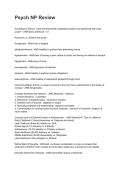
According to Erikson, what developmental undertaking ought to be performed with early
youth? - ANS-Early childhood- 1-3
Autonomy vs. Shame and doubt
Acrophobia - ANS-Fear of heights
adiadochokinesia - ANS-Inability to perform fast alternating moves
Agoraphobia - ANS-Fear of having a panic attack in public and having no method of escape
Algophobia - ANS-worry of ache
anosognosia - ANS-Ignorance of infection
apraxias - ANS-Inability to perform precise obligations
astereognosis - ANS-Inability to apprehend gadgets through touch
Coherent patients that by no means receives to the point has a disturbance in the shape of
concept - ANS-Tangentality
Contrast dementia with delirium. - ANS-Dementia - Delirium
1. Chronic/insidious - acute/fast
2. Sensorium unimpaired early - sensorium clouded
3. Ordinary level of arousal - agitation or stupor
4. Normally progressive & deteriorating - regularly reversible
5. Commonplace in nursing houses & psych hospitals - common on scientific, surgical, &
neuro wards
Correctly pick out Erikson's levels of development. - ANS-Infants(0-1) Trust vs. Mistrust
Early Childhood (1-three) Autonomy vs. Disgrace and doubt
Late Childhood (three-6) Initiative vs. Guilt
School age (6-12) Industry vs. Inferiority
Adolescence (12-20) Identity vs. Position confusion
Early Adulthood (20-35) Initmacy vs. Isolation
Middle Adulthood (35-65) Generativity vs. Stagnation
Late Adulthood (>65) Intergrity vs. Despair
Define flight of thoughts - ANS-fast, continious verbalization or play on phrases that
produces a shift from one concept to some other, ideas have a tendency to be related
Describe Alzhemier's Disease - ANS-Irreversible reason of dementia
, 50-60% of degenerative dementias.
Insidious onset.
Death eight-10 yrs after symptoms recognized.
Physical findings commonly absent or present simplest in later degrees (hyperreflexia,
Babinski, frontal lobe launch signs and symptoms).
May experience illusions, hallucinations, or delusions.
Cortical atrophy, enlarged cerebral ventricles
Describe Cluster A personality problems - ANS-extraordinary, ecentric
Describe Cluster B personality disorders - ANS-dramatic, emotional, erratic
Describe Cluster C persona problems - ANS-stressful and apprehensive
Describe Deja entendu - ANS-an illusion of auditory recognition
Describe Deja pense - ANS-concerning a brand new notion as a repetition of a previous
notion
Describe deja vu - ANS-regarding a new situation as a repetition of a preceding experience
Describe identification, ego, and superego - ANS-Id: unorganized, subconscious, instinctual
Ego: changed through direct outside impacts, is rational
Supergo: spawns self-hatred, self-critism, willpower and self-recrimination
Describe Jamais vu - ANS-feeling an unfamiliarity with a familiar scenario
Describe receptive and expressive aphasia - ANS-expressive aphasia- not able to get out
what you want
receptive aphasia- unable to understand
Discuss Wernicke-Korsakoff Syndrome - ANS-1. Cognitive and memory impairment bear
after thiamine remedy for alcohol-associated amnesia.
2. Autopsy indicates hemorrhage & sclerosis of hypothalamic mamillary bodies & nuclei of
thalamus; greater diffuse lesions in brainstem, cerebellum, & limbic machine.
Discuss Wernicke's Encephalopathy - ANS-1. Alcohol-associated amnesia
2. Probably due to chronic thiamine (B1) deficiency
three. Ophthalmoplegia, ataxic gait, nystagmus, intellectual confusion
four. Calls for emergency thiamine remedy
Distinction between autism, intellectual retardation, & learning disorders? - ANS-AUTISM:
uneven profile of purposeful highbrow talents
MR: subnormal intelligence + deficits in adaptive functioning
According to Erikson, what developmental undertaking ought to be performed with early
youth? - ANS-Early childhood- 1-3
Autonomy vs. Shame and doubt
Acrophobia - ANS-Fear of heights
adiadochokinesia - ANS-Inability to perform fast alternating moves
Agoraphobia - ANS-Fear of having a panic attack in public and having no method of escape
Algophobia - ANS-worry of ache
anosognosia - ANS-Ignorance of infection
apraxias - ANS-Inability to perform precise obligations
astereognosis - ANS-Inability to apprehend gadgets through touch
Coherent patients that by no means receives to the point has a disturbance in the shape of
concept - ANS-Tangentality
Contrast dementia with delirium. - ANS-Dementia - Delirium
1. Chronic/insidious - acute/fast
2. Sensorium unimpaired early - sensorium clouded
3. Ordinary level of arousal - agitation or stupor
4. Normally progressive & deteriorating - regularly reversible
5. Commonplace in nursing houses & psych hospitals - common on scientific, surgical, &
neuro wards
Correctly pick out Erikson's levels of development. - ANS-Infants(0-1) Trust vs. Mistrust
Early Childhood (1-three) Autonomy vs. Disgrace and doubt
Late Childhood (three-6) Initiative vs. Guilt
School age (6-12) Industry vs. Inferiority
Adolescence (12-20) Identity vs. Position confusion
Early Adulthood (20-35) Initmacy vs. Isolation
Middle Adulthood (35-65) Generativity vs. Stagnation
Late Adulthood (>65) Intergrity vs. Despair
Define flight of thoughts - ANS-fast, continious verbalization or play on phrases that
produces a shift from one concept to some other, ideas have a tendency to be related
Describe Alzhemier's Disease - ANS-Irreversible reason of dementia
, 50-60% of degenerative dementias.
Insidious onset.
Death eight-10 yrs after symptoms recognized.
Physical findings commonly absent or present simplest in later degrees (hyperreflexia,
Babinski, frontal lobe launch signs and symptoms).
May experience illusions, hallucinations, or delusions.
Cortical atrophy, enlarged cerebral ventricles
Describe Cluster A personality problems - ANS-extraordinary, ecentric
Describe Cluster B personality disorders - ANS-dramatic, emotional, erratic
Describe Cluster C persona problems - ANS-stressful and apprehensive
Describe Deja entendu - ANS-an illusion of auditory recognition
Describe Deja pense - ANS-concerning a brand new notion as a repetition of a previous
notion
Describe deja vu - ANS-regarding a new situation as a repetition of a preceding experience
Describe identification, ego, and superego - ANS-Id: unorganized, subconscious, instinctual
Ego: changed through direct outside impacts, is rational
Supergo: spawns self-hatred, self-critism, willpower and self-recrimination
Describe Jamais vu - ANS-feeling an unfamiliarity with a familiar scenario
Describe receptive and expressive aphasia - ANS-expressive aphasia- not able to get out
what you want
receptive aphasia- unable to understand
Discuss Wernicke-Korsakoff Syndrome - ANS-1. Cognitive and memory impairment bear
after thiamine remedy for alcohol-associated amnesia.
2. Autopsy indicates hemorrhage & sclerosis of hypothalamic mamillary bodies & nuclei of
thalamus; greater diffuse lesions in brainstem, cerebellum, & limbic machine.
Discuss Wernicke's Encephalopathy - ANS-1. Alcohol-associated amnesia
2. Probably due to chronic thiamine (B1) deficiency
three. Ophthalmoplegia, ataxic gait, nystagmus, intellectual confusion
four. Calls for emergency thiamine remedy
Distinction between autism, intellectual retardation, & learning disorders? - ANS-AUTISM:
uneven profile of purposeful highbrow talents
MR: subnormal intelligence + deficits in adaptive functioning