
Manipulating
genomes
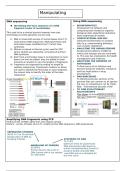
DNA sequencing Using DNA sequencing
Identifying the base sequence of a DNA BIOINFORMATICS
fragment (order of nucleotides) Development of software and
computing tools needed to organise
This used to be a manual process however now uses biological data. Algorithms/ statistical
technology so entire genomes can be read. tests mathematical models.
1) DNA is mixed with excess of normal bases (A,G,C,T), COMPUTATIONAL BIOLOGY
small primer DNA sequences, DNA polymerase and Using the bioinformatics to analyse
terminator bases (modified A,G,C,T which stop data (e.g. understanding pathways
synthesis) such as gene regulation).
2) Mixture is placed in thermal cycler used for PCR ANALYSING THE HUMAN GENOME
where strands are separated, annealing of primers, Analysing the patterns of DNA we
DNA synthesis. inherit and diseases we are vulnerable
3) Each time a terminator base is incorporated no more to. This also has implications for health
bases can then be added, they are added in lower management and medicine.
amounts at random to vary the lengths of fragments. ANALYSING THE GENOMES OF
4) Fragments are separated according to length by PATHOGENS
capillary sequencing. Fluorescent markers on bases To find source of an infection and
are used to identify the final base on each fragment, prevent spread of antibiotic resistance
the colours help to identify the order of the base and has implications in drug
(sequence). development.
DNA BARCODING
A= green / G=Yellow/ C= Blue/ T=red To identify particular sections of the
genome that are common to all species
but vary so comparisons can be made.
IBOL- “international barcode of life”
TO FIND EVOLUTIONARY
RELATIONSHIPS
This allows us to build evolutionary
trees/ phylogenetic diagrams
Amplifying DNA fragments using PCR
Produces lots of DNA copies from one original sample
Mixture : excess of bases (A,G,C,T), smaller primer DNA sequences, DNA polymerase
SEPERATING STRANDS
90-95 ® C for 30 seconds
Denaturation of DNA by
breaking H-bonds SYNTHESIS OF DNA
72-75®C
Optimum temp for polymerase
ANNEALING OF PRIMERS DNA polymerase adds bases to
55-60®C primer (complementary strand) to
Primers bind to the ends of produce double stranded DNA
DNA strands which are needed -new DNA acts as a template for
for replication the next cycle
genomes
DNA sequencing Using DNA sequencing
Identifying the base sequence of a DNA BIOINFORMATICS
fragment (order of nucleotides) Development of software and
computing tools needed to organise
This used to be a manual process however now uses biological data. Algorithms/ statistical
technology so entire genomes can be read. tests mathematical models.
1) DNA is mixed with excess of normal bases (A,G,C,T), COMPUTATIONAL BIOLOGY
small primer DNA sequences, DNA polymerase and Using the bioinformatics to analyse
terminator bases (modified A,G,C,T which stop data (e.g. understanding pathways
synthesis) such as gene regulation).
2) Mixture is placed in thermal cycler used for PCR ANALYSING THE HUMAN GENOME
where strands are separated, annealing of primers, Analysing the patterns of DNA we
DNA synthesis. inherit and diseases we are vulnerable
3) Each time a terminator base is incorporated no more to. This also has implications for health
bases can then be added, they are added in lower management and medicine.
amounts at random to vary the lengths of fragments. ANALYSING THE GENOMES OF
4) Fragments are separated according to length by PATHOGENS
capillary sequencing. Fluorescent markers on bases To find source of an infection and
are used to identify the final base on each fragment, prevent spread of antibiotic resistance
the colours help to identify the order of the base and has implications in drug
(sequence). development.
DNA BARCODING
A= green / G=Yellow/ C= Blue/ T=red To identify particular sections of the
genome that are common to all species
but vary so comparisons can be made.
IBOL- “international barcode of life”
TO FIND EVOLUTIONARY
RELATIONSHIPS
This allows us to build evolutionary
trees/ phylogenetic diagrams
Amplifying DNA fragments using PCR
Produces lots of DNA copies from one original sample
Mixture : excess of bases (A,G,C,T), smaller primer DNA sequences, DNA polymerase
SEPERATING STRANDS
90-95 ® C for 30 seconds
Denaturation of DNA by
breaking H-bonds SYNTHESIS OF DNA
72-75®C
Optimum temp for polymerase
ANNEALING OF PRIMERS DNA polymerase adds bases to
55-60®C primer (complementary strand) to
Primers bind to the ends of produce double stranded DNA
DNA strands which are needed -new DNA acts as a template for
for replication the next cycle


