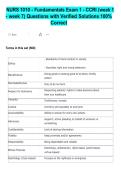
NURS 1010 - Fundamentals Exam 1 - CCRI (week 1
- week 7) Questions with Verified Solutions 100%
Correct
Save
Terms in this set (560)
- Standards of moral conduct in society.
Ethics
- Describes right and wrong behaviors
Beneficence Doing good or causing good to be done; kindly
action
Nonmaleficence Duty to do no harm
Respect for Autonomy Respecting patients' rights to make decisions about
their own healthcare
Veracity Truthfulness, honesty
Justice Act fairly and equitably to everyone
Accountability Ability to answer for one's own actions
Support; active pleading on behalf of someone or
Advocacy
something
Confidentiality Limit of sharing information
Fidelity Keep promises and/or agreements
Responsibility Being dependable and reliable
Deontology, utilitarianism, rights-based, justice-based,
Ethical Theories
virtue-based
Deontology (Duty-based) Focuses on the rightness or wrongness
, Utilitarianism Focuses on the consequences from the actions
An individual's rights are more important than what
Rights-based
might be best for all of society
No individual should have an advantage over another
Justice-based
person. All people should be treated equal.
Virute-based Personal traits of individual - not societal norms
Defines the values, morals, and standards guiding
Code of Ethics
practice in a specific discipline or profession
To advise and supervise their students, collaborate
Responsibility of nurse with students to identify individual learning needs
educators within the clinical setting, and facilitate the
educational process
Responsibility of student Held to the same standards as actual nurses
nurses
Civility Being polite and respectful
The study of ethics related to issues that arise in
Bioethics
health care.
Can help determine likelihood of disorders
Genetic testing and gene
editing
Ex: cystic fibrosis, Huntington disease, breast cancer
Can potentially save lives through effective treatment
or cures for disorders like:
Cloning and embryonic
stem cell research
Ex: severe spinal cord injury, type 1 diabetes mellitus,
Alzheimers, cystic fibrosis, multiple sclerosis
Care that is useless and prolongs the time until death
Futile care
rather than restoring life
Any person involved in an ethical dilemma, including
Ethics committee nurses, physicians, health care providers, patients, and
family members, can request access to this
- week 7) Questions with Verified Solutions 100%
Correct
Save
Terms in this set (560)
- Standards of moral conduct in society.
Ethics
- Describes right and wrong behaviors
Beneficence Doing good or causing good to be done; kindly
action
Nonmaleficence Duty to do no harm
Respect for Autonomy Respecting patients' rights to make decisions about
their own healthcare
Veracity Truthfulness, honesty
Justice Act fairly and equitably to everyone
Accountability Ability to answer for one's own actions
Support; active pleading on behalf of someone or
Advocacy
something
Confidentiality Limit of sharing information
Fidelity Keep promises and/or agreements
Responsibility Being dependable and reliable
Deontology, utilitarianism, rights-based, justice-based,
Ethical Theories
virtue-based
Deontology (Duty-based) Focuses on the rightness or wrongness
, Utilitarianism Focuses on the consequences from the actions
An individual's rights are more important than what
Rights-based
might be best for all of society
No individual should have an advantage over another
Justice-based
person. All people should be treated equal.
Virute-based Personal traits of individual - not societal norms
Defines the values, morals, and standards guiding
Code of Ethics
practice in a specific discipline or profession
To advise and supervise their students, collaborate
Responsibility of nurse with students to identify individual learning needs
educators within the clinical setting, and facilitate the
educational process
Responsibility of student Held to the same standards as actual nurses
nurses
Civility Being polite and respectful
The study of ethics related to issues that arise in
Bioethics
health care.
Can help determine likelihood of disorders
Genetic testing and gene
editing
Ex: cystic fibrosis, Huntington disease, breast cancer
Can potentially save lives through effective treatment
or cures for disorders like:
Cloning and embryonic
stem cell research
Ex: severe spinal cord injury, type 1 diabetes mellitus,
Alzheimers, cystic fibrosis, multiple sclerosis
Care that is useless and prolongs the time until death
Futile care
rather than restoring life
Any person involved in an ethical dilemma, including
Ethics committee nurses, physicians, health care providers, patients, and
family members, can request access to this