
Neuronal
communication
Coordination Structure of neurones
Functions of organs must be coordinated to Neurones= to transmit electrical impulses rapidly around the body so that the
maintain a relatively constant internal organism can respond to changes in its internal and external environment.
environment= homeostasis.
Cell signalling
Nervous and hormonal systems coordinate the
activities of whole organisms. This coordination
relies on communication at a cellular level through
cell signalling. Cells release chemicals which effect
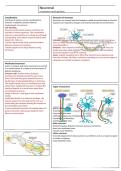
target cells. Cells can: Cell Body- contains the nucleus surrounded by cytoplasm. In the cytoplasm
Transfer signals locally using neurotransmitters there are many mitochondria and ER which are involved in the production of
between neurones at synapses. neurotransmitters.
Transfer signals across large distances using Dendrons- short extensions from the cell body which can divide into even
hormones. smaller branches called dendrites. These are responsible for transmitting
electrical impulses towards the cell body.
Axons- singular elongated nerve fibres that transmit nerve impulses away
from the cell body. The fibre is cylindrical consisting of a very narrow region of
cytoplasm surrounded by plasma membrane.
Myelinated neurones
Axons on sensory and motor neurones are covered
in a myelin sheath. It is made up of many layers of
plasma membrane.
Schwann cells- produce layers of plasma
membrane by growing around the axon many
times. Each time they grow around the axon a
double layer of phospholipid bilayer is laid down.
The myelin sheath acts as an insulating layer and
allows these myelinated neurones to conduct the Types of neurones
electrical impulse at a much faster speed than
unmyelinated neurones.
Nodes of Ranvier- small gaps in the myelinated
sheath.
Myelinated sheath is an electrical insulator, the
impulse jumps from one node to the next as it
travels along the neurone allowing the impulse to
be transmitted much faster.
In Non-myelinated neurones the impulse does not Sensory neurones-
jump it transmits continuously along the nerve Transmit impulses from a sensory receptor cell to a relay neurone in CNS.
fibre so is much slower. Long myelinated axon
Cell body contains lots of mitochondria and ER.
Contains lots of dendrites.
Contains receptor sites.
Relay neurones-
transmit impulses between neurones (sensory and motor)
short non-myelinated axon
Contain many dendrites.
Motor neurones-
Transmit impulses from relay neurone to an effector such as a muscle or gland
to create a response.
Long myelinated axon.
communication
Coordination Structure of neurones
Functions of organs must be coordinated to Neurones= to transmit electrical impulses rapidly around the body so that the
maintain a relatively constant internal organism can respond to changes in its internal and external environment.
environment= homeostasis.
Cell signalling
Nervous and hormonal systems coordinate the
activities of whole organisms. This coordination
relies on communication at a cellular level through
cell signalling. Cells release chemicals which effect
target cells. Cells can: Cell Body- contains the nucleus surrounded by cytoplasm. In the cytoplasm
Transfer signals locally using neurotransmitters there are many mitochondria and ER which are involved in the production of
between neurones at synapses. neurotransmitters.
Transfer signals across large distances using Dendrons- short extensions from the cell body which can divide into even
hormones. smaller branches called dendrites. These are responsible for transmitting
electrical impulses towards the cell body.
Axons- singular elongated nerve fibres that transmit nerve impulses away
from the cell body. The fibre is cylindrical consisting of a very narrow region of
cytoplasm surrounded by plasma membrane.
Myelinated neurones
Axons on sensory and motor neurones are covered
in a myelin sheath. It is made up of many layers of
plasma membrane.
Schwann cells- produce layers of plasma
membrane by growing around the axon many
times. Each time they grow around the axon a
double layer of phospholipid bilayer is laid down.
The myelin sheath acts as an insulating layer and
allows these myelinated neurones to conduct the Types of neurones
electrical impulse at a much faster speed than
unmyelinated neurones.
Nodes of Ranvier- small gaps in the myelinated
sheath.
Myelinated sheath is an electrical insulator, the
impulse jumps from one node to the next as it
travels along the neurone allowing the impulse to
be transmitted much faster.
In Non-myelinated neurones the impulse does not Sensory neurones-
jump it transmits continuously along the nerve Transmit impulses from a sensory receptor cell to a relay neurone in CNS.
fibre so is much slower. Long myelinated axon
Cell body contains lots of mitochondria and ER.
Contains lots of dendrites.
Contains receptor sites.
Relay neurones-
transmit impulses between neurones (sensory and motor)
short non-myelinated axon
Contain many dendrites.
Motor neurones-
Transmit impulses from relay neurone to an effector such as a muscle or gland
to create a response.
Long myelinated axon.


