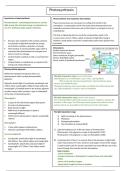
Photosynthesis
Importance of photosynthesis Photosynthesis and respiration interrelation
Photosynthesis= a physiological process to convert These two processes are necessary for cycling CO2 and O2 in the
light energy into chemical energy so organisms can atmosphere. Compensation point= the point when photosynthesis and
use it to synthesise large organic molecules. respiration proceed at the same rate so that there’s no net gain or loss of
carbohydrate.
The time is taking the plant to reach the compensation point is the
compensation period. When a plant is exposed to light after being in
Energy is also needed for this reaction, photons darkness, shade plants reach their compensation point much quicker than
are particles of light that provide the energy, sun plants.
each photon contains a quantum of energy.
Main product is monosaccharide sugar which is Chloroplasts
Double membrane bound.
converted into disaccharides for transport and
Intermembrane space.
then to starch for storage.
Outer membrane is highly permeable.
Carbon fixation reaction as CO2 is converted into
Stroma: fluid filled matrix.
sugars. Grana: stacks of thylakoid membranes.
Carbon fixation is endothermic so requires both
energy and needs electrons.
Photosynthetic pigments
Within the thylakoid membranes there are
photosystems which contain photosynthetic The light Dependent stage occurs in the grana.
pigments. Chloroplasts have 3 membranes: outer, inner, and thylakoid.
With 3 separate internal compartments: intermembrane space,
Pigments absorb light of a particular wavelength and stroma, and thylakoid space.
reflects other wavelengths of light. Energy within the Thylakoid membrane is less permeable and folded into flattened disc like
wavelength is funnelled down to the primary pigment sacs called thylakoids. Granum= stack of thylakoids.
reaction centre which contains a type of chlorophyll
at the base of the photosystem.
Chlorophyll a The light independent stage occurs in the stroma.
This is the fluid filled matrix that contains enzymes needed to catalyse the
2 types of this which both appear blue/green. reactions in this stage. The DNA loop contains genes that code for these
At centre of photosystems proteins which are assembled at the ribosomes of the chloroplast.
Both absorb red light.
P680 found in photosystem II (peak is
The light dependent stage
wavelength 680nm)
P700 found in photosystem I (peak is wavelength 1) Light harvesting at the photosystems
700nm) 2) Photolysis
3) Photophosphorylation
Chlorophyll b
4) The formation of reduced NADP.
1 type which appears yellow/green.
Absorbs wavelengths 400-500nm, 640nm. 1) Light harvesting occurs in the two types of photosystems.
Photosystem I the pigment is a type of chlorophyll a P700.
Accessory pigments Photosystem II the pigment is a type of chlorophyll a P680.
Carotenoids- absorb blue light of wavelengths
400-500nm. They reflect yellow and orange light. 2) In photosystem II there’s an enzyme that in the presence of light splits
Xanthophylls- absorb blue and green light of water into protons (H+ ions), electrons and oxygen. Some of the oxygen
wavelengths 375-550nm. They reflect yellow is used by plant cells for aerobic respiration but most diffuses out of the
light. leaves through the stomata into the atmosphere.
Role of water:
-source of protons
-donates electrons to chlorophyll to replace those lost when light
strikes
-source of by product oxygen
-keeps plants turgid for them to function.
Importance of photosynthesis Photosynthesis and respiration interrelation
Photosynthesis= a physiological process to convert These two processes are necessary for cycling CO2 and O2 in the
light energy into chemical energy so organisms can atmosphere. Compensation point= the point when photosynthesis and
use it to synthesise large organic molecules. respiration proceed at the same rate so that there’s no net gain or loss of
carbohydrate.
The time is taking the plant to reach the compensation point is the
compensation period. When a plant is exposed to light after being in
Energy is also needed for this reaction, photons darkness, shade plants reach their compensation point much quicker than
are particles of light that provide the energy, sun plants.
each photon contains a quantum of energy.
Main product is monosaccharide sugar which is Chloroplasts
Double membrane bound.
converted into disaccharides for transport and
Intermembrane space.
then to starch for storage.
Outer membrane is highly permeable.
Carbon fixation reaction as CO2 is converted into
Stroma: fluid filled matrix.
sugars. Grana: stacks of thylakoid membranes.
Carbon fixation is endothermic so requires both
energy and needs electrons.
Photosynthetic pigments
Within the thylakoid membranes there are
photosystems which contain photosynthetic The light Dependent stage occurs in the grana.
pigments. Chloroplasts have 3 membranes: outer, inner, and thylakoid.
With 3 separate internal compartments: intermembrane space,
Pigments absorb light of a particular wavelength and stroma, and thylakoid space.
reflects other wavelengths of light. Energy within the Thylakoid membrane is less permeable and folded into flattened disc like
wavelength is funnelled down to the primary pigment sacs called thylakoids. Granum= stack of thylakoids.
reaction centre which contains a type of chlorophyll
at the base of the photosystem.
Chlorophyll a The light independent stage occurs in the stroma.
This is the fluid filled matrix that contains enzymes needed to catalyse the
2 types of this which both appear blue/green. reactions in this stage. The DNA loop contains genes that code for these
At centre of photosystems proteins which are assembled at the ribosomes of the chloroplast.
Both absorb red light.
P680 found in photosystem II (peak is
The light dependent stage
wavelength 680nm)
P700 found in photosystem I (peak is wavelength 1) Light harvesting at the photosystems
700nm) 2) Photolysis
3) Photophosphorylation
Chlorophyll b
4) The formation of reduced NADP.
1 type which appears yellow/green.
Absorbs wavelengths 400-500nm, 640nm. 1) Light harvesting occurs in the two types of photosystems.
Photosystem I the pigment is a type of chlorophyll a P700.
Accessory pigments Photosystem II the pigment is a type of chlorophyll a P680.
Carotenoids- absorb blue light of wavelengths
400-500nm. They reflect yellow and orange light. 2) In photosystem II there’s an enzyme that in the presence of light splits
Xanthophylls- absorb blue and green light of water into protons (H+ ions), electrons and oxygen. Some of the oxygen
wavelengths 375-550nm. They reflect yellow is used by plant cells for aerobic respiration but most diffuses out of the
light. leaves through the stomata into the atmosphere.
Role of water:
-source of protons
-donates electrons to chlorophyll to replace those lost when light
strikes
-source of by product oxygen
-keeps plants turgid for them to function.