
Classification and
Classification
evolution
Binomial naming system
The process of naming and organising Naming organisms- before classification systems
organisms into groups based on their were widely used organisms were called by their
characteristics common names based on certain physical
characteristics, behaviour or their habitat.
Taxonomic system
Disadvantages with using common names:
D.K.P.C.O.F.G.S
Not useful internationally
“Delicious king prawn curry over fat greasy
More than 1 common name
sausages”
Different names in different languages
Do not provide information about the
relationships between organisms
The binomial name
developed by Carl Linnaeus
Two words/components- the generic name and the
specific name
1st word= Generic name – the genus the
organism belongs to.
2nd word= Specific name- the species the
organism belongs to.
All in lower-case letters except for the first
letter of the generic name
The whole specific name should be in italics.
Reasons for classification: Advantages of the binomial naming system:
In order to identify species, predict characteristics No two species have the same generic name
and find evolutionary links. and specific name
It is universal – an organism’s binomial name
Species a group of organisms that are able to is everywhere in the world
produce fertile offspring
Non-species organisms that cannot produce
fertile offspring, they will be infertile (have an odd
number of chromosomes so meiosis cannot occur)
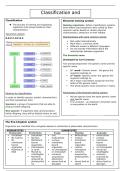
The five-kingdom system
Organisms are classified into a kingdom based on similarities in observable characteristics.
PROKARYOTES EUKARYOTES
Prokaryota Protoctista Fungi Plantae Animalia
Unicellular Unicellular Uni/ Multicellular multicellular
No nucleus Nucleus multicellular nucleus nucleus
No Membrane nucleus membrane membrane
membrane bound membrane bound bound
bound organelles bound organelles organelles
organelles Chloroplasts organelles contain no chloroplasts
Plasmids of in some no chloroplasts chlorophyll moved by
DNA Moved by or chlorophyll nutrients cilia/flagella
cilia/flagella nutrients acquired by nutrients
Nutrients acquired by photosynthes acquired by
acquired by absorption is ingestion
photosynthe stores food as stores food as stores food as
sis glycogen starch glycogen
Classification
evolution
Binomial naming system
The process of naming and organising Naming organisms- before classification systems
organisms into groups based on their were widely used organisms were called by their
characteristics common names based on certain physical
characteristics, behaviour or their habitat.
Taxonomic system
Disadvantages with using common names:
D.K.P.C.O.F.G.S
Not useful internationally
“Delicious king prawn curry over fat greasy
More than 1 common name
sausages”
Different names in different languages
Do not provide information about the
relationships between organisms
The binomial name
developed by Carl Linnaeus
Two words/components- the generic name and the
specific name
1st word= Generic name – the genus the
organism belongs to.
2nd word= Specific name- the species the
organism belongs to.
All in lower-case letters except for the first
letter of the generic name
The whole specific name should be in italics.
Reasons for classification: Advantages of the binomial naming system:
In order to identify species, predict characteristics No two species have the same generic name
and find evolutionary links. and specific name
It is universal – an organism’s binomial name
Species a group of organisms that are able to is everywhere in the world
produce fertile offspring
Non-species organisms that cannot produce
fertile offspring, they will be infertile (have an odd
number of chromosomes so meiosis cannot occur)
The five-kingdom system
Organisms are classified into a kingdom based on similarities in observable characteristics.
PROKARYOTES EUKARYOTES
Prokaryota Protoctista Fungi Plantae Animalia
Unicellular Unicellular Uni/ Multicellular multicellular
No nucleus Nucleus multicellular nucleus nucleus
No Membrane nucleus membrane membrane
membrane bound membrane bound bound
bound organelles bound organelles organelles
organelles Chloroplasts organelles contain no chloroplasts
Plasmids of in some no chloroplasts chlorophyll moved by
DNA Moved by or chlorophyll nutrients cilia/flagella
cilia/flagella nutrients acquired by nutrients
Nutrients acquired by photosynthes acquired by
acquired by absorption is ingestion
photosynthe stores food as stores food as stores food as
sis glycogen starch glycogen


