STUDY SHEET CELL MEMBRANE AND
TRANSPORT
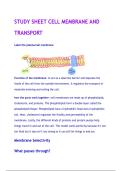
Label the plasma/cell membrane
Phosphate
0000
0000000000000000000000
blood
ddddbbbdlbddbbdddb
tk Petanna
Function of the membrane- to act as a selective barrier and separate the
inside of the cell from the outside environment. It regulates the transport of
materials entering and exiting the cell.
how the parts work together- cell membranes are made up of phospholipids,
cholesterol, and proteins. The phospholipids form a double layer called the
phospholipid bilayer. Phospholipids have a hydrophilic head and a hydrophobic
tail. Next, cholesterol regulates the fluidity and permeability of the
membrane. Lastly, the different kinds of proteins and protein pumps help
things travel in and out of the cell. This model works perfectly because it’s not
too fluid but it also isn’t too strong so it can still let things in and out.
Membrane Selectivity
What passes through?
, Small, non-polar molecules- can easily pass through.
Larger, polar molecules- are still able to pass through, but it is harder.
why?
Small, non-polar molecules- can dissolve in the phospholipid bilayer.
Larger, polar molecules- they need assistance from transport proteins because
they can’t make it through on their own
how?
Small, non-polar molecules- passive transport
Larger, polar molecules- active transport
Examples of cell transport in digestion- the absorption of glucose from the
small intestine into the bloodstream.
Examples of cell transport in respiration- carbon dioxide is transported from
the cells to the lungs. It diffuses into the blood, where it gets carried to the
lungs by another cell (usually a red blood cell)
PASSIVE TRANSPORT
Simple diffusion
TRANSPORT
Label the plasma/cell membrane
Phosphate
0000
0000000000000000000000
blood
ddddbbbdlbddbbdddb
tk Petanna
Function of the membrane- to act as a selective barrier and separate the
inside of the cell from the outside environment. It regulates the transport of
materials entering and exiting the cell.
how the parts work together- cell membranes are made up of phospholipids,
cholesterol, and proteins. The phospholipids form a double layer called the
phospholipid bilayer. Phospholipids have a hydrophilic head and a hydrophobic
tail. Next, cholesterol regulates the fluidity and permeability of the
membrane. Lastly, the different kinds of proteins and protein pumps help
things travel in and out of the cell. This model works perfectly because it’s not
too fluid but it also isn’t too strong so it can still let things in and out.
Membrane Selectivity
What passes through?
, Small, non-polar molecules- can easily pass through.
Larger, polar molecules- are still able to pass through, but it is harder.
why?
Small, non-polar molecules- can dissolve in the phospholipid bilayer.
Larger, polar molecules- they need assistance from transport proteins because
they can’t make it through on their own
how?
Small, non-polar molecules- passive transport
Larger, polar molecules- active transport
Examples of cell transport in digestion- the absorption of glucose from the
small intestine into the bloodstream.
Examples of cell transport in respiration- carbon dioxide is transported from
the cells to the lungs. It diffuses into the blood, where it gets carried to the
lungs by another cell (usually a red blood cell)
PASSIVE TRANSPORT
Simple diffusion