SEOs, Rights and Placings
Monday, 10 February 2020 16:04
Myers & Majluf, J of Financial Economics 12, 1984
Assumptions
- Managers act in interests of existing ('old') shareholders
- Old shareholders do not buy any of new shares issued
- There is information asymmetry between company and stock market
Company has a 'true value' of a. An investment opportunity arrives, with a true
value of b. External equity is needed to fund the project
Three time periods
t = -1 Opportunity arrives. Symmetric info. Both managers and stock market
are uncertain about values of a and b
t=0 Managers learn a and b, and decide whether to issue. The market is still
uncertain about a and b. There's info asymmetry. Managers know
whether shares are over- or undervalued.
t = +1 Market learns values of a and b. Share price reflects full info again
Analysis
If managers choose to issue shares, proportion of firm owned by old shareholders is
P'/(P' + E), where P' is market value of old shares given issue and E is new equity
raised (at same price per share as old shares).
True value of firm with no share issue is a
True value of firm given share issue is a + b + E
Therefore, true value of old shares = [P'/(P' + E)](a + b + E), revealed at t + 1
If value of old shares on announcement of issue reflects true value of firm,
P' = a + b
And true value of E = cash amount raised by share issue
, P' = a + b
And true value of E = cash amount raised by share issue
Potential problem for share issue
Managers might not issue and invest, if shares on announcement are undervalued:
P' < a + b
In this case, new investors will make a capital gain between t = 0 and t = 1
At t = 1, market value of firm rises by:
V 1 - V 0 = a + b + E - (P' + E) = a + b - P'
Therefore, new investors gain:
E1 - E = [E/(P' + E)](a + b - P')
This is a loss to old shareholders (wealth transfer)
If gain to new investors exceeds NPV of project:
E1 - E > b
And old investors will be worse off, because they capture none of the project's NPV
With no share issue or project, value of old shares at t1 = P1 = a
With share issue and shares fairly valued at t0, P' = a + b, and P1 = a + b
With share issue and shares undervalued at t0, P' < a + b, and P1 = a + b - (E1 - E)
Therefore, even if b > 0 (project has positive NPV), managers will not issue and
invest if E1 - E > b
Prediction 1: firms will sometimes underinvest, if they have to raise external equity
Implication for market reaction to share issue
○ Firms that choose not to raise equity are always undervalued
○ So news that a firm is issuing shares implies that issuer is more likely to
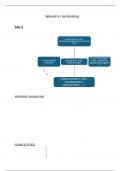
be overvalued than undervalued. See diagram
, ○ Firms that choose not to raise equity are always undervalued
○ So news that a firm is issuing shares implies that issuer is more likely to
be overvalued than undervalued. See diagram
Leads to Prediction 2: share price is expected to fail on announcement of an SEO
- Means that issue price is lower. This loss of value can be seen as a cost of the
SEO
No share issue if firm can borrow
- Now suppose firm can borrow. Debt (bonds) D is used to finance the project
- Value of old shares at t + 1 is
○ a + b - (D1 - D)
○ Where D1 is market value of new debt at t + 1. Managers will issue if
§ a < a + b - (D1 - D), or if b > DD = (D1 - D)
- Lenders gain if cost of debt agreed at t = 0 is based on an underestimate of
the true firm value. Lenders' gain is shareholders loss.
- But value of debt is less sensitive to firm value than value of equity
○ DD < DE, if firm is undervalued at t = 0
○ Undervalued firms always prefer debt
○ Overvalued firms might prefer equity, but choice of equity would imply
overvaluation, so they would issue debt
Pecking order
So a firm that can borrow cannot issue equity at a fair price
Prediction 3: firms never issue equity, unless borrowing is out of the question
- If external finance is needed, debt is preferred by undervalued and
Monday, 10 February 2020 16:04
Myers & Majluf, J of Financial Economics 12, 1984
Assumptions
- Managers act in interests of existing ('old') shareholders
- Old shareholders do not buy any of new shares issued
- There is information asymmetry between company and stock market
Company has a 'true value' of a. An investment opportunity arrives, with a true
value of b. External equity is needed to fund the project
Three time periods
t = -1 Opportunity arrives. Symmetric info. Both managers and stock market
are uncertain about values of a and b
t=0 Managers learn a and b, and decide whether to issue. The market is still
uncertain about a and b. There's info asymmetry. Managers know
whether shares are over- or undervalued.
t = +1 Market learns values of a and b. Share price reflects full info again
Analysis
If managers choose to issue shares, proportion of firm owned by old shareholders is
P'/(P' + E), where P' is market value of old shares given issue and E is new equity
raised (at same price per share as old shares).
True value of firm with no share issue is a
True value of firm given share issue is a + b + E
Therefore, true value of old shares = [P'/(P' + E)](a + b + E), revealed at t + 1
If value of old shares on announcement of issue reflects true value of firm,
P' = a + b
And true value of E = cash amount raised by share issue
, P' = a + b
And true value of E = cash amount raised by share issue
Potential problem for share issue
Managers might not issue and invest, if shares on announcement are undervalued:
P' < a + b
In this case, new investors will make a capital gain between t = 0 and t = 1
At t = 1, market value of firm rises by:
V 1 - V 0 = a + b + E - (P' + E) = a + b - P'
Therefore, new investors gain:
E1 - E = [E/(P' + E)](a + b - P')
This is a loss to old shareholders (wealth transfer)
If gain to new investors exceeds NPV of project:
E1 - E > b
And old investors will be worse off, because they capture none of the project's NPV
With no share issue or project, value of old shares at t1 = P1 = a
With share issue and shares fairly valued at t0, P' = a + b, and P1 = a + b
With share issue and shares undervalued at t0, P' < a + b, and P1 = a + b - (E1 - E)
Therefore, even if b > 0 (project has positive NPV), managers will not issue and
invest if E1 - E > b
Prediction 1: firms will sometimes underinvest, if they have to raise external equity
Implication for market reaction to share issue
○ Firms that choose not to raise equity are always undervalued
○ So news that a firm is issuing shares implies that issuer is more likely to
be overvalued than undervalued. See diagram
, ○ Firms that choose not to raise equity are always undervalued
○ So news that a firm is issuing shares implies that issuer is more likely to
be overvalued than undervalued. See diagram
Leads to Prediction 2: share price is expected to fail on announcement of an SEO
- Means that issue price is lower. This loss of value can be seen as a cost of the
SEO
No share issue if firm can borrow
- Now suppose firm can borrow. Debt (bonds) D is used to finance the project
- Value of old shares at t + 1 is
○ a + b - (D1 - D)
○ Where D1 is market value of new debt at t + 1. Managers will issue if
§ a < a + b - (D1 - D), or if b > DD = (D1 - D)
- Lenders gain if cost of debt agreed at t = 0 is based on an underestimate of
the true firm value. Lenders' gain is shareholders loss.
- But value of debt is less sensitive to firm value than value of equity
○ DD < DE, if firm is undervalued at t = 0
○ Undervalued firms always prefer debt
○ Overvalued firms might prefer equity, but choice of equity would imply
overvaluation, so they would issue debt
Pecking order
So a firm that can borrow cannot issue equity at a fair price
Prediction 3: firms never issue equity, unless borrowing is out of the question
- If external finance is needed, debt is preferred by undervalued and