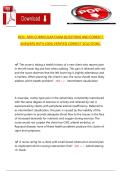
HESI - MID-CURRICULAR EXAM
HESI - MID-CURRICULAR EXAM QUESTIONS AND CORRECT
ANSWERS WITH 100% VERIFIED CORRECT SOLUTIONS.
The nurse is taking a health history of a new client who reports pain
in the left lower leg and foot when walking. This pain is relieved with rest
and the nurse observes that the left lower leg is slightly edematous and
is hairless. When planning this client's care, the nurse should most likely
address which health problem? ANS >>> Intermittent claudication
A muscular, cramp-type pain in the extremities consistently reproduced
with the same degree of exercise or activity and relieved by rest is
experienced by clients with peripheral arterial insufficiency. Referred to
as intermittent claudication, this pain is caused by the inability of the
arterial system to provide adequate blood flow to the tissues in the face
of increased demands for nutrients and oxygen during exercise. The
nurse would not suspect the client has CAD, arterial embolus, or
Raynaud disease; none of these health problems produce this cluster of
signs and symptoms.
A nurse caring for a client with small-bowel obstruction should plan
to implement which nursing intervention first? ANS >>> Administering
I.V. fluids
,HESI - MID-CURRICULAR EXAM
The nurse should first administer I.V. infusions containing normal saline
solution and potassium to maintain fluid and electrolyte balance. For the
client's comfort and to assist in bowel decompression, the nurse should
prepare to insert an NG tube next. A blood sample is then obtained for
laboratory studies to help diagnose bowel obstruction and guide
treatment. Blood studies usually include a complete blood count, serum
electrolyte levels, and blood urea nitrogen level. Pain medication
commonly is withheld until obstruction is diagnosed because analgesics
can decrease intestinal motility.
A client has a gastric sump tube inserted and attached to low
intermittent suction. The health care provider has ordered the tube to be
irrigated with 30 mL of normal saline every 6 hours. When reviewing the
client's intake and output record for the past 24 hours, the nurse would
expect to note that the client received how much fluid with the
irrigation? ANS >>> 120
The client receives 30 mL every 6 hours. So, over a 24-hour period, the
client would receive 4 irrigations. 4 times 30 mL equals 120 mile
The nurse is working with an Unlicensed Assistive Personnel (UAP) to
care for a client. In which situation will the nurse intervene to discuss
standard precautions with the UAP? Select all that apply. ANS >>> - The
UAP applies a second pair of nonsterile gloves over soiled gloves while
assisting with a bloody procedure.
Nonsterile gloves must be changed after contact with materials that may
contain high concentration of microorganisms, such as blood, even when
working with the same client. Each of the other listed actions adheres to
standard precautions.
, HESI - MID-CURRICULAR EXAM
A nurse has assessed a client in the hospital emergency department
who was struck several times in the face by an intimate partner. As the
client has their facial injuries assessed, they tell the nurse they do not
want to return home. Which action should the nurse take? ANS >>>
Provide the client with a list of phone numbers for shelters
The nurse can provide teaching, resources and support to the client
when managing intimate partner violence. This should include
information about possible shelters that the client can access while
decided on the next plan of action if the client does not want to return
to the intimate partner. The client must independently make the decision
to go to a shelter, without the perception of pressure to make this
decision from the health care provider. For this reason, it is important
that the client call the shelter on their own accord. The nurse should not
call the 24-hour hotline for the client. This is a resource for victims of
violence to utilize when needing emotional support or developing a plan
to leave the abusive situation. A safety plan is a tool that the nurse can
assist the client in developing if the client decides to return home. The
plan needs to be individualized to meet the client's unique needs for
their situation; the nurse should not provide a premade plan.
After a motor vehicle crash, a client is admitted to the medical-
surgical unit with a cervical collar in place. The cervical spinal X-rays
haven't been read, so the nurse doesn't know whether the client has a
cervical spinal injury. Until such an injury is ruled out, the nurse should
restrict this client to which position? ANS >>> Flat, except for logrolling
as needed
HESI - MID-CURRICULAR EXAM QUESTIONS AND CORRECT
ANSWERS WITH 100% VERIFIED CORRECT SOLUTIONS.
The nurse is taking a health history of a new client who reports pain
in the left lower leg and foot when walking. This pain is relieved with rest
and the nurse observes that the left lower leg is slightly edematous and
is hairless. When planning this client's care, the nurse should most likely
address which health problem? ANS >>> Intermittent claudication
A muscular, cramp-type pain in the extremities consistently reproduced
with the same degree of exercise or activity and relieved by rest is
experienced by clients with peripheral arterial insufficiency. Referred to
as intermittent claudication, this pain is caused by the inability of the
arterial system to provide adequate blood flow to the tissues in the face
of increased demands for nutrients and oxygen during exercise. The
nurse would not suspect the client has CAD, arterial embolus, or
Raynaud disease; none of these health problems produce this cluster of
signs and symptoms.
A nurse caring for a client with small-bowel obstruction should plan
to implement which nursing intervention first? ANS >>> Administering
I.V. fluids
,HESI - MID-CURRICULAR EXAM
The nurse should first administer I.V. infusions containing normal saline
solution and potassium to maintain fluid and electrolyte balance. For the
client's comfort and to assist in bowel decompression, the nurse should
prepare to insert an NG tube next. A blood sample is then obtained for
laboratory studies to help diagnose bowel obstruction and guide
treatment. Blood studies usually include a complete blood count, serum
electrolyte levels, and blood urea nitrogen level. Pain medication
commonly is withheld until obstruction is diagnosed because analgesics
can decrease intestinal motility.
A client has a gastric sump tube inserted and attached to low
intermittent suction. The health care provider has ordered the tube to be
irrigated with 30 mL of normal saline every 6 hours. When reviewing the
client's intake and output record for the past 24 hours, the nurse would
expect to note that the client received how much fluid with the
irrigation? ANS >>> 120
The client receives 30 mL every 6 hours. So, over a 24-hour period, the
client would receive 4 irrigations. 4 times 30 mL equals 120 mile
The nurse is working with an Unlicensed Assistive Personnel (UAP) to
care for a client. In which situation will the nurse intervene to discuss
standard precautions with the UAP? Select all that apply. ANS >>> - The
UAP applies a second pair of nonsterile gloves over soiled gloves while
assisting with a bloody procedure.
Nonsterile gloves must be changed after contact with materials that may
contain high concentration of microorganisms, such as blood, even when
working with the same client. Each of the other listed actions adheres to
standard precautions.
, HESI - MID-CURRICULAR EXAM
A nurse has assessed a client in the hospital emergency department
who was struck several times in the face by an intimate partner. As the
client has their facial injuries assessed, they tell the nurse they do not
want to return home. Which action should the nurse take? ANS >>>
Provide the client with a list of phone numbers for shelters
The nurse can provide teaching, resources and support to the client
when managing intimate partner violence. This should include
information about possible shelters that the client can access while
decided on the next plan of action if the client does not want to return
to the intimate partner. The client must independently make the decision
to go to a shelter, without the perception of pressure to make this
decision from the health care provider. For this reason, it is important
that the client call the shelter on their own accord. The nurse should not
call the 24-hour hotline for the client. This is a resource for victims of
violence to utilize when needing emotional support or developing a plan
to leave the abusive situation. A safety plan is a tool that the nurse can
assist the client in developing if the client decides to return home. The
plan needs to be individualized to meet the client's unique needs for
their situation; the nurse should not provide a premade plan.
After a motor vehicle crash, a client is admitted to the medical-
surgical unit with a cervical collar in place. The cervical spinal X-rays
haven't been read, so the nurse doesn't know whether the client has a
cervical spinal injury. Until such an injury is ruled out, the nurse should
restrict this client to which position? ANS >>> Flat, except for logrolling
as needed