ccrn aacn practice questions and answers
updated 2026
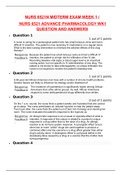
A patient with a history of bronchogenic carcinoma is admitted with respiratory failure. the patient is
intubated and on mechanical ventilation. the patient develops lethargy, headache, slight confusion and
abdominal cramping urinary output is decreasing and significant lab data includes
Serum Na+ 127
Serum osmolality 270
urine specific gravity elevated - ANSWER Initiation of fluid restriction -
this pt has risk factors signs and symptoms of SIADH
fluid restriction slows glomerular filtration and blood flow enhances proximal reabsorption of sodium
and water increases aldosterone secretion and enhances distal tubule sodium reabsorption. chemo may
alleviate some of the water retention caused by some cancers but non will completely inhibit ADH
secretions. three percent saline administration in severe case only
A pt is being admitted in HHS with dehydration and a serum glucose level of 836 mg/dl. Which
additional laboratory findings should the nurse anticipate? - ANSWER > elevated BUN > Elevated
creatinine >elevated osmolality
HHNS - Hyperosmolar hyperglycemic nonketonic state
A 49 year old patient male recently admitted with an inferiors wall MI resulting from 100% occlusion of
the right coronary artery (RCA). The 12 lead ECG reveals ST elevation in leads 11, 111, and aVf. you
would expect to see reciprocal changes in which leads? - ANSWER 1 and aVL the RCA perfuses the
inferior wall and the mirror image or reciprocal changes would be seen in the the high lateral wall, which
is reflected in leads 1 and avl on the 12 lead ECG. Lead v1 and v2 correlate with the septal area, lead v 3
and v4 correlate with the anterior area of the heart
a patient is admitted following a MVA , Lab data reveal elevated creatinine phosphokinase and
myoglobin. What should the nurse anticipate? - ANSWER Rhabdomyolysis -MVA is a risk factor for
rhabdomyolysis and lab data consistent with condition
a patient is admitted with pulmonary hypertension. What should lead the nurse to suspect pulmonary
fibrosis - ANSWER dyspnea at rest
1
updated 2026
A patient with a history of bronchogenic carcinoma is admitted with respiratory failure. the patient is
intubated and on mechanical ventilation. the patient develops lethargy, headache, slight confusion and
abdominal cramping urinary output is decreasing and significant lab data includes
Serum Na+ 127
Serum osmolality 270
urine specific gravity elevated - ANSWER Initiation of fluid restriction -
this pt has risk factors signs and symptoms of SIADH
fluid restriction slows glomerular filtration and blood flow enhances proximal reabsorption of sodium
and water increases aldosterone secretion and enhances distal tubule sodium reabsorption. chemo may
alleviate some of the water retention caused by some cancers but non will completely inhibit ADH
secretions. three percent saline administration in severe case only
A pt is being admitted in HHS with dehydration and a serum glucose level of 836 mg/dl. Which
additional laboratory findings should the nurse anticipate? - ANSWER > elevated BUN > Elevated
creatinine >elevated osmolality
HHNS - Hyperosmolar hyperglycemic nonketonic state
A 49 year old patient male recently admitted with an inferiors wall MI resulting from 100% occlusion of
the right coronary artery (RCA). The 12 lead ECG reveals ST elevation in leads 11, 111, and aVf. you
would expect to see reciprocal changes in which leads? - ANSWER 1 and aVL the RCA perfuses the
inferior wall and the mirror image or reciprocal changes would be seen in the the high lateral wall, which
is reflected in leads 1 and avl on the 12 lead ECG. Lead v1 and v2 correlate with the septal area, lead v 3
and v4 correlate with the anterior area of the heart
a patient is admitted following a MVA , Lab data reveal elevated creatinine phosphokinase and
myoglobin. What should the nurse anticipate? - ANSWER Rhabdomyolysis -MVA is a risk factor for
rhabdomyolysis and lab data consistent with condition
a patient is admitted with pulmonary hypertension. What should lead the nurse to suspect pulmonary
fibrosis - ANSWER dyspnea at rest
1