MUSIC CAMBRIDGE IGCSE (2026):
REVISION NOTES
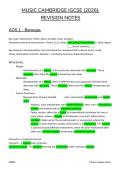
AOS 1 - Baroque:
Key solo instruments: Violin, oboe, recorder, flute, trumpet
Standard orchestral instruments: Violins (1,2), violas, celli, (bassi,) harpsichord (+ flute, oboe)
\____basso continuo____/
Key features: Ornamentation, terraced dynamics, baroque flute / natural horns, small
string-dominated orchestra, diatonic + functional harmony, balanced phrases.
Structures:
- Rondo
- Restatements of a theme, in the same key, alternate with episodes. These
episodes often have the soloist introducing new ideas.
- Ritornello
- Restatements of a theme, often in different keys (as opposed to Rondo form),
alternate with episodes. These episodes often have the soloist introducing new
ideas.
- French Overtures
- Baroque form of piece divided into 2 parts, enclosed by double bars and repeat
signs
- Majestic, slow introduction with dotted rhythms, often with a homophonic
texture and ending with an imperfect cadence.
- Faster section, often like a fugue (a compositional technique for two or
more voices, where a subject is introduced in one part, before being
imitated / taken up by the remaining parts in succession) where the
subject in each iteration usually comes back in a related key. The subject
is passed around different instruments, when the prior instrument often
takes up a counter-subject, producing a polyphonic texture.
Concerto vs. Concerto Grosso:
Concerto - 1 soloist with orchestra
Concerto Grosso - 2+ soloists (forming the concertino) with orchestra (ripieno)
RDKM - If found, please return.
, Useful Terms (Baroque):
Red - Melodic
Blue - Harmonic
Maroon - Rhythmic / Metric
Purple - Textural
Green - Articulatory / Dynamic
Orange - Structural (within piece)
Ornamentation (acciaccatura, appoggiatura, Simple, compound
trill, mordent, turn)
Duple, triple, quadruple
Sequence (ascending, descending) Hemiola
Scalic, arpeggiated Anacrusis
Disjunct, conjunct Monophonic
Range (large, small) Homophonic, melody and accompaniment
Subject, counter-subject Polyphonic, interweaving
Consonant, dissonant Imitation
Diatonic, modal Unison, doubled at the octave
Functional Legato, staccato
Dominant, subdominant Accent
(Relative) major, minor Terraced dynamics
Suspension Figured bass
Cadence (perfect - V → I, plagal - IV → I, Balanced phrases, antecedent - consequent
imperfect - ? → V, Interrupted V → ?)
Episode
Dominant 7th, diminished 7th Ripieno, concertino
(Tonic, dominant) pedal Basso continuo
RDKM - If found, please return.
REVISION NOTES
AOS 1 - Baroque:
Key solo instruments: Violin, oboe, recorder, flute, trumpet
Standard orchestral instruments: Violins (1,2), violas, celli, (bassi,) harpsichord (+ flute, oboe)
\____basso continuo____/
Key features: Ornamentation, terraced dynamics, baroque flute / natural horns, small
string-dominated orchestra, diatonic + functional harmony, balanced phrases.
Structures:
- Rondo
- Restatements of a theme, in the same key, alternate with episodes. These
episodes often have the soloist introducing new ideas.
- Ritornello
- Restatements of a theme, often in different keys (as opposed to Rondo form),
alternate with episodes. These episodes often have the soloist introducing new
ideas.
- French Overtures
- Baroque form of piece divided into 2 parts, enclosed by double bars and repeat
signs
- Majestic, slow introduction with dotted rhythms, often with a homophonic
texture and ending with an imperfect cadence.
- Faster section, often like a fugue (a compositional technique for two or
more voices, where a subject is introduced in one part, before being
imitated / taken up by the remaining parts in succession) where the
subject in each iteration usually comes back in a related key. The subject
is passed around different instruments, when the prior instrument often
takes up a counter-subject, producing a polyphonic texture.
Concerto vs. Concerto Grosso:
Concerto - 1 soloist with orchestra
Concerto Grosso - 2+ soloists (forming the concertino) with orchestra (ripieno)
RDKM - If found, please return.
, Useful Terms (Baroque):
Red - Melodic
Blue - Harmonic
Maroon - Rhythmic / Metric
Purple - Textural
Green - Articulatory / Dynamic
Orange - Structural (within piece)
Ornamentation (acciaccatura, appoggiatura, Simple, compound
trill, mordent, turn)
Duple, triple, quadruple
Sequence (ascending, descending) Hemiola
Scalic, arpeggiated Anacrusis
Disjunct, conjunct Monophonic
Range (large, small) Homophonic, melody and accompaniment
Subject, counter-subject Polyphonic, interweaving
Consonant, dissonant Imitation
Diatonic, modal Unison, doubled at the octave
Functional Legato, staccato
Dominant, subdominant Accent
(Relative) major, minor Terraced dynamics
Suspension Figured bass
Cadence (perfect - V → I, plagal - IV → I, Balanced phrases, antecedent - consequent
imperfect - ? → V, Interrupted V → ?)
Episode
Dominant 7th, diminished 7th Ripieno, concertino
(Tonic, dominant) pedal Basso continuo
RDKM - If found, please return.