Introduction to Microbiology SCIN202 Assignment 4 (100 points)
Student Name:
Student ID: 7337264
Course ID: SCIN202 I001 Fall 2025
Professor Stahl
Questions:
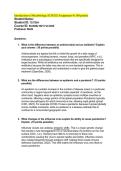
1. What is the difference between an antimicrobial and an antibiotic? Explain
your answer. (10 points possible)
Antimicrobials are agents that kill or inhibit the growth of a wide range of
microorganisms, including bacteria, viruses, fungi, and parasites (NPIC, n.d.).
Antibiotics are a subcategory of antimicrobials that are specifically designed to
target bacteria. While all antibiotics are antimicrobials, not all antimicrobials are
antibiotics because the latter may also act on non-bacterial organisms. This is
very important to differentiate and understand in order to give the patient proper
treatment (OpenStax, 2020).
2. What are the differences between an epidemic and a pandemic? (10 points
possible)
An epidemic is a sudden increase in the number of disease cases in a particular
community or region beyond what is normally expected. A pandemic, on the
other hand, happens when an epidemic spreads across multiple countries or
continents, affecting a large portion of the global population.Pandemics typically
involve new pathogens for which immunity is low, allowing rapid global spread
(CDC, 2023). For example,COVID-19 was a pandemic because it spread globally
across multiple continents, while an epidemic is a disease outbreak that is
confined to a more limited geographic area.
3. What changes in the influenza virus explain its ability to cause pandemics?
Explain. (10 points possible)
Influenza viruses can undergo antigenic shifts. This is a major genetic change
that results in new hemagglutinin (H) or neuraminidase (N) proteins on the viral
surface (CDC, n.d.). Humans have little to no immunity to these new
combinations causing the virus to spread rapidly and widely. Influenza viruses
also mutate frequently through antigenic drift, helping them evade immune
defenses (OpenStax, 2020). This shift makes the Influenza virus very likely to
cause pandemics.
Student Name:
Student ID: 7337264
Course ID: SCIN202 I001 Fall 2025
Professor Stahl
Questions:
1. What is the difference between an antimicrobial and an antibiotic? Explain
your answer. (10 points possible)
Antimicrobials are agents that kill or inhibit the growth of a wide range of
microorganisms, including bacteria, viruses, fungi, and parasites (NPIC, n.d.).
Antibiotics are a subcategory of antimicrobials that are specifically designed to
target bacteria. While all antibiotics are antimicrobials, not all antimicrobials are
antibiotics because the latter may also act on non-bacterial organisms. This is
very important to differentiate and understand in order to give the patient proper
treatment (OpenStax, 2020).
2. What are the differences between an epidemic and a pandemic? (10 points
possible)
An epidemic is a sudden increase in the number of disease cases in a particular
community or region beyond what is normally expected. A pandemic, on the
other hand, happens when an epidemic spreads across multiple countries or
continents, affecting a large portion of the global population.Pandemics typically
involve new pathogens for which immunity is low, allowing rapid global spread
(CDC, 2023). For example,COVID-19 was a pandemic because it spread globally
across multiple continents, while an epidemic is a disease outbreak that is
confined to a more limited geographic area.
3. What changes in the influenza virus explain its ability to cause pandemics?
Explain. (10 points possible)
Influenza viruses can undergo antigenic shifts. This is a major genetic change
that results in new hemagglutinin (H) or neuraminidase (N) proteins on the viral
surface (CDC, n.d.). Humans have little to no immunity to these new
combinations causing the virus to spread rapidly and widely. Influenza viruses
also mutate frequently through antigenic drift, helping them evade immune
defenses (OpenStax, 2020). This shift makes the Influenza virus very likely to
cause pandemics.